 Add to Chrome
 Add to Firefox
 Add to Edge
Repetition as Reinforcement: Enhancing Sample Efficiency via Instant Episode Repetition in Reinforcement Learning
Aug 18, 2026
Repetition is a fundamental mechanism in human learning, where revisiting successful experiences strengthens memory, consolidates skills, and improves future performance. Motivated by this biological principle, we introduce Instant Episode Repetition (IER), a simple and novel mechanism that improves sample efficiency by immediately repeating action sequences from successful episodes during environment interaction. Unlike conventional approaches such as Experience Replay and Self-Imitation Learning (SIL), which passively reuse past experience during training updates, IER directly influences the data collection process. Upon identifying a high-reward episode, the agent repeats its action sequence for a fixed number of subsequent episodes, reinforcing valuable behaviors through renewed interaction with the environment. We integrate IER into state-of-the-art SAC and TD3 algorithms and evaluate its effectiveness on continuous-control benchmarks, including MuJoCo, the DeepMind Control Suite, and a real-world dynamic object translation task with a robotic manipulator. Experimental results demonstrate that this simple mechanism improves learning performance over standard and self-imitation-based baselines.

Benchmarking Reinforcement Learning Methods for Dexterous Robotic Manipulation with a Three-Fingered Gripper
Aug 27, 2024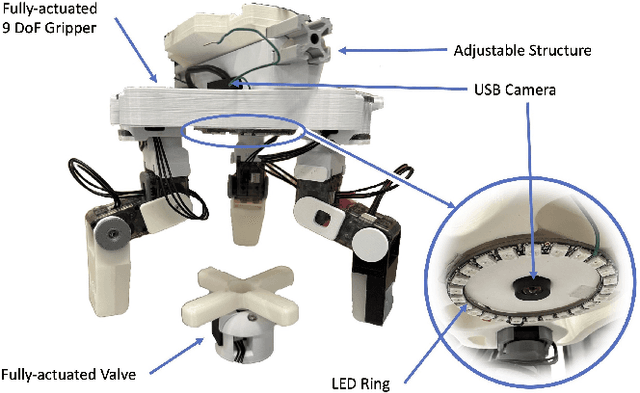
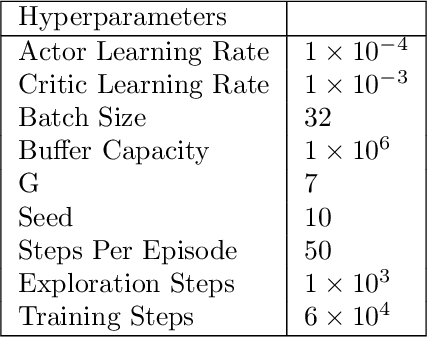
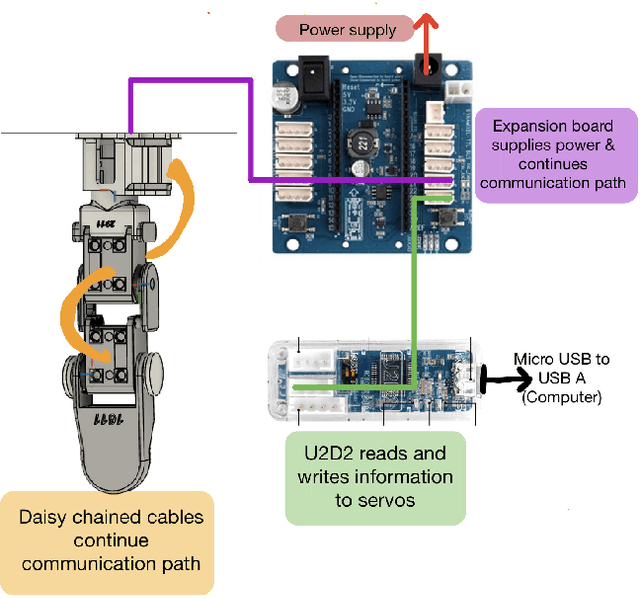
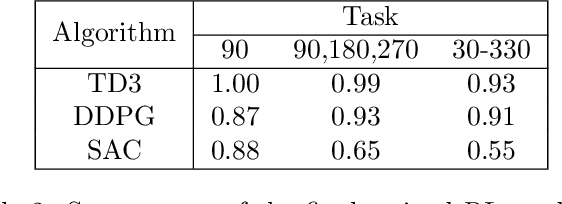
Reinforcement Learning (RL) training is predominantly conducted in cost-effective and controlled simulation environments. However, the transfer of these trained models to real-world tasks often presents unavoidable challenges. This research explores the direct training of RL algorithms in controlled yet realistic real-world settings for the execution of dexterous manipulation. The benchmarking results of three RL algorithms trained on intricate in-hand manipulation tasks within practical real-world contexts are presented. Our study not only demonstrates the practicality of RL training in authentic real-world scenarios, facilitating direct real-world applications, but also provides insights into the associated challenges and considerations. Additionally, our experiences with the employed experimental methods are shared, with the aim of empowering and engaging fellow researchers and practitioners in this dynamic field of robotics.