 Add to Chrome
 Add to Firefox
 Add to Edge
Integrating Novelty and Surprise for Experience Prioritization and Exploration in Image-Based Reinforcement Learning
Aug 18, 2026
Sample efficiency is a central challenge in reinforcement learning (RL), particularly in image-based domains where agents must learn from high-dimensional visual inputs. Traditional sampling often relies on random or suboptimal experience selection, leading to redundant updates and slow learning. Improving efficiency requires mechanisms that prioritize informative experiences while also encouraging effective exploration. Prioritized Experience Replay (PER) addresses part of this challenge by reusing high-value transitions, while intrinsic rewards promote the exploration of novel or uncertain states. However, their integration has not been extensively studied. This paper introduces Novelty and Surprise Prioritized Experience Replay (NSPER), which uses novelty to capture underrepresented states and surprise to expose gaps in the agent's understanding of the environment. We further extend this with NSPER+R, integrating these signals as intrinsic rewards to jointly improve replay quality and exploration. Experiments on DeepMind Control Suite tasks show that NSPER and NSPER+R improve training efficiency and convergence speed compared to existing methods in image-based RL.
* 9 pages, 4 figures. Published in International Journal of Computer and Systems Engineering, 2026. Code: https://github.com/UoA-CARES/NSPER

Repetition as Reinforcement: Enhancing Sample Efficiency via Instant Episode Repetition in Reinforcement Learning
Aug 18, 2026Repetition is a fundamental mechanism in human learning, where revisiting successful experiences strengthens memory, consolidates skills, and improves future performance. Motivated by this biological principle, we introduce Instant Episode Repetition (IER), a simple and novel mechanism that improves sample efficiency by immediately repeating action sequences from successful episodes during environment interaction. Unlike conventional approaches such as Experience Replay and Self-Imitation Learning (SIL), which passively reuse past experience during training updates, IER directly influences the data collection process. Upon identifying a high-reward episode, the agent repeats its action sequence for a fixed number of subsequent episodes, reinforcing valuable behaviors through renewed interaction with the environment. We integrate IER into state-of-the-art SAC and TD3 algorithms and evaluate its effectiveness on continuous-control benchmarks, including MuJoCo, the DeepMind Control Suite, and a real-world dynamic object translation task with a robotic manipulator. Experimental results demonstrate that this simple mechanism improves learning performance over standard and self-imitation-based baselines.
Reward Prediction Error Prioritisation in Experience Replay: The RPE-PER Method
Jan 30, 2025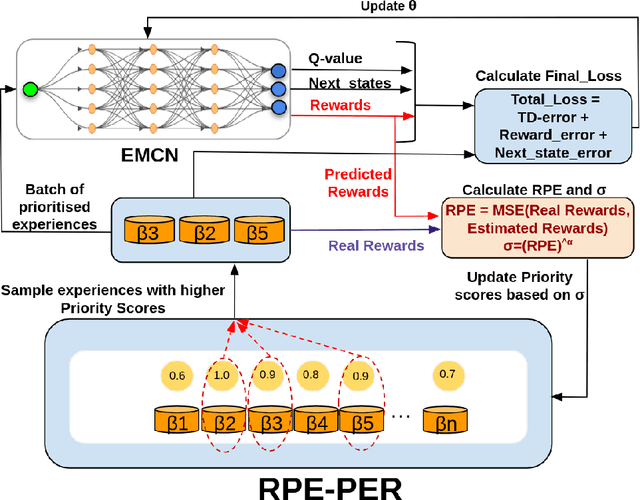
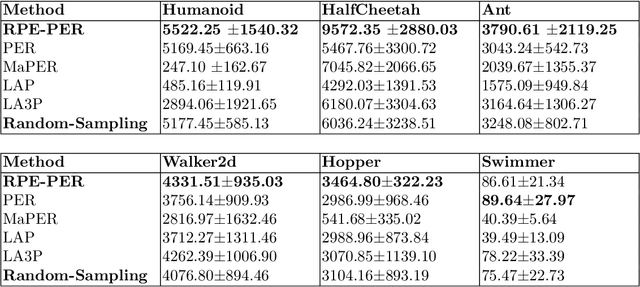
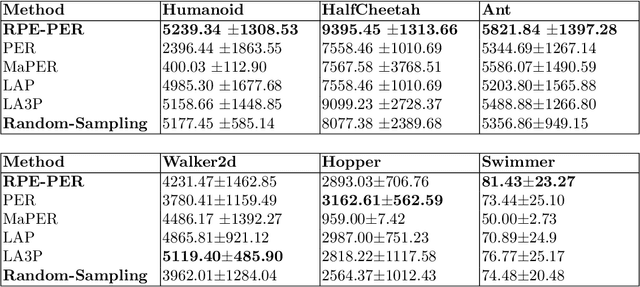
Reinforcement Learning algorithms aim to learn optimal control strategies through iterative interactions with an environment. A critical element in this process is the experience replay buffer, which stores past experiences, allowing the algorithm to learn from a diverse range of interactions rather than just the most recent ones. This buffer is especially essential in dynamic environments with limited experiences. However, efficiently selecting high-value experiences to accelerate training remains a challenge. Drawing inspiration from the role of reward prediction errors (RPEs) in biological systems, where they are essential for adaptive behaviour and learning, we introduce Reward Predictive Error Prioritised Experience Replay (RPE-PER). This novel approach prioritises experiences in the buffer based on RPEs. Our method employs a critic network, EMCN, that predicts rewards in addition to the Q-values produced by standard critic networks. The discrepancy between these predicted and actual rewards is computed as RPE and utilised as a signal for experience prioritisation. Experimental evaluations across various continuous control tasks demonstrate RPE-PER's effectiveness in enhancing the learning speed and performance of off-policy actor-critic algorithms compared to baseline approaches.