 Add to Chrome
 Add to Firefox
 Add to Edge
A Unified Framework for Automated Assembly Sequence and Production Line Planning using Graph-based Optimization
Dec 15, 2025
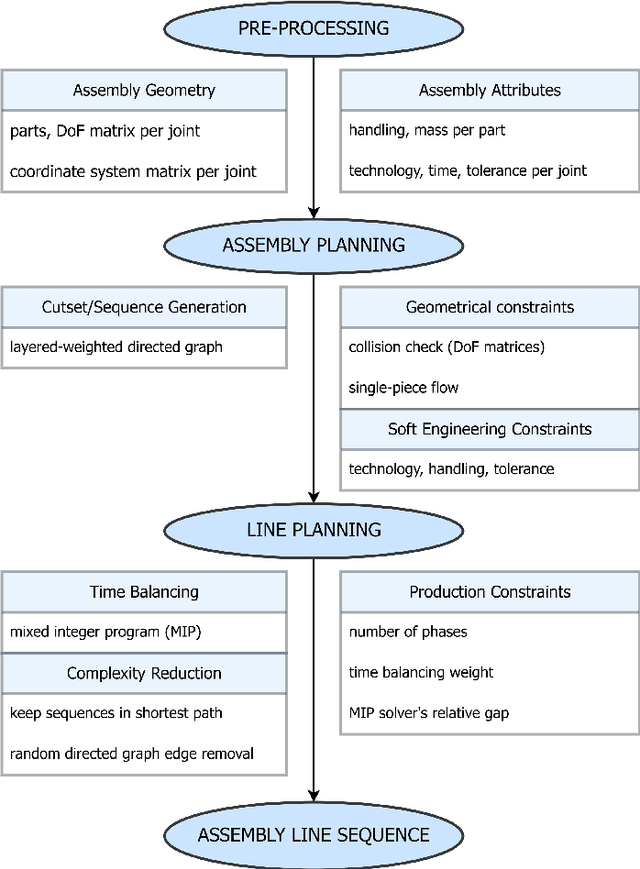
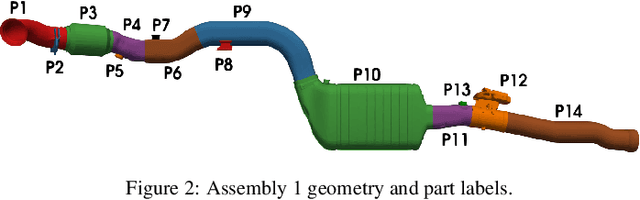
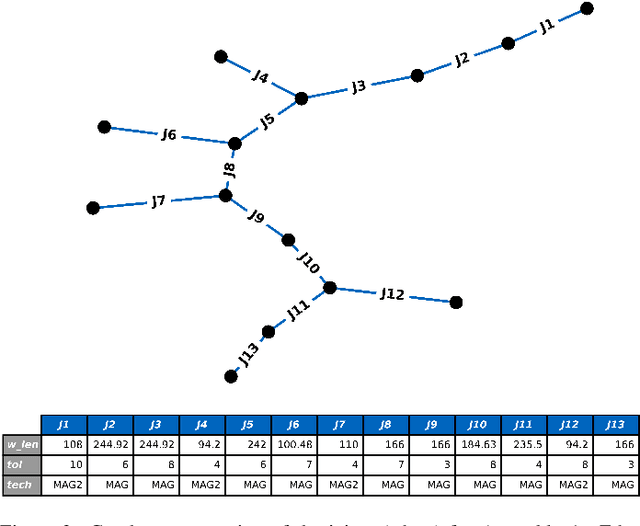
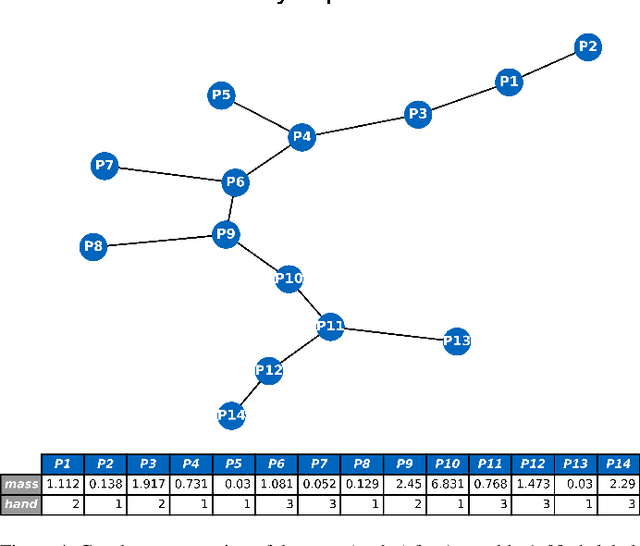
This paper presents PyCAALP (Python-based Computer-Aided Assembly Line Planning), a framework for automated Assembly Sequence Planning (ASP) and Production Line Planning (PLP), employing a graph-based approach to model components and joints within production modules. The framework integrates kinematic boundary conditions, such as potential part collisions, to guarantee the feasibility of automated assembly planning. The developed algorithm computes all feasible production sequences, integrating modules for detecting spatial relationships and formulating geometric constraints. The algorithm incorporates additional attributes, including handling feasibility, tolerance matching, and joint compatibility, to manage the high combinatorial complexity inherent in assembly sequence generation. Heuristics, such as Single-Piece Flow assembly and geometrical constraint enforcement, are utilized to further refine the solution space, facilitating more efficient planning for complex assemblies. The PLP stage is formulated as a Mixed-Integer Program (MIP), balancing the total times of a fixed number of manufacturing stations. While some complexity reduction techniques may sacrifice optimality, they significantly reduce the MIPs computational time. Furthermore, the framework enables customization of engineering constraints and supports a flexible trade-off between ASP and PLP. The open-source nature of the framework, available at https://github.com/TUM-utg/PyCAALP, promotes further collaboration and adoption in both industrial and production research applications.

Fountain -- an intelligent contextual assistant combining knowledge representation and language models for manufacturing risk identification
Aug 01, 2023Deviations from the approved design or processes during mass production can lead to unforeseen risks. However, these changes are sometimes necessary due to changes in the product design characteristics or an adaptation in the manufacturing process. A major challenge is to identify these risks early in the workflow so that failures leading to warranty claims can be avoided. We developed Fountain as a contextual assistant integrated in the deviation management workflow that helps in identifying the risks based on the description of the existing design and process criteria and the proposed deviation. In the manufacturing context, it is important that the assistant provides recommendations that are explainable and consistent. We achieve this through a combination of the following two components 1) language models finetuned for domain specific semantic similarity and, 2) knowledge representation in the form of a property graph derived from the bill of materials, Failure Modes and Effect Analysis (FMEA) and prior failures reported by customers. Here, we present the nuances of selecting and adapting pretrained language models for an engineering domain, continuous model updates based on user interaction with the contextual assistant and creating the causal chain for explainable recommendations based on the knowledge representation. Additionally, we demonstrate that the model adaptation is feasible using moderate computational infrastructure already available to most engineering teams in manufacturing organizations and inference can be performed on standard CPU only instances for integration with existing applications making these methods easily deployable.