 Add to Chrome
 Add to Firefox
 Add to Edge
Improving Interpretability of Lexical Semantic Change with Neurobiological Features
Feb 10, 2026
Lexical Semantic Change (LSC) is the phenomenon in which the meaning of a word change over time. Most studies on LSC focus on improving the performance of estimating the degree of LSC, however, it is often difficult to interpret how the meaning of a word change. Enhancing the interpretability of LSC is a significant challenge as it could lead to novel insights in this field. To tackle this challenge, we propose a method to map the semantic space of contextualized embeddings of words obtained by a pre-trained language model to a neurobiological feature space. In the neurobiological feature space, each dimension corresponds to a primitive feature of words, and its value represents the intensity of that feature. This enables humans to interpret LSC systematically. When employed for the estimation of the degree of LSC, our method demonstrates superior performance in comparison to the majority of the previous methods. In addition, given the high interpretability of the proposed method, several analyses on LSC are carried out. The results demonstrate that our method not only discovers interesting types of LSC that have been overlooked in previous studies but also effectively searches for words with specific types of LSC.

Discovering Highly Influential Shortcut Reasoning: An Automated Template-Free Approach
Dec 15, 2023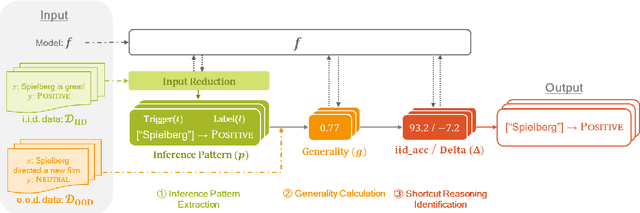
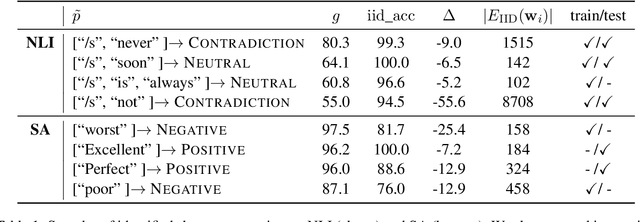
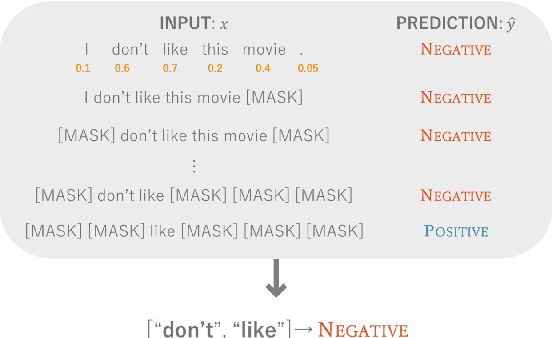
Shortcut reasoning is an irrational process of inference, which degrades the robustness of an NLP model. While a number of previous work has tackled the identification of shortcut reasoning, there are still two major limitations: (i) a method for quantifying the severity of the discovered shortcut reasoning is not provided; (ii) certain types of shortcut reasoning may be missed. To address these issues, we propose a novel method for identifying shortcut reasoning. The proposed method quantifies the severity of the shortcut reasoning by leveraging out-of-distribution data and does not make any assumptions about the type of tokens triggering the shortcut reasoning. Our experiments on Natural Language Inference and Sentiment Analysis demonstrate that our framework successfully discovers known and unknown shortcut reasoning in the previous work.