 Add to Chrome
 Add to Firefox
 Add to Edge
Blockwise Advantage Estimation for Multi-Objective RL with Verifiable Rewards
Feb 10, 2026
Group Relative Policy Optimization (GRPO) assigns a single scalar advantage to all tokens in a completion. For structured generations with explicit segments and objectives, this couples unrelated reward signals across segments, leading to objective interference and misattributed credit. We propose Blockwise Advantage Estimation, a family of GRPO-compatible methods that assigns each objective its own advantage and applies it only to the tokens in the corresponding text block, reducing reliance on hand-designed scalar rewards and scaling naturally to additional objectives. A key challenge is estimating advantages for later blocks whose rewards are conditioned on sampled prefixes; standard unbiased approaches require expensive nested rollouts from intermediate states. Concretely, we introduce an Outcome-Conditioned Baseline that approximates intermediate state values using only within-group statistics by stratifying samples according to a prefix-derived intermediate outcome. On math tasks with uncertainty estimation, our method mitigates reward interference, is competitive with a state-of-the-art reward-designed approach, and preserves test-time gains from confidence-weighted ensembling. More broadly, it provides a modular recipe for optimizing sequential objectives in structured generations without additional rollouts.

Tensor network to learn the wavefunction of data
Nov 15, 2021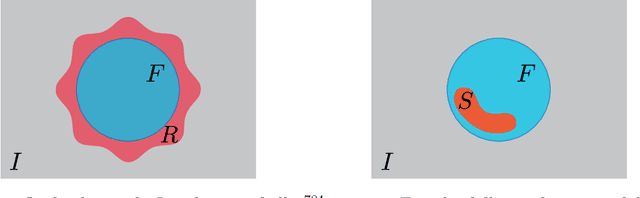


How many different ways are there to handwrite digit 3? To quantify this question imagine extending a dataset of handwritten digits MNIST by sampling additional images until they start repeating. We call the collection of all resulting images of digit 3 the "full set." To study the properties of the full set we introduce a tensor network architecture which simultaneously accomplishes both classification (discrimination) and sampling tasks. Qualitatively, our trained network represents the indicator function of the full set. It therefore can be used to characterize the data itself. We illustrate that by studying the full sets associated with the digits of MNIST. Using quantum mechanical interpretation of our network we characterize the full set by calculating its entanglement entropy. We also study its geometric properties such as mean Hamming distance, effective dimension, and size. The latter answers the question above -- the total number of black and white threes written MNIST style is $2^{72}$.