 Add to Chrome
 Add to Firefox
 Add to Edge
HKJudge: A Legal Discourse-Annotated Corpus for Interpreting What Courts Find, How They Reason, and What They Rule
Jun 04, 2026
Court judgments are central to legal practice and jurisprudence, yet discourse analysis of Hong Kong judgments has received limited attention, owing largely to the absence of expert-annotated corpora. We introduce the Hong Kong Judgment Discourse Dataset (HKJudge), the first sentence-level expert-annotated legal discourse corpus. HKJudge includes criminal judgments across all five levels of HK's court hierarchy, comprising $\sim$290k sentences and $\sim$6.5 million tokens, fully annotated by legal linguistics experts. We design a two-tier discourse schema that captures what facts a court finds, how it reasons, and what it rules. At the sentence level, each sentence is assigned one of 26 rhetorical roles. At the span level, sentences are further annotated with three sentencing elements (charge, imprisonment term, fine). Ten legal linguistics annotators produced the annotations with an inter-annotator agreement of $κ= 0.8$. We formulate two tasks on HKJudge, termed rhetorical role classification and legal element extraction, and provide the first benchmark evaluation of four BERT-based models, two open-source LLMs under zero-shot and fine-tuning settings, and four commercial LLMs on both tasks. Our work demonstrates the value of sentence-level discourse annotation for modeling the structure of HK judgments and provides a rich data foundation for future work on legal judgment prediction. The HKJudge dataset and code are available at https://github.com/xuanxixi/HKJudge.

TransLaw: Benchmarking Large Language Models in Multi-Agent Simulation of the Collaborative Translation
Jul 01, 2025Multi-agent systems empowered by large language models (LLMs) have demonstrated remarkable capabilities in a wide range of downstream applications, including machine translation. However, the potential of LLMs in translating Hong Kong legal judgments remains uncertain due to challenges such as intricate legal terminology, culturally embedded nuances, and strict linguistic structures. In this work, we introduce TransLaw, a novel multi-agent framework implemented for real-world Hong Kong case law translation. It employs three specialized agents, namely, Translator, Annotator, and Proofreader, to collaboratively produce translations for high accuracy in legal meaning, appropriateness in style, and adequate coherence and cohesion in structure. This framework supports customizable LLM configurations and achieves tremendous cost reduction compared to professional human translation services. We evaluated its performance using 13 open-source and commercial LLMs as agents and obtained interesting findings, including that it surpasses GPT-4o in legal semantic accuracy, structural coherence, and stylistic fidelity, yet trails human experts in contextualizing complex terminology and stylistic naturalness. Our platform website is available at CityUHK, and our bilingual judgment corpus used for the evaluation is available at Hugging Face.
Solving the unsolvable: Translating case law in Hong Kong
Jan 16, 2025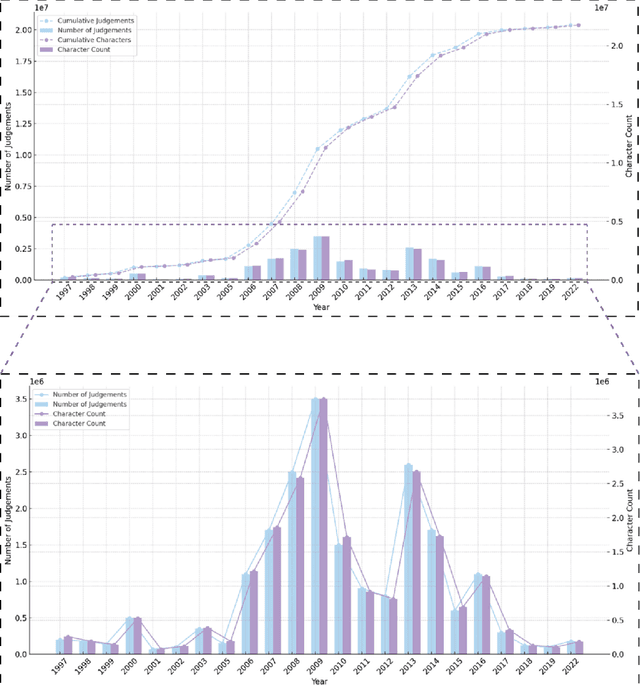
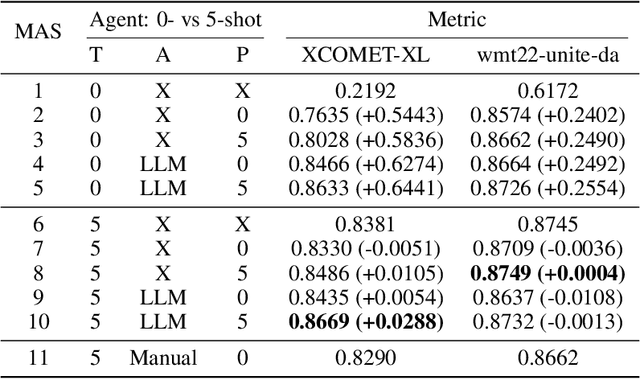
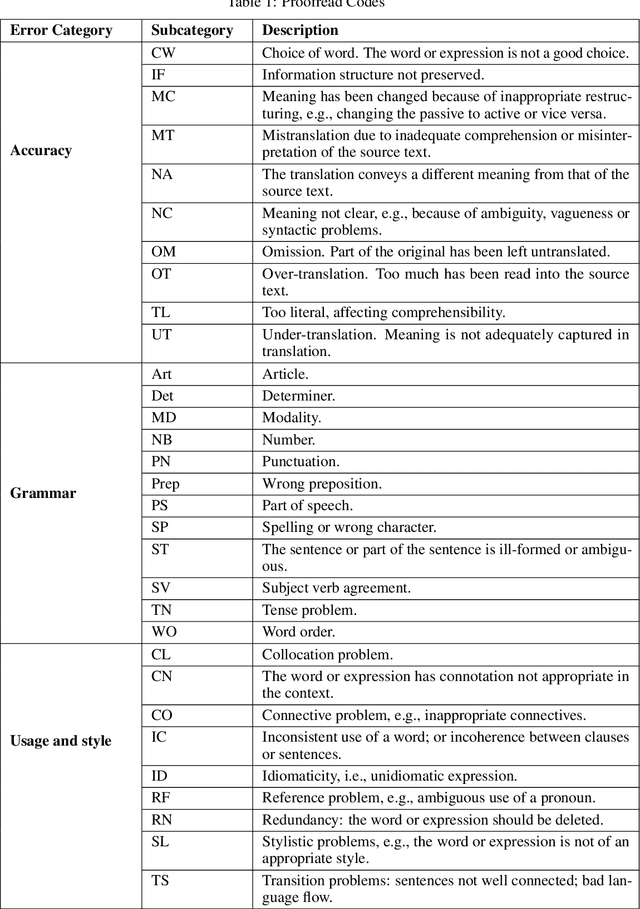
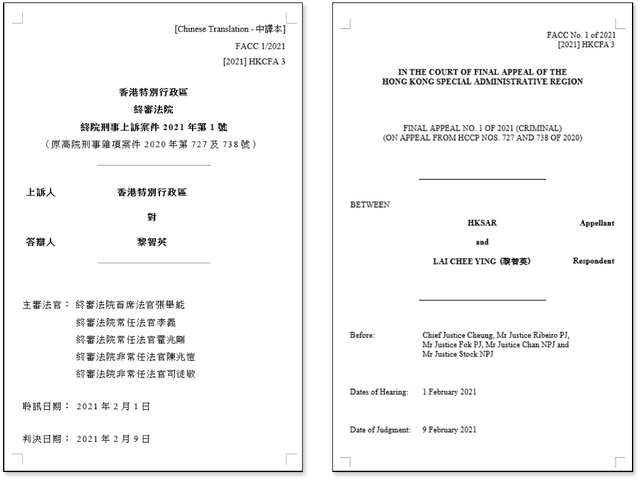
This paper addresses the challenges translating case law under Hong Kong's bilingual legal system. It highlights the initial success of translating all written statutes into Chinese before the 1997 handover, a task mandated by the Basic Law. The effort involved significant collaboration among legal, linguistic, and translation experts, resulting in a comprehensive and culturally appropriate bilingual legal system. However, translating case law remains a significant challenge due to the sheer volume and continuous growth of judicial decisions. The paper critiques the governments and judiciarys sporadic and uncoordinated efforts to translate case law, contrasting it with the thorough approach previously taken for statute translation. Although the government acknowledges the importance of legal bilingualism, it lacks a sustainable strategy for translating case law. The Judiciarys position that translating all judgments is unnecessary, unrealistic, and not cost-effectiveis analyzed and critiqued for its impact on legal transparency and public trust. A proposed solution involves leveraging machine translation technology through a human-machine interactive translation platform, which undergoes two major transitions. Initially based on a neural model, the platform transitions to using a large language model for improved translation accuracy. Furthermore, it evolves from a single-agent system to a multi-agent system, incorporating Translator, Annotator, and Proofreader agents. This multi-agent approach, supported by a grant, aims to facilitate efficient, high-quality translation of judicial judgments by integrating advanced artificial intelligence and continuous feedback mechanisms, thus better meeting the needs of a bilingual legal system.