 Add to Chrome
 Add to Firefox
 Add to Edge
HS-3D-NeRF: 3D Surface and Hyperspectral Reconstruction From Stationary Hyperspectral Images Using Multi-Channel NeRFs
Feb 18, 2026
Advances in hyperspectral imaging (HSI) and 3D reconstruction have enabled accurate, high-throughput characterization of agricultural produce quality and plant phenotypes, both essential for advancing agricultural sustainability and breeding programs. HSI captures detailed biochemical features of produce, while 3D geometric data substantially improves morphological analysis. However, integrating these two modalities at scale remains challenging, as conventional approaches involve complex hardware setups incompatible with automated phenotyping systems. Recent advances in neural radiance fields (NeRF) offer computationally efficient 3D reconstruction but typically require moving-camera setups, limiting throughput and reproducibility in standard indoor agricultural environments. To address these challenges, we introduce HSI-SC-NeRF, a stationary-camera multi-channel NeRF framework for high-throughput hyperspectral 3D reconstruction targeting postharvest inspection of agricultural produce. Multi-view hyperspectral data is captured using a stationary camera while the object rotates within a custom-built Teflon imaging chamber providing diffuse, uniform illumination. Object poses are estimated via ArUco calibration markers and transformed to the camera frame of reference through simulated pose transformations, enabling standard NeRF training on stationary-camera data. A multi-channel NeRF formulation optimizes reconstruction across all hyperspectral bands jointly using a composite spectral loss, supported by a two-stage training protocol that decouples geometric initialization from radiometric refinement. Experiments on three agricultural produce samples demonstrate high spatial reconstruction accuracy and strong spectral fidelity across the visible and near-infrared spectrum, confirming the suitability of HSI-SC-NeRF for integration into automated agricultural workflows.

NeRF-based Point Cloud Reconstruction using a Stationary Camera for Agricultural Applications
Mar 27, 2025
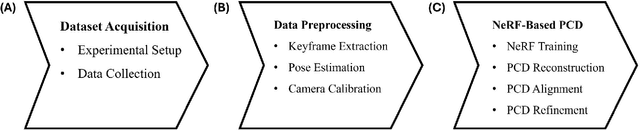
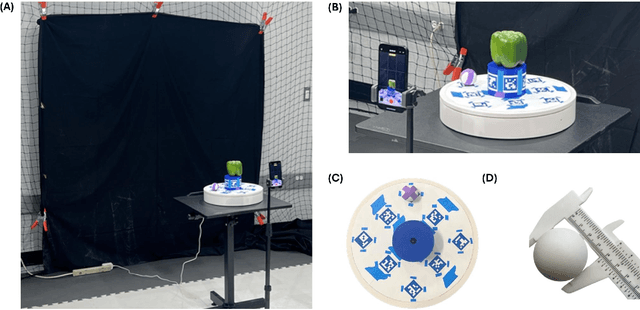
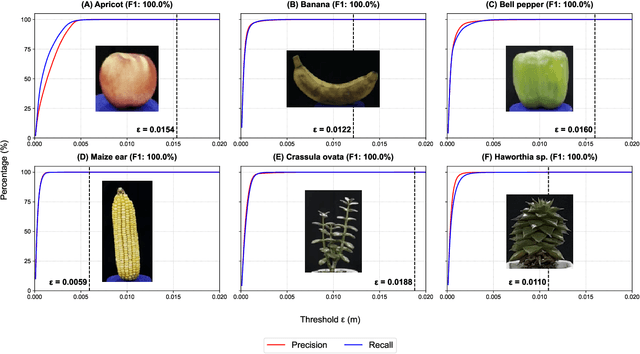
This paper presents a NeRF-based framework for point cloud (PCD) reconstruction, specifically designed for indoor high-throughput plant phenotyping facilities. Traditional NeRF-based reconstruction methods require cameras to move around stationary objects, but this approach is impractical for high-throughput environments where objects are rapidly imaged while moving on conveyors or rotating pedestals. To address this limitation, we develop a variant of NeRF-based PCD reconstruction that uses a single stationary camera to capture images as the object rotates on a pedestal. Our workflow comprises COLMAP-based pose estimation, a straightforward pose transformation to simulate camera movement, and subsequent standard NeRF training. A defined Region of Interest (ROI) excludes irrelevant scene data, enabling the generation of high-resolution point clouds (10M points). Experimental results demonstrate excellent reconstruction fidelity, with precision-recall analyses yielding an F-score close to 100.00 across all evaluated plant objects. Although pose estimation remains computationally intensive with a stationary camera setup, overall training and reconstruction times are competitive, validating the method's feasibility for practical high-throughput indoor phenotyping applications. Our findings indicate that high-quality NeRF-based 3D reconstructions are achievable using a stationary camera, eliminating the need for complex camera motion or costly imaging equipment. This approach is especially beneficial when employing expensive and delicate instruments, such as hyperspectral cameras, for 3D plant phenotyping. Future work will focus on optimizing pose estimation techniques and further streamlining the methodology to facilitate seamless integration into automated, high-throughput 3D phenotyping pipelines.