 Add to Chrome
 Add to Firefox
 Add to Edge
Rethinking Molecular Text Representations for LLMs: An Empirical Study
Jun 02, 2026
Large language models (LLMs) are increasingly used for molecular tasks, but it remains unclear which molecular representation to use. We present a systematic benchmark evaluating LLM molecular competence across nine representations and eight chemical tasks. We benchmark 16 LLMs across five model families, including reasoning and non-reasoning variants, chemistry-specialized LLMs, and closed frontier models. Performance is strongly representation-dependent and no single representation wins across tasks, though CML is the best, followed by MolJSON, InChI, and then canonical SMILES. Explicit structured text representations (CML and MolJSON) dominate structural tasks; IUPAC dominates semantic tasks, winning molecule retrieval for all 16 LLMs; and SMILES variants are rarely optimal despite their prevalence in pretraining. Chemistry-specialized models perform well with SMILES at the cost of large degradations with structured text representations, suggesting SMILES-only evaluation rewards specialization that does not generalize. Using LLM-as-a-judge, we find that IUPAC produces the highest fraction of correct molecule generations. A mechanistic study via tokenization audits, linear probes and attention shows that representations are encoded differently inside the model; for example, structured representations require higher attention across the molecular span. Our results argue against representation-invariant evaluation and motivate task-aware representation routing for LLM-based chemistry.

Variational Learning of Fractional Posteriors
Mar 29, 2026We introduce a novel one-parameter variational objective that lower bounds the data evidence and enables the estimation of approximate fractional posteriors. We extend this framework to hierarchical construction and Bayes posteriors, offering a versatile tool for probabilistic modelling. We demonstrate two cases where gradients can be obtained analytically and a simulation study on mixture models showing that our fractional posteriors can be used to achieve better calibration compared to posteriors from the conventional variational bound. When applied to variational autoencoders (VAEs), our approach attains higher evidence bounds and enables learning of high-performing approximate Bayes posteriors jointly with fractional posteriors. We show that VAEs trained with fractional posteriors produce decoders that are better aligned for generation from the prior.
PhiNet v2: A Mask-Free Brain-Inspired Vision Foundation Model from Video
May 16, 2025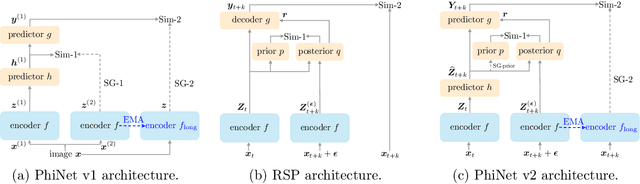

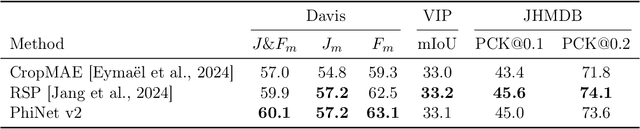
Recent advances in self-supervised learning (SSL) have revolutionized computer vision through innovative architectures and learning objectives, yet they have not fully leveraged insights from biological visual processing systems. Recently, a brain-inspired SSL model named PhiNet was proposed; it is based on a ResNet backbone and operates on static image inputs with strong augmentation. In this paper, we introduce PhiNet v2, a novel Transformer-based architecture that processes temporal visual input (that is, sequences of images) without relying on strong augmentation. Our model leverages variational inference to learn robust visual representations from continuous input streams, similar to human visual processing. Through extensive experimentation, we demonstrate that PhiNet v2 achieves competitive performance compared to state-of-the-art vision foundation models, while maintaining the ability to learn from sequential input without strong data augmentation. This work represents a significant step toward more biologically plausible computer vision systems that process visual information in a manner more closely aligned with human cognitive processes.