 Add to Chrome
 Add to Firefox
 Add to Edge
RMIT-ADM+S at the MMU-RAG NeurIPS 2025 Competition
Feb 24, 2026
This paper presents the award-winning RMIT-ADM+S system for the Text-to-Text track of the NeurIPS~2025 MMU-RAG Competition. We introduce Routing-to-RAG (R2RAG), a research-focused retrieval-augmented generation (RAG) architecture composed of lightweight components that dynamically adapt the retrieval strategy based on inferred query complexity and evidence sufficiency. The system uses smaller LLMs, enabling operation on a single consumer-grade GPU while supporting complex research tasks. It builds on the G-RAG system, winner of the ACM~SIGIR~2025 LiveRAG Challenge, and extends it with modules informed by qualitative review of outputs. R2RAG won the Best Dynamic Evaluation award in the Open Source category, demonstrating high effectiveness with careful design and efficient use of resources.

RMIT-ADM+S at the SIGIR 2025 LiveRAG Challenge
Jun 17, 2025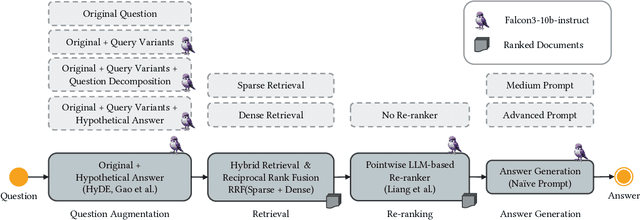
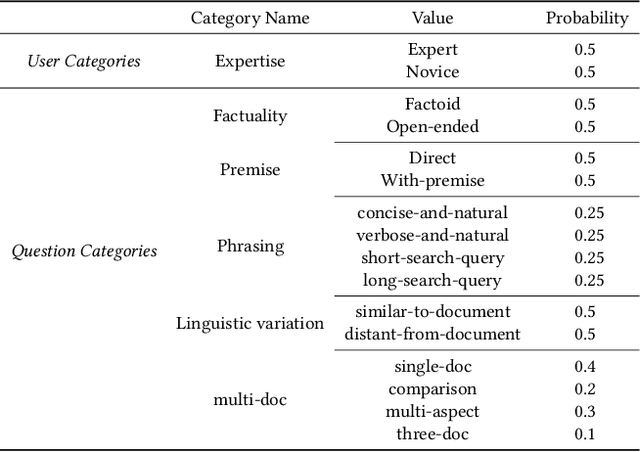
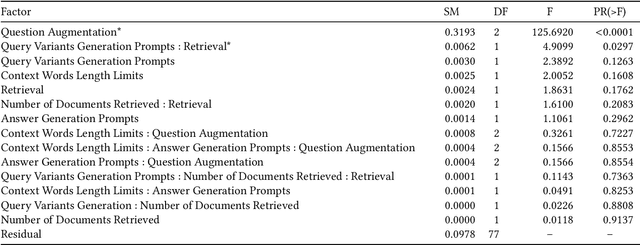
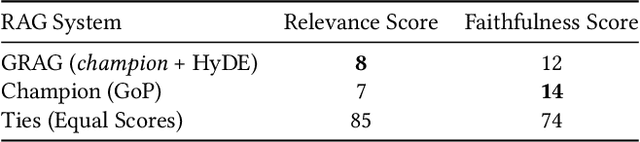
This paper presents the RMIT--ADM+S participation in the SIGIR 2025 LiveRAG Challenge. Our Generation-Retrieval-Augmented Generation (GRAG) approach relies on generating a hypothetical answer that is used in the retrieval phase, alongside the original question. GRAG also incorporates a pointwise large language model (LLM)-based re-ranking step prior to final answer generation. We describe the system architecture and the rationale behind our design choices. In particular, a systematic evaluation using the Grid of Points (GoP) framework and N-way ANOVA enabled comparison across multiple configurations, including query variant generation, question decomposition, rank fusion strategies, and prompting techniques for answer generation. Our system achieved a Relevance score of 1.199 and a Faithfulness score of 0.477 on the private leaderboard, placing among the top four finalists in the LiveRAG 2025 Challenge.