 Add to Chrome
 Add to Firefox
 Add to Edge
Gradient Under Microscope: Benchmarking Resource Utilization of Memory-Efficient Gradient Computation Methods
Aug 09, 2026
AI training's rising resource intensity is straining electricity supplies and carbon budgets, motivating systematic study of memory-efficient training on constrained hardware. We benchmark five gradient optimizers (SGD, Adam, Adagrad, Adadelta, and Conjugate Gradient Descent) under three memory strategies (standard training, gradient checkpointing, and gradient accumulation) across four transformer architectures (ViT, ModernBERT, Llama 3.1 1B, and NanoVLM), measuring training loss, GPU utilization, training time, and memory usage. Gradient accumulation emerges as the most reliable strategy, cutting training loss by roughly an order of magnitude on the vision-language model and about four-fold on the language model without additional GPU memory. Contrary to common practice, Adam is not universally superior: Adadelta and SGD outperform it on the encoder and autoregressive architectures. Gradient checkpointing's effect is strongly architecture-dependent, improving vision transformer loss while severely degrading the encoder model, and it increases training time by up to 60% on memory-bound models. GPU utilization is governed primarily by architecture, ranging from 8-15% for the memory-bound language model to 96-99% for compute-bound vision models. These findings provide practical guidelines for optimizer and gradient-strategy selection in resource-efficient model training and deployment.

Can LLMs substitute SQL? Comparing Resource Utilization of Querying LLMs versus Traditional Relational Databases
Apr 12, 2024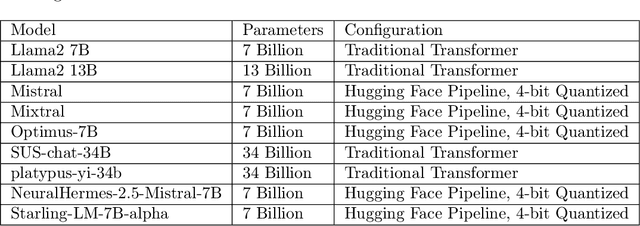
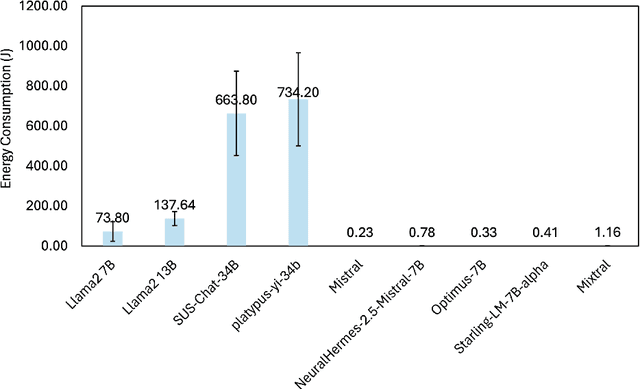
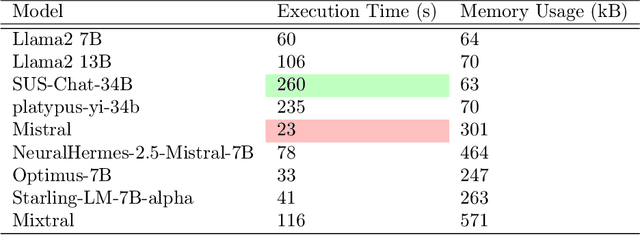
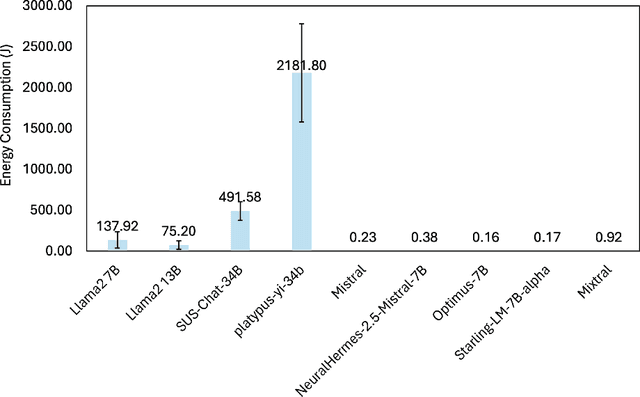
Large Language Models (LLMs) can automate or substitute different types of tasks in the software engineering process. This study evaluates the resource utilization and accuracy of LLM in interpreting and executing natural language queries against traditional SQL within relational database management systems. We empirically examine the resource utilization and accuracy of nine LLMs varying from 7 to 34 Billion parameters, including Llama2 7B, Llama2 13B, Mistral, Mixtral, Optimus-7B, SUS-chat-34B, platypus-yi-34b, NeuralHermes-2.5-Mistral-7B and Starling-LM-7B-alpha, using a small transaction dataset. Our findings indicate that using LLMs for database queries incurs significant energy overhead (even small and quantized models), making it an environmentally unfriendly approach. Therefore, we advise against replacing relational databases with LLMs due to their substantial resource utilization.