 Add to Chrome
 Add to Firefox
 Add to Edge
Generating Benchmark Health Data Using a Tabular Diffusion Transformer
Aug 14, 2026
Cross-Tabular Data Generation (CTDG) seeks to learn a generative model from multiple heterogeneous tables and produce new synthetic tabular datasets. However, existing synthetic tabular data generation methods are largely restricted to single-input-table scenarios and struggle to effectively handle multiple heterogeneous tables with diverse feature sets. To address this limitation, we propose a two-stage framework for cross-tabular data generation. In the first stage, each heterogeneous raw table is transformed into a standardized statistical table with the same set of columns across all tables. Each statistical table captures the marginal distributions of the original columns and the pairwise correlations among them. In the second stage, a diffusion transformer model is trained to capture structural patterns across these homogeneous statistical tables and to generate synthetic statistical tables. Synthetic raw tables are subsequently reconstructed from the generated statistical tables via multivariate Gaussian sampling followed by an inverse probability integral transform. This two-stage CTDG framework enables the learning of a unified generative model from multiple heterogeneous tables and supports the generation of an unlimited number of realistic synthetic heterogeneous tables. Experimental results demonstrate high fidelity in the learned statistical representations and a favorable fidelity-diversity trade-off in the generated synthetic data, validating the effectiveness of the proposed approach.

A Consensus Privacy Metrics Framework for Synthetic Data
Mar 06, 2025Synthetic data generation is one approach for sharing individual-level data. However, to meet legislative requirements, it is necessary to demonstrate that the individuals' privacy is adequately protected. There is no consolidated standard for measuring privacy in synthetic data. Through an expert panel and consensus process, we developed a framework for evaluating privacy in synthetic data. Our findings indicate that current similarity metrics fail to measure identity disclosure, and their use is discouraged. For differentially private synthetic data, a privacy budget other than close to zero was not considered interpretable. There was consensus on the importance of membership and attribute disclosure, both of which involve inferring personal information about an individual without necessarily revealing their identity. The resultant framework provides precise recommendations for metrics that address these types of disclosures effectively. Our findings further present specific opportunities for future research that can help with widespread adoption of synthetic data.
Synthetic Data Generation for Augmenting Small Samples
Jan 30, 2025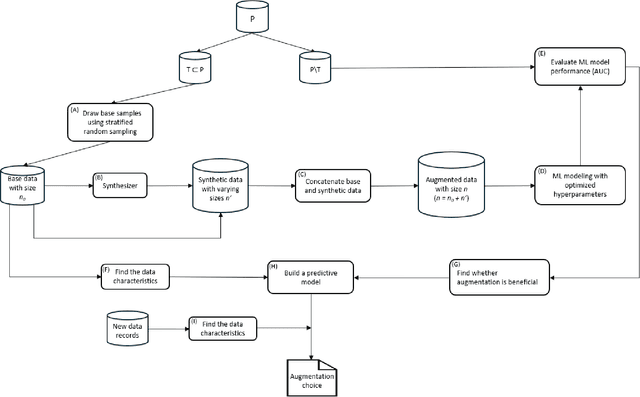
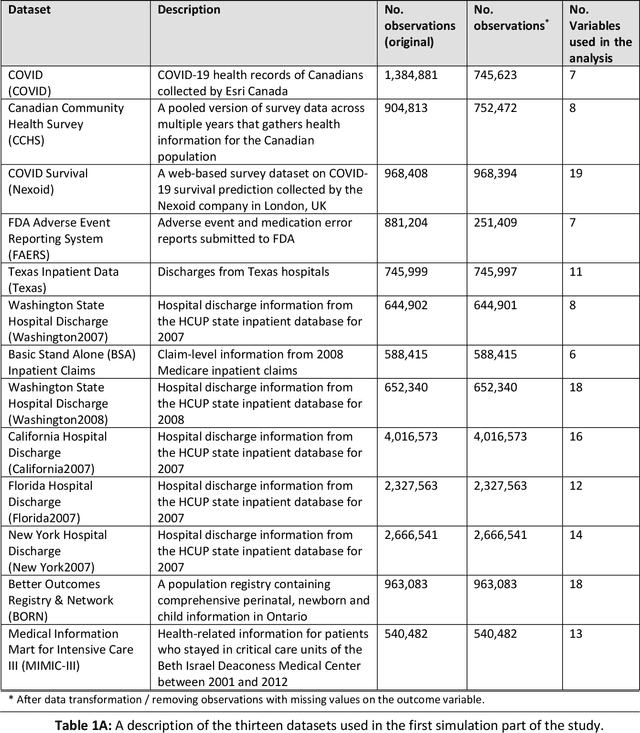
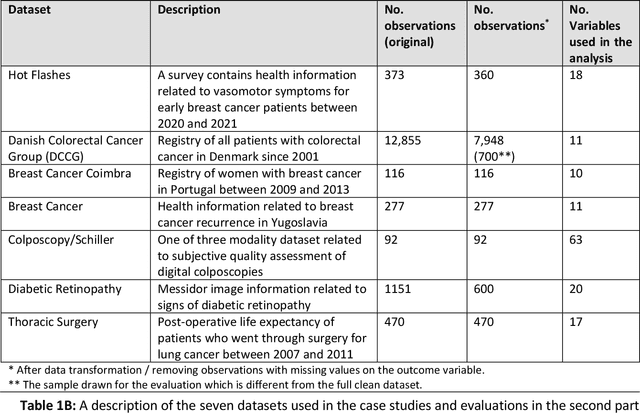
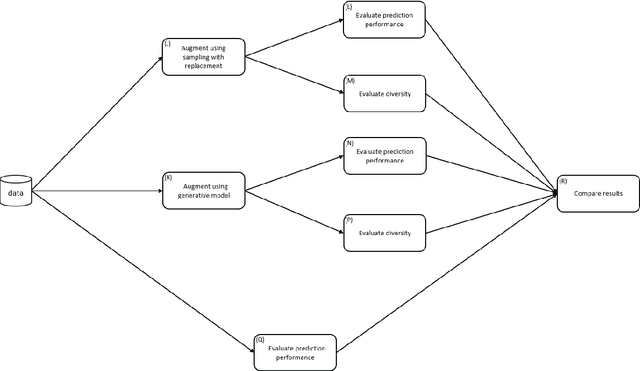
Small datasets are common in health research. However, the generalization performance of machine learning models is suboptimal when the training datasets are small. To address this, data augmentation is one solution. Augmentation increases sample size and is seen as a form of regularization that increases the diversity of small datasets, leading them to perform better on unseen data. We found that augmentation improves prognostic performance for datasets that: have fewer observations, with smaller baseline AUC, have higher cardinality categorical variables, and have more balanced outcome variables. No specific generative model consistently outperformed the others. We developed a decision support model that can be used to inform analysts if augmentation would be useful. For seven small application datasets, augmenting the existing data results in an increase in AUC between 4.31% (AUC from 0.71 to 0.75) and 43.23% (AUC from 0.51 to 0.73), with an average 15.55% relative improvement, demonstrating the nontrivial impact of augmentation on small datasets (p=0.0078). Augmentation AUC was higher than resampling only AUC (p=0.016). The diversity of augmented datasets was higher than the diversity of resampled datasets (p=0.046).