 Add to Chrome
 Add to Firefox
 Add to Edge
Multi-Agent Collaboration for Automated Design Exploration on High Performance Computing Systems
Mar 12, 2026
Today's scientific challenges, from climate modeling to Inertial Confinement Fusion design to novel material design, require exploring huge design spaces. In order to enable high-impact scientific discovery, we need to scale up our ability to test hypotheses, generate results, and learn from them rapidly. We present MADA (Multi-Agent Design Assistant), a Large Language Model (LLM) powered multi-agent framework that coordinates specialized agents for complex design workflows. A Job Management Agent (JMA) launches and manages ensemble simulations on HPC systems, a Geometry Agent (GA) generates meshes, and an Inverse Design Agent (IDA) proposes new designs informed by simulation outcomes. While general purpose, we focus development and validation on Richtmyer--Meshkov Instability (RMI) suppression, a critical challenge in Inertial Confinement Fusion. We evaluate on two complementary settings: running a hydrodynamics simulations on HPC systems, and using a pre-trained machine learning surrogate for rapid design exploration. Our results demonstrate that the MADA system successfully executes iterative design refinement, automatically improving designs toward optimal RMI suppression with minimal manual intervention. Our framework reduces cumbersome manual workflow setup, and enables automated design exploration at scale. More broadly, it demonstrates a reusable pattern for coupling reasoning, simulation, specialized tools, and coordinated workflows to accelerate scientific discovery.

Spatio-temporal, multi-field deep learning of shock propagation in meso-structured media
Sep 19, 2025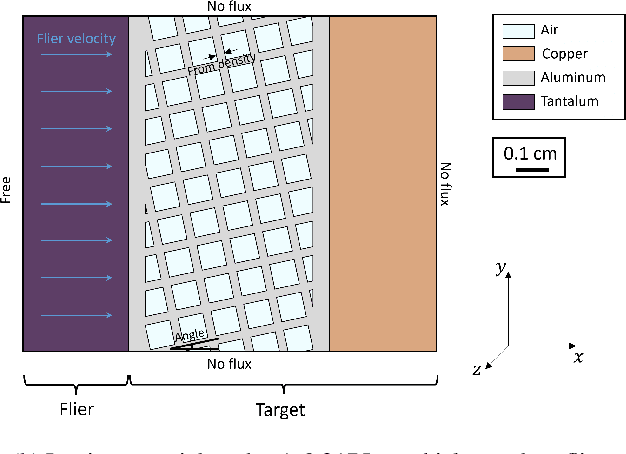
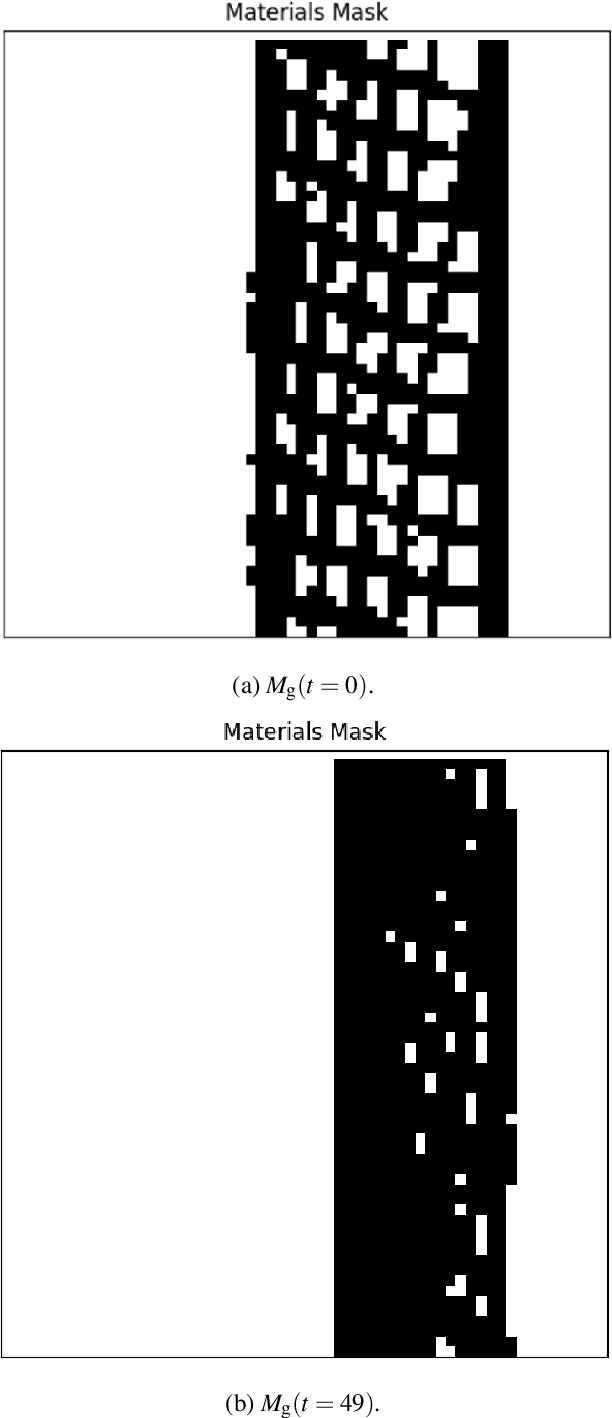
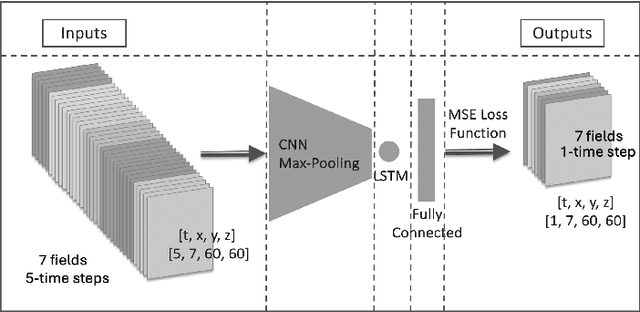
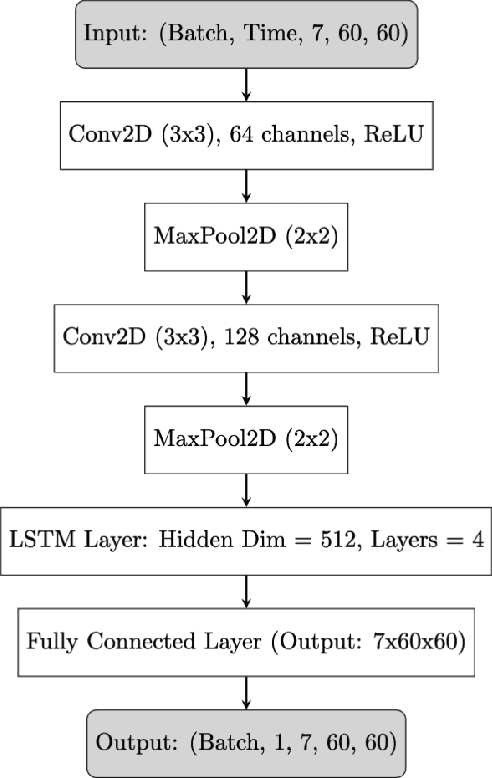
The ability to predict how shock waves traverse porous and architected materials is a decisive factor in planetary defense, national security, and the race to achieve inertial fusion energy. Yet capturing pore collapse, anomalous Hugoniot responses, and localized heating -- phenomena that can determine the success of asteroid deflection or fusion ignition -- has remained a major challenge despite recent advances in single-field and reduced representations. We introduce a multi-field spatio-temporal deep learning model (MSTM) that unifies seven coupled fields -- pressure, density, temperature, energy, material distribution, and two velocity components -- into a single autoregressive surrogate. Trained on high-fidelity hydrocode data, MSTM runs about a thousand times faster than direct simulation, achieving errors below 4\% in porous materials and below 10\% in lattice structures. Unlike prior single-field or operator-based surrogates, MSTM resolves sharp shock fronts while preserving integrated quantities such as mass-averaged pressure and temperature to within 5\%. This advance transforms problems once considered intractable into tractable design studies, establishing a practical framework for optimizing meso-structured materials in planetary impact mitigation, inertial fusion energy, and national security.