 Add to Chrome
 Add to Firefox
 Add to Edge
Multi-Agent Collaboration for Automated Design Exploration on High Performance Computing Systems
Mar 12, 2026
Today's scientific challenges, from climate modeling to Inertial Confinement Fusion design to novel material design, require exploring huge design spaces. In order to enable high-impact scientific discovery, we need to scale up our ability to test hypotheses, generate results, and learn from them rapidly. We present MADA (Multi-Agent Design Assistant), a Large Language Model (LLM) powered multi-agent framework that coordinates specialized agents for complex design workflows. A Job Management Agent (JMA) launches and manages ensemble simulations on HPC systems, a Geometry Agent (GA) generates meshes, and an Inverse Design Agent (IDA) proposes new designs informed by simulation outcomes. While general purpose, we focus development and validation on Richtmyer--Meshkov Instability (RMI) suppression, a critical challenge in Inertial Confinement Fusion. We evaluate on two complementary settings: running a hydrodynamics simulations on HPC systems, and using a pre-trained machine learning surrogate for rapid design exploration. Our results demonstrate that the MADA system successfully executes iterative design refinement, automatically improving designs toward optimal RMI suppression with minimal manual intervention. Our framework reduces cumbersome manual workflow setup, and enables automated design exploration at scale. More broadly, it demonstrates a reusable pattern for coupling reasoning, simulation, specialized tools, and coordinated workflows to accelerate scientific discovery.

Neural Network Layers for Prediction of Positive Definite Elastic Stiffness Tensors
Mar 25, 2022


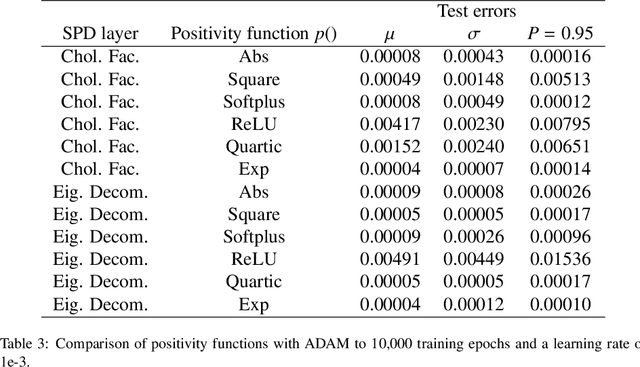
Machine learning models can be used to predict physical quantities like homogenized elasticity stiffness tensors, which must always be symmetric positive definite (SPD) based on conservation arguments. Two datasets of homogenized elasticity tensors of lattice materials are presented as examples, where it is desired to obtain models that map unit cell geometric and material parameters to their homogenized stiffness. Fitting a model to SPD data does not guarantee the model's predictions will remain SPD. Existing Cholsesky factorization and Eigendecomposition schemes are abstracted in this work as transformation layers which enforce the SPD condition. These layers can be included in many popular machine learning models to enforce SPD behavior. This work investigates the effects that different positivity functions have on the layers and how their inclusion affects model accuracy. Commonly used models are considered, including polynomials, radial basis functions, and neural networks. Ultimately it is shown that a single SPD layer improves the model's average prediction accuracy.
Testing Surrogate-Based Optimization with the Fortified Branin-Hoo Extended to Four Dimensions
Jul 16, 2021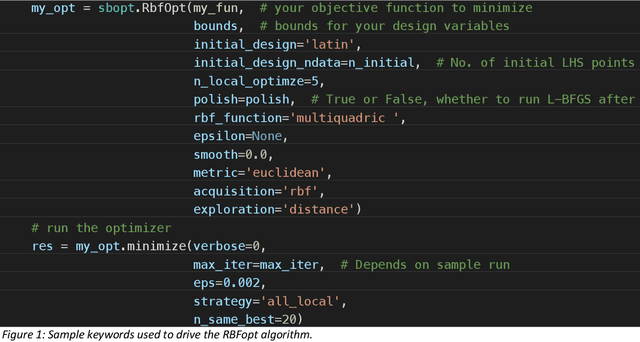

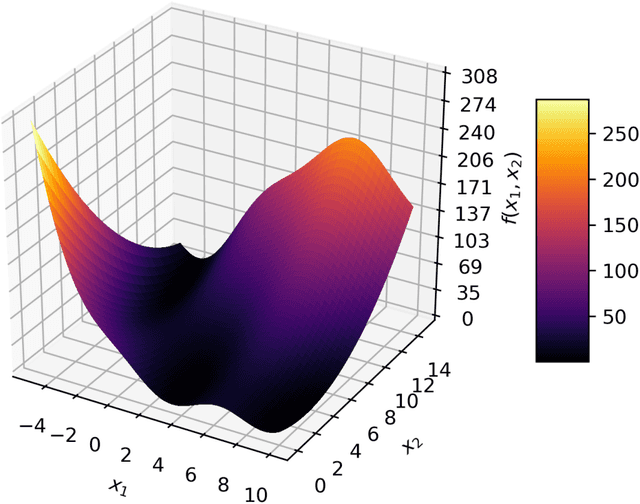

Some popular functions used to test global optimization algorithms have multiple local optima, all with the same value, making them all global optima. It is easy to make them more challenging by fortifying them via adding a localized bump at the location of one of the optima. In previous work the authors illustrated this for the Branin-Hoo function and the popular differential evolution algorithm, showing that the fortified Branin-Hoo required an order of magnitude more function evaluations. This paper examines the effect of fortifying the Branin-Hoo function on surrogate-based optimization, which usually proceeds by adaptive sampling. Two algorithms are considered. The EGO algorithm, which is based on a Gaussian process (GP) and an algorithm based on radial basis functions (RBF). EGO is found to be more frugal in terms of the number of required function evaluations required to identify the correct basin, but it is expensive to run on a desktop, limiting the number of times the runs could be repeated to establish sound statistics on the number of required function evaluations. The RBF algorithm was cheaper to run, providing more sound statistics on performance. A four-dimensional version of the Branin-Hoo function was introduced in order to assess the effect of dimensionality. It was found that the difference between the ordinary function and the fortified one was much more pronounced for the four-dimensional function compared to the two dimensional one.