 Add to Chrome
 Add to Firefox
 Add to Edge
Deep Learning-Driven Quantitative Spectroscopic Photoacoustic Imaging for Segmentation and Oxygen Saturation Estimation
Dec 17, 2025
Spectroscopic photoacoustic (sPA) imaging can potentially estimate blood oxygenation saturation (sO2) in vivo noninvasively. However, quantitatively accurate results require accurate optical fluence estimates. Robust modeling in heterogeneous tissue, where light with different wavelengths can experience significantly different absorption and scattering, is difficult. In this work, we developed a deep neural network (Hybrid-Net) for sPA imaging to simultaneously estimate sO2 in blood vessels and segment those vessels from surrounding background tissue. sO2 error was minimized only in blood vessels segmented in Hybrid-Net, resulting in more accurate predictions. Hybrid-Net was first trained on simulated sPA data (at 700 nm and 850 nm) representing initial pressure distributions from three-dimensional Monte Carlo simulations of light transport in breast tissue. Then, for experimental verification, the network was retrained on experimental sPA data (at 700 nm and 850 nm) acquired from simple tissue mimicking phantoms with an embedded blood pool. Quantitative measures were used to evaluate Hybrid-Net performance with an averaged segmentation accuracy of >= 0.978 in simulations with varying noise levels (0dB-35dB) and 0.998 in the experiment, and an averaged sO2 mean squared error of <= 0.048 in simulations with varying noise levels (0dB-35dB) and 0.003 in the experiment. Overall, these results show that Hybrid-Net can provide accurate blood oxygenation without estimating the optical fluence, and this study could lead to improvements in in-vivo sO2 estimation.

A Two-step-training Deep Learning Framework for Real-time Computational Imaging without Physics Priors
Jan 10, 2020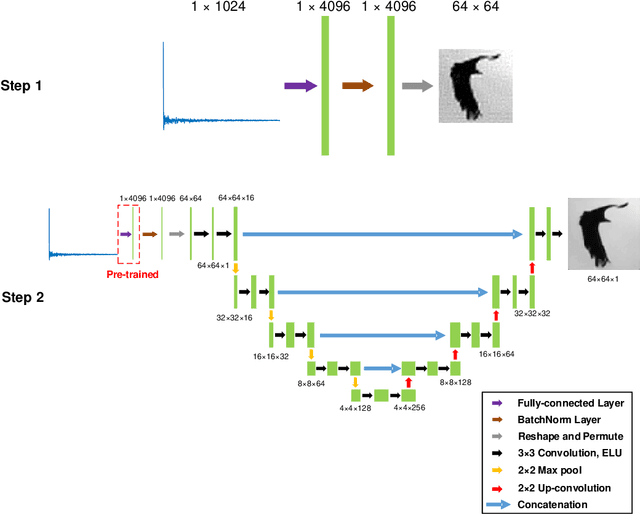
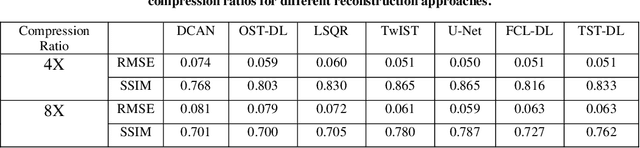
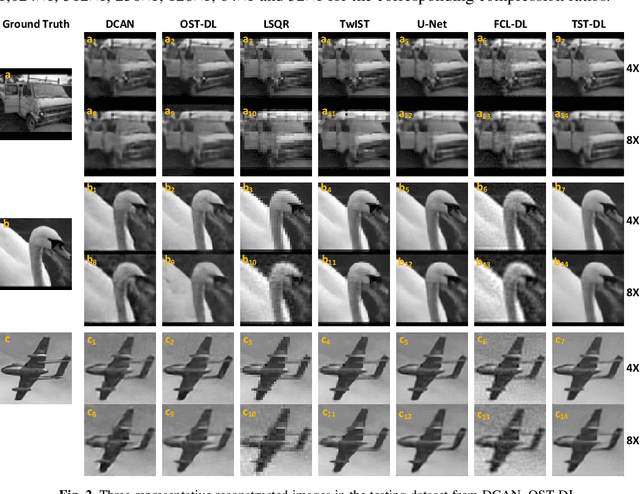
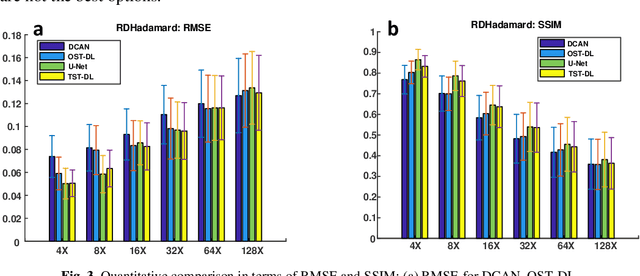
Deep learning (DL) is a powerful tool in computational imaging for many applications. A common strategy is to reconstruct a preliminary image as the input of a neural network to achieve an optimized image. Usually, the preliminary image is acquired with the prior knowledge of the model. One outstanding challenge, however, is that the model is sometimes difficult to acquire with high accuracy. In this work, a two-step-training DL (TST-DL) framework is proposed for real-time computational imaging without prior knowledge of the model. A single fully-connected layer (FCL) is trained to directly learn the model with the raw measurement data as input and the image as output. Then, this pre-trained FCL is fixed and connected with an un-trained deep convolutional network for a second-step training to improve the output image fidelity. This approach has three main advantages. First, no prior knowledge of the model is required since the first-step training is to directly learn the model. Second, real-time imaging can be achieved since the raw measurement data is directly used as the input to the model. Third, it can handle any dimension of the network input and solve the input-output dimension mismatch issues which arise in convolutional neural networks. We demonstrate this framework in the applications of single-pixel imaging and photoacoustic imaging for linear model cases. The results are quantitatively compared with those from other DL frameworks and model-based optimization approaches. Noise robustness and the required size of the training dataset are studied for this framework. We further extend this concept to nonlinear models in the application of image de-autocorrelation by using multiple FCLs in the first-step training. Overall, this TST-DL framework is widely applicable to many computational imaging techniques for real-time image reconstruction without the physics priors.