 Add to Chrome
 Add to Firefox
 Add to Edge
DiffSOS: Acoustic Conditional Diffusion Model for Speed-of-Sound Reconstruction in Ultrasound Computed Tomography
Feb 27, 2026
Accurate Speed-of-Sound (SoS) reconstruction from acoustic waveforms is a cornerstone of ultrasound computed tomography (USCT), enabling quantitative velocity mapping that reveals subtle anatomical details and pathological variations often invisible in conventional imaging. However, practical utility is hindered by the limitations of existing algorithms; traditional Full Waveform Inversion (FWI) is computationally intensive, while current deep learning approaches tend to produce oversmoothed results lacking fine details. We propose DiffSOS, a conditional diffusion model that directly maps acoustic waveforms to SoS maps. Our framework employs a specialized acoustic ControlNet to strictly ground the denoising process in physical wave measurements. To ensure structural consistency, we optimize a hybrid loss function that integrates noise prediction, spatial reconstruction, and noise frequency content. To accelerate inference, we employ stochastic Denoising Diffusion Implicit Model (DDIM) sampling, achieving near real-time reconstruction with only 10 steps. Crucially, we exploit the stochastic generative nature of our framework to estimate pixel-wise uncertainty, providing a measure of reliability that is often absent in deterministic approaches. Evaluated on the OpenPros USCT benchmark, DiffSOS significantly outperforms state-of-the-art networks, achieving an average Multi-scale Structural Similarity of 0.957. Our approach provides high-fidelity SoS maps with a principled measure of confidence, facilitating safer and faster clinical interpretation.

IRSDE-Despeckle: A Physics-Grounded Diffusion Model for Generalizable Ultrasound Despeckling
Feb 26, 2026Ultrasound imaging is widely used for real-time, noninvasive diagnosis, but speckle and related artifacts reduce image quality and can hinder interpretation. We present a diffusion-based ultrasound despeckling method built on the Image Restoration Stochastic Differential Equations framework. To enable supervised training, we curate large paired datasets by simulating ultrasound images from speckle-free magnetic resonance images using the Matlab UltraSound Toolbox. The proposed model reconstructs speckle-suppressed images while preserving anatomically meaningful edges and contrast. On a held-out simulated test set, our approach consistently outperforms classical filters and recent learning-based despeckling baselines. We quantify prediction uncertainty via cross-model variance and show that higher uncertainty correlates with higher reconstruction error, providing a practical indicator of difficult or failure-prone regions. Finally, we evaluate sensitivity to simulation probe settings and observe domain shift, motivating diversified training and adaptation for robust clinical deployment.
Deep Learning-Driven Quantitative Spectroscopic Photoacoustic Imaging for Segmentation and Oxygen Saturation Estimation
Dec 17, 2025Spectroscopic photoacoustic (sPA) imaging can potentially estimate blood oxygenation saturation (sO2) in vivo noninvasively. However, quantitatively accurate results require accurate optical fluence estimates. Robust modeling in heterogeneous tissue, where light with different wavelengths can experience significantly different absorption and scattering, is difficult. In this work, we developed a deep neural network (Hybrid-Net) for sPA imaging to simultaneously estimate sO2 in blood vessels and segment those vessels from surrounding background tissue. sO2 error was minimized only in blood vessels segmented in Hybrid-Net, resulting in more accurate predictions. Hybrid-Net was first trained on simulated sPA data (at 700 nm and 850 nm) representing initial pressure distributions from three-dimensional Monte Carlo simulations of light transport in breast tissue. Then, for experimental verification, the network was retrained on experimental sPA data (at 700 nm and 850 nm) acquired from simple tissue mimicking phantoms with an embedded blood pool. Quantitative measures were used to evaluate Hybrid-Net performance with an averaged segmentation accuracy of >= 0.978 in simulations with varying noise levels (0dB-35dB) and 0.998 in the experiment, and an averaged sO2 mean squared error of <= 0.048 in simulations with varying noise levels (0dB-35dB) and 0.003 in the experiment. Overall, these results show that Hybrid-Net can provide accurate blood oxygenation without estimating the optical fluence, and this study could lead to improvements in in-vivo sO2 estimation.
Joint Segmentation and Image Reconstruction with Error Prediction in Photoacoustic Imaging using Deep Learning
Jul 02, 2024Deep learning has been used to improve photoacoustic (PA) image reconstruction. One major challenge is that errors cannot be quantified to validate predictions when ground truth is unknown. Validation is key to quantitative applications, especially using limited-bandwidth ultrasonic linear detector arrays. Here, we propose a hybrid Bayesian convolutional neural network (Hybrid-BCNN) to jointly predict PA image and segmentation with error (uncertainty) predictions. Each output pixel represents a probability distribution where error can be quantified. The Hybrid-BCNN was trained with simulated PA data and applied to both simulations and experiments. Due to the sparsity of PA images, segmentation focuses Hybrid-BCNN on minimizing the loss function in regions with PA signals for better predictions. The results show that accurate PA segmentations and images are obtained, and error predictions are highly statistically correlated to actual errors. To leverage error predictions, confidence processing created PA images above a specific confidence level.
Deep-learning-driven Reliable Single-pixel Imaging with Uncertainty Approximation
Jul 24, 2021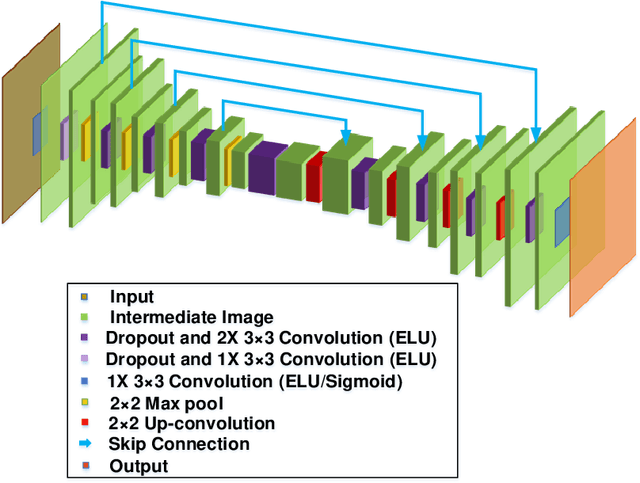
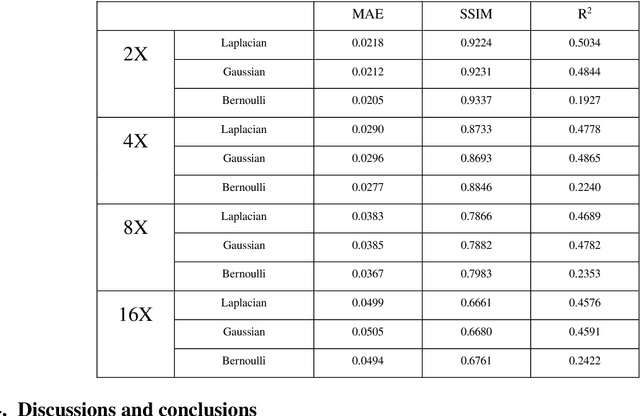
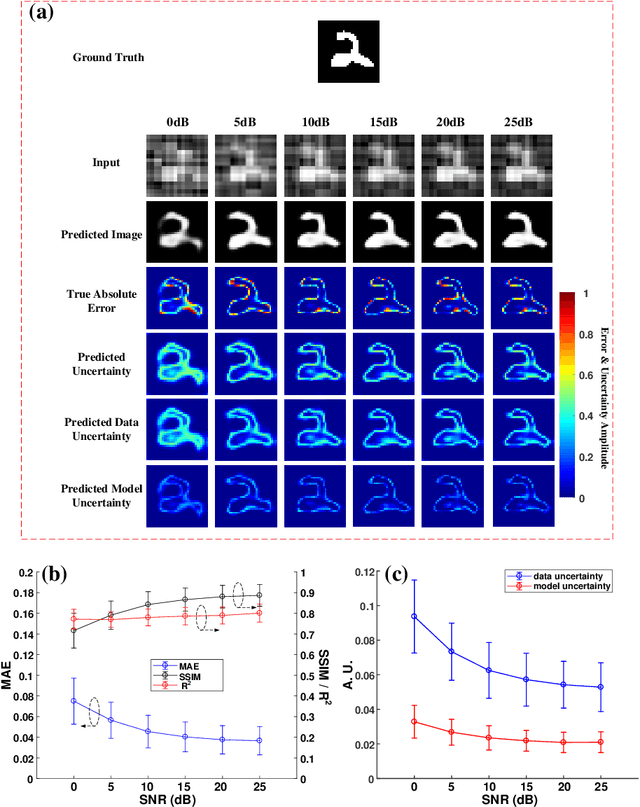
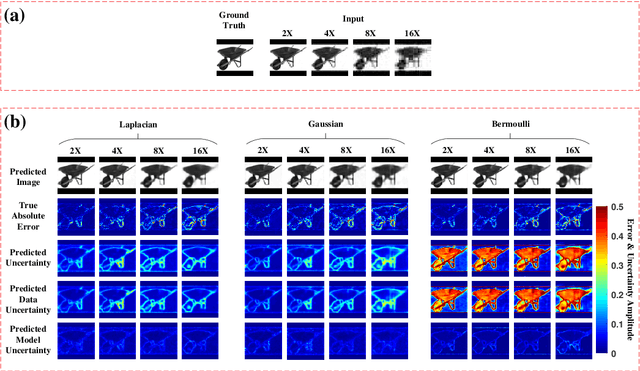
Single-pixel imaging (SPI) has the advantages of high-speed acquisition over a broad wavelength range and system compactness, which are difficult to achieve by conventional imaging sensors. However, a common challenge is low image quality arising from undersampling. Deep learning (DL) is an emerging and powerful tool in computational imaging for many applications and researchers have applied DL in SPI to achieve higher image quality than conventional reconstruction approaches. One outstanding challenge, however, is that the accuracy of DL predictions in SPI cannot be assessed in practical applications where the ground truths are unknown. Here, we propose the use of the Bayesian convolutional neural network (BCNN) to approximate the uncertainty (coming from finite training data and network model) of the DL predictions in SPI. Each pixel in the predicted result from BCNN represents the parameter of a probability distribution rather than the image intensity value. Then, the uncertainty can be approximated with BCNN by minimizing a negative log-likelihood loss function in the training stage and Monte Carlo dropout in the prediction stage. The results show that the BCNN can reliably approximate the uncertainty of the DL predictions in SPI with varying compression ratios and noise levels. The predicted uncertainty from BCNN in SPI reveals that most of the reconstruction errors in deep-learning-based SPI come from the edges of the image features. The results show that the proposed BCNN can provide a reliable tool to approximate the uncertainty of DL predictions in SPI and can be widely used in many applications of SPI.
A Two-step-training Deep Learning Framework for Real-time Computational Imaging without Physics Priors
Jan 10, 2020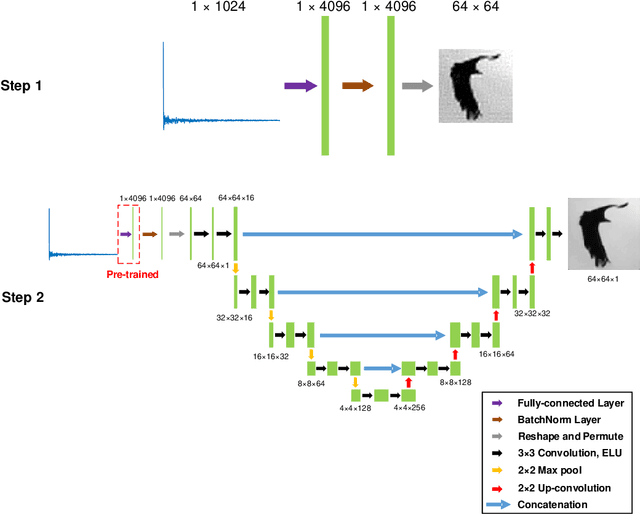
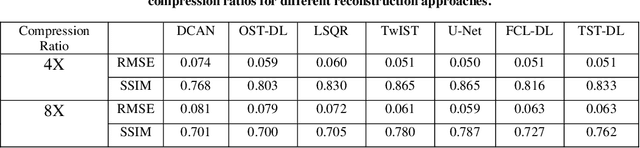
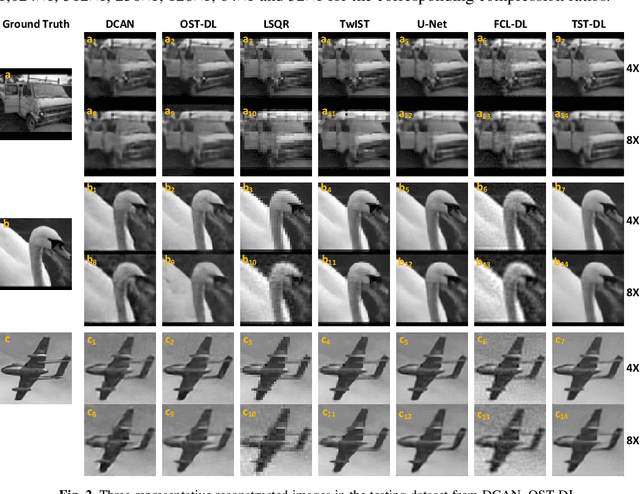
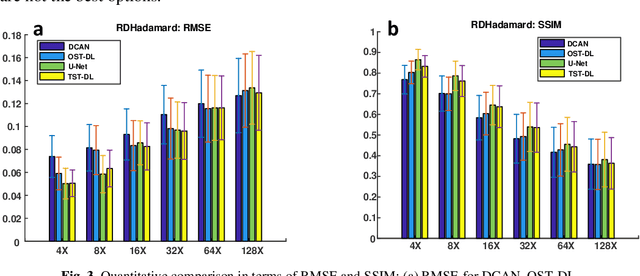
Deep learning (DL) is a powerful tool in computational imaging for many applications. A common strategy is to reconstruct a preliminary image as the input of a neural network to achieve an optimized image. Usually, the preliminary image is acquired with the prior knowledge of the model. One outstanding challenge, however, is that the model is sometimes difficult to acquire with high accuracy. In this work, a two-step-training DL (TST-DL) framework is proposed for real-time computational imaging without prior knowledge of the model. A single fully-connected layer (FCL) is trained to directly learn the model with the raw measurement data as input and the image as output. Then, this pre-trained FCL is fixed and connected with an un-trained deep convolutional network for a second-step training to improve the output image fidelity. This approach has three main advantages. First, no prior knowledge of the model is required since the first-step training is to directly learn the model. Second, real-time imaging can be achieved since the raw measurement data is directly used as the input to the model. Third, it can handle any dimension of the network input and solve the input-output dimension mismatch issues which arise in convolutional neural networks. We demonstrate this framework in the applications of single-pixel imaging and photoacoustic imaging for linear model cases. The results are quantitatively compared with those from other DL frameworks and model-based optimization approaches. Noise robustness and the required size of the training dataset are studied for this framework. We further extend this concept to nonlinear models in the application of image de-autocorrelation by using multiple FCLs in the first-step training. Overall, this TST-DL framework is widely applicable to many computational imaging techniques for real-time image reconstruction without the physics priors.