 Add to Chrome
 Add to Firefox
 Add to Edge
Control of Microrobots with Reinforcement Learning under On-Device Compute Constraints
Dec 31, 2025
An important function of autonomous microrobots is the ability to perform robust movement over terrain. This paper explores an edge ML approach to microrobot locomotion, allowing for on-device, lower latency control under compute, memory, and power constraints. This paper explores the locomotion of a sub-centimeter quadrupedal microrobot via reinforcement learning (RL) and deploys the resulting controller on an ultra-small system-on-chip (SoC), SC$μ$M-3C, featuring an ARM Cortex-M0 microcontroller running at 5 MHz. We train a compact FP32 multilayer perceptron (MLP) policy with two hidden layers ($[128, 64]$) in a massively parallel GPU simulation and enhance robustness by utilizing domain randomization over simulation parameters. We then study integer (Int8) quantization (per-tensor and per-feature) to allow for higher inference update rates on our resource-limited hardware, and we connect hardware power budgets to achievable update frequency via a cycles-per-update model for inference on our Cortex-M0. We propose a resource-aware gait scheduling viewpoint: given a device power budget, we can select the gait mode (trot/intermediate/gallop) that maximizes expected RL reward at a corresponding feasible update frequency. Finally, we deploy our MLP policy on a real-world large-scale robot on uneven terrain, qualitatively noting that domain-randomized training can improve out-of-distribution stability. We do not claim real-world large-robot empirical zero-shot transfer in this work.

Can Custom Models Learn In-Context? An Exploration of Hybrid Architecture Performance on In-Context Learning Tasks
Nov 06, 2024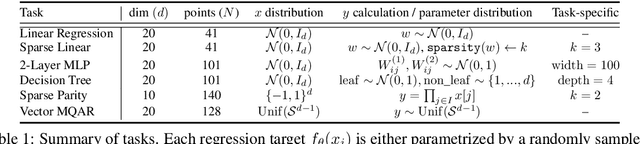
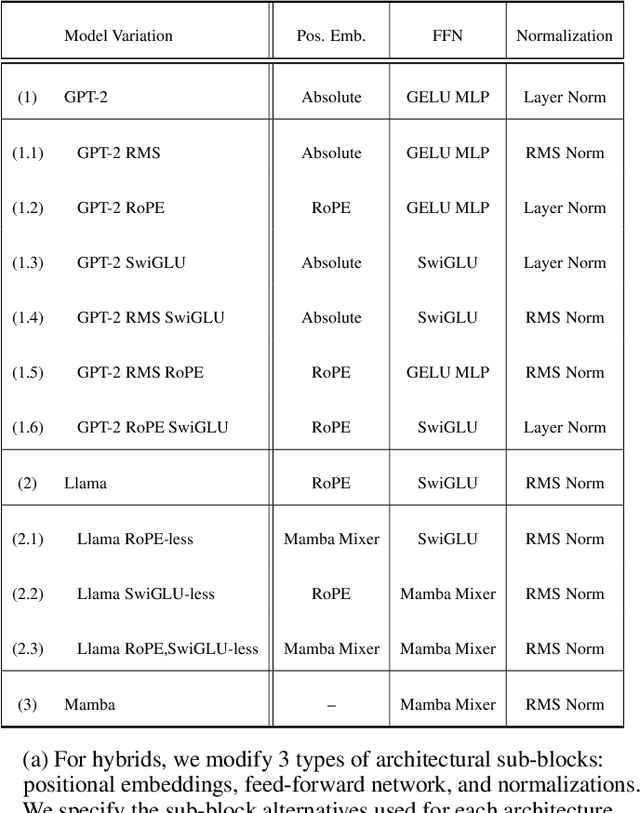
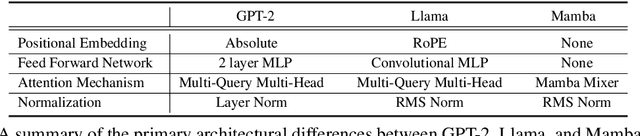
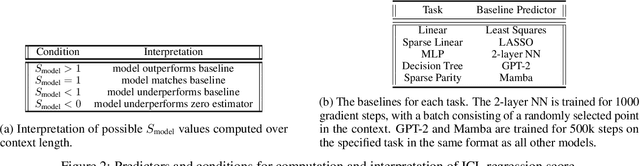
In-Context Learning (ICL) is a phenomenon where task learning occurs through a prompt sequence without the necessity of parameter updates. ICL in Multi-Headed Attention (MHA) with absolute positional embedding has been the focus of more study than other sequence model varieties. We examine implications of architectural differences between GPT-2 and LLaMa as well as LlaMa and Mamba. We extend work done by Garg et al. (2022) and Park et al. (2024) to GPT-2/LLaMa hybrid and LLaMa/Mamba hybrid models - examining the interplay between sequence transformation blocks and regressive performance in-context. We note that certain architectural changes cause degraded training efficiency/ICL accuracy by converging to suboptimal predictors or converging slower. We also find certain hybrids showing optimistic performance improvements, informing potential future ICL-focused architecture modifications. Additionally, we propose the "ICL regression score", a scalar metric describing a model's whole performance on a specific task. Compute limitations impose restrictions on our architecture-space, training duration, number of training runs, function class complexity, and benchmark complexity. To foster reproducible and extensible research, we provide a typed, modular, and extensible Python package on which we run all experiments.