 Add to Chrome
 Add to Firefox
 Add to Edge
ROIX-Comp: Optimizing X-ray Computed Tomography Imaging Strategy for Data Reduction and Reconstruction
Feb 17, 2026
In high-performance computing (HPC) environments, particularly in synchrotron radiation facilities, vast amounts of X-ray images are generated. Processing large-scale X-ray Computed Tomography (X-CT) datasets presents significant computational and storage challenges due to their high dimensionality and data volume. Traditional approaches often require extensive storage capacity and high transmission bandwidth, limiting real-time processing capabilities and workflow efficiency. To address these constraints, we introduce a region-of-interest (ROI)-driven extraction framework (ROIX-Comp) that intelligently compresses X-CT data by identifying and retaining only essential features. Our work reduces data volume while preserving critical information for downstream processing tasks. At pre-processing stage, we utilize error-bounded quantization to reduce the amount of data to be processed and therefore improve computational efficiencies. At the compression stage, our methodology combines object extraction with multiple state-of-the-art lossless and lossy compressors, resulting in significantly improved compression ratios. We evaluated this framework against seven X-CT datasets and observed a relative compression ratio improvement of 12.34x compared to the standard compression.

MLPerf HPC: A Holistic Benchmark Suite for Scientific Machine Learning on HPC Systems
Oct 26, 2021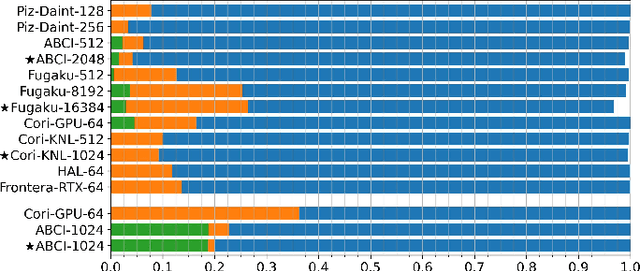
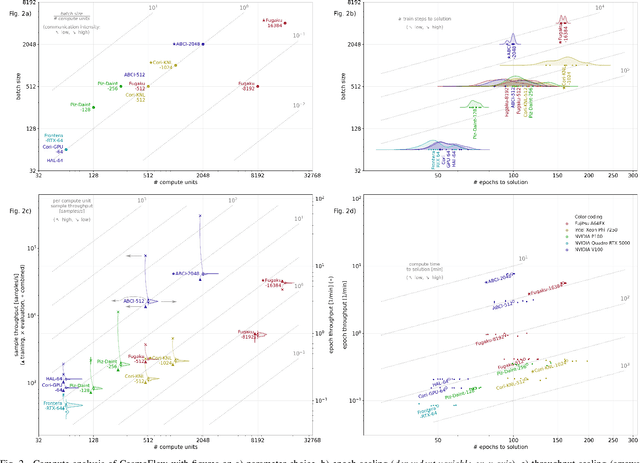
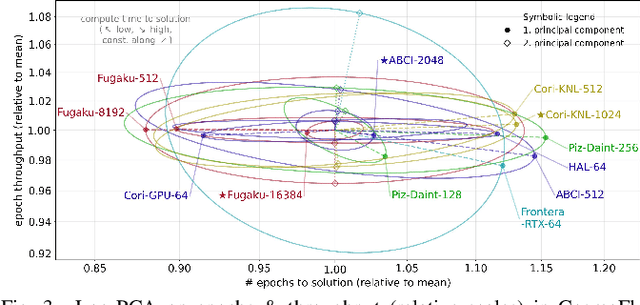
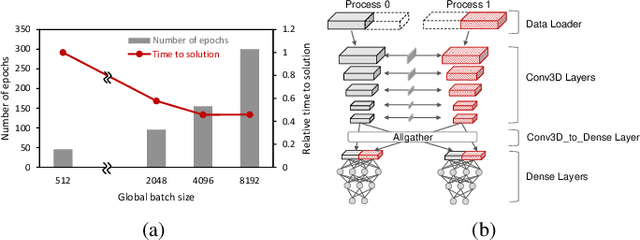
Scientific communities are increasingly adopting machine learning and deep learning models in their applications to accelerate scientific insights. High performance computing systems are pushing the frontiers of performance with a rich diversity of hardware resources and massive scale-out capabilities. There is a critical need to understand fair and effective benchmarking of machine learning applications that are representative of real-world scientific use cases. MLPerf is a community-driven standard to benchmark machine learning workloads, focusing on end-to-end performance metrics. In this paper, we introduce MLPerf HPC, a benchmark suite of large-scale scientific machine learning training applications driven by the MLCommons Association. We present the results from the first submission round, including a diverse set of some of the world's largest HPC systems. We develop a systematic framework for their joint analysis and compare them in terms of data staging, algorithmic convergence, and compute performance. As a result, we gain a quantitative understanding of optimizations on different subsystems such as staging and on-node loading of data, compute-unit utilization, and communication scheduling, enabling overall $>10 \times$ (end-to-end) performance improvements through system scaling. Notably, our analysis shows a scale-dependent interplay between the dataset size, a system's memory hierarchy, and training convergence that underlines the importance of near-compute storage. To overcome the data-parallel scalability challenge at large batch sizes, we discuss specific learning techniques and hybrid data-and-model parallelism that are effective on large systems. We conclude by characterizing each benchmark with respect to low-level memory, I/O, and network behavior to parameterize extended roofline performance models in future rounds.