 Add to Chrome
 Add to Firefox
 Add to Edge
Tiny-YOLOSAM: Fast Hybrid Image Segmentation
Dec 20, 2025
The Segment Anything Model (SAM) enables promptable, high-quality segmentation but is often too computationally expensive for latency-critical settings. TinySAM is a lightweight, distilled SAM variant that preserves strong zero-shot mask quality, yet its "segment-everything" mode still requires hundreds of prompts and remains slow in practice. We first replicate TinySAM on COCO val2017 using official checkpoints, matching the reported AP within 0.03%, establishing a reliable experimental baseline. Building on this, we propose Tiny-YOLOSAM, a fast hybrid pipeline that uses a recent YOLO detector (YOLOv12) to generate box prompts for TinySAM on salient foreground objects, and supplements uncovered regions with sparse point prompts sampled only where YOLO-guided masks provide no coverage. On COCO val2017, the hybrid system substantially improves class-agnostic coverage (AR from 16.4% to 77.1%, mIoU from 19.2% to 67.8%) while reducing end-to-end runtime from 49.20s/image to 10.39s/image (4.7x) on an Apple M1 Pro CPU. These results suggest detector-guided prompting combined with targeted sparse sampling as an effective alternative to dense "segment-everything" prompting for practical full-scene segmentation.

Splat Feature Solver
Aug 17, 2025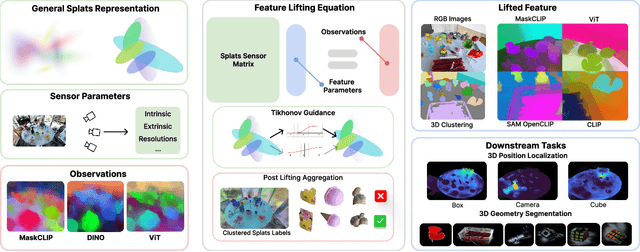
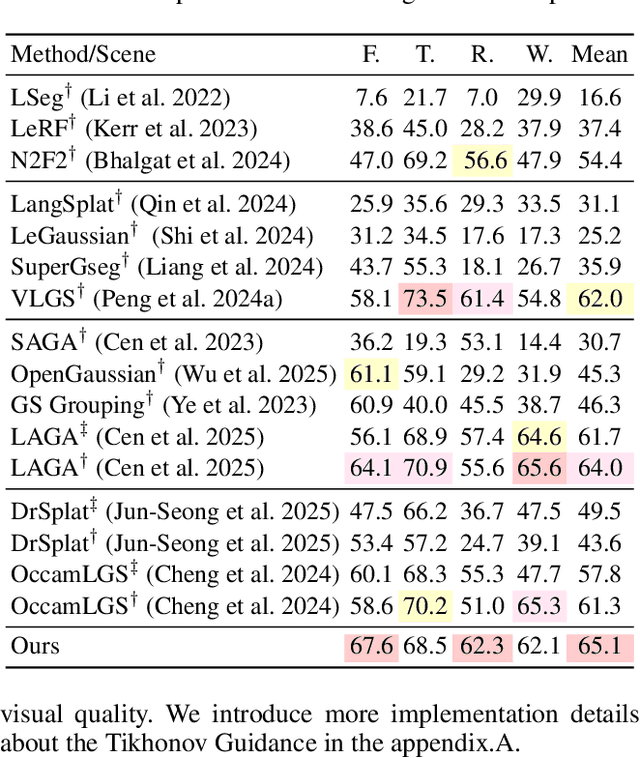
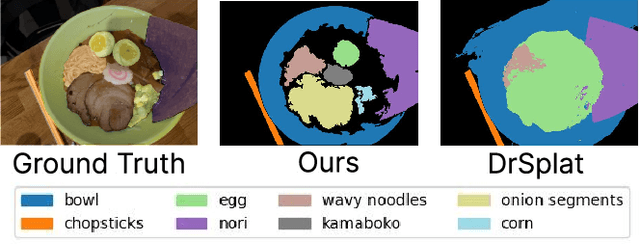
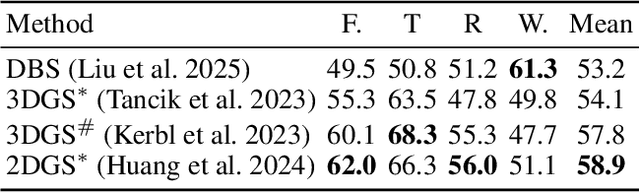
Feature lifting has emerged as a crucial component in 3D scene understanding, enabling the attachment of rich image feature descriptors (e.g., DINO, CLIP) onto splat-based 3D representations. The core challenge lies in optimally assigning rich general attributes to 3D primitives while addressing the inconsistency issues from multi-view images. We present a unified, kernel- and feature-agnostic formulation of the feature lifting problem as a sparse linear inverse problem, which can be solved efficiently in closed form. Our approach admits a provable upper bound on the global optimal error under convex losses for delivering high quality lifted features. To address inconsistencies and noise in multi-view observations, we introduce two complementary regularization strategies to stabilize the solution and enhance semantic fidelity. Tikhonov Guidance enforces numerical stability through soft diagonal dominance, while Post-Lifting Aggregation filters noisy inputs via feature clustering. Extensive experiments demonstrate that our approach achieves state-of-the-art performance on open-vocabulary 3D segmentation benchmarks, outperforming training-based, grouping-based, and heuristic-forward baselines while producing the lifted features in minutes. Code is available at \href{https://github.com/saliteta/splat-distiller.git}{\textbf{github}}. We also have a \href{https://splat-distiller.pages.dev/}