 Add to Chrome
 Add to Firefox
 Add to Edge
Same Branches, Different Trees: A Bifurcation Connectedness Metric for Coronary Artery Segmentation and FFR-CT Decision Agreement
Jul 30, 2026
Fractional flow reserve derived from CT angiography (FFR-CT) simulates flow through a patient-specific vessel model, so its accuracy depends on the connectedness of the segmented tree, not only on volumetric overlap: a segmentation can reach high Dice yet sever a bifurcation, dropping the downstream subtree and reversing the treatment decision. Topology-aware losses such as clDice and Skeleton Recall act on the global centreline and can miss localised breaks. We study the Bifurcation Connectedness Score (BCS), which scores connectedness at each ground-truth bifurcation, and soft-BCS, its differentiable training surrogate. BCS captures a property of segmentation quality the standard metrics miss: it responds strongly to breaks in connectedness while staying largely unchanged under connectedness-preserving narrowing. Higher BCS accompanies closer agreement between the FFR-CT decisions a solver makes on predicted versus ground-truth geometry, most clearly in severe disease (OR 2.16, CI [1.23, 4.18]). Both decisions come from the same solver, so this reflects geometric, not clinical, fidelity. In training, soft-BCS and Skeleton Recall recover the same branches but build different trees. Recovering branches and keeping them connected are separable properties, so we recommend reporting a measure of each.

Curb Your Normality: On the Quality Requirements of Demand Prediction for Dynamic Public Transport
Sep 01, 2020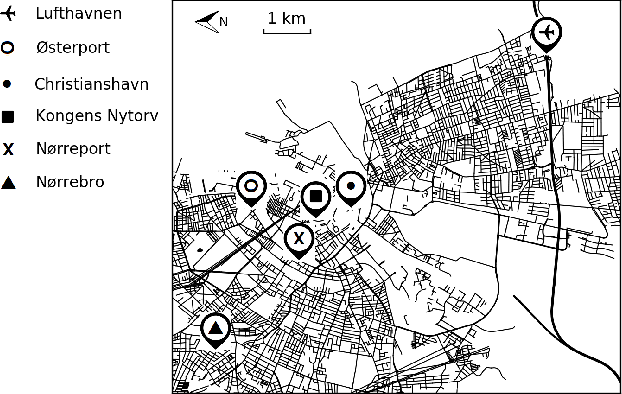
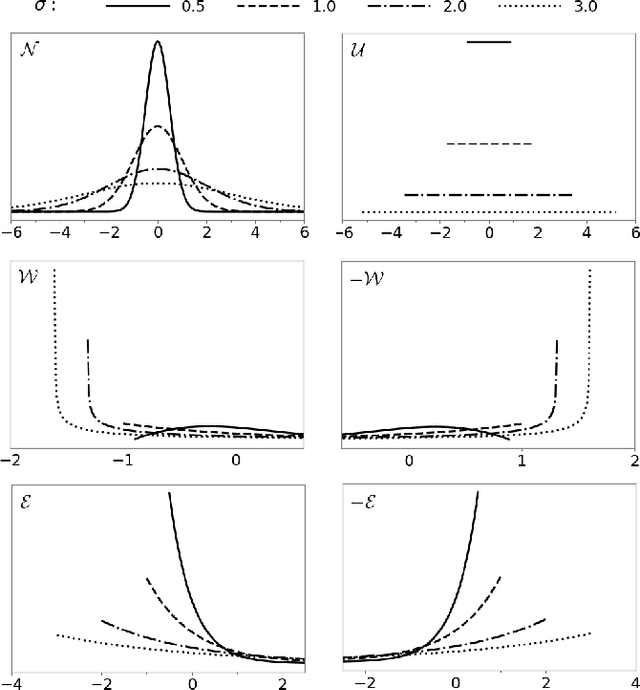
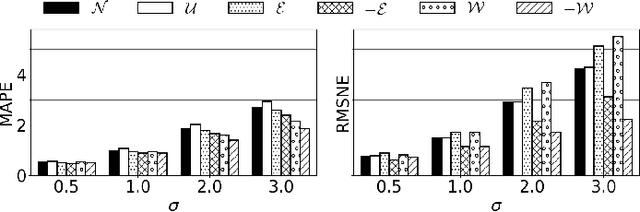
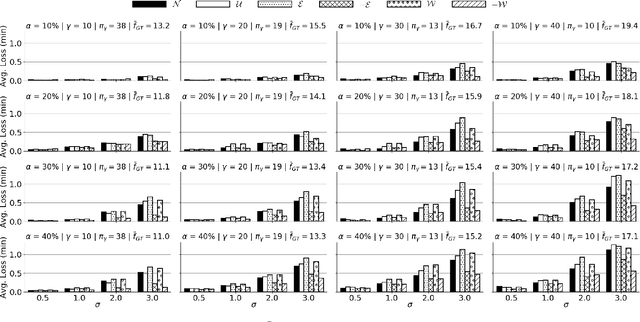
As Public Transport (PT) becomes more dynamic and demand-responsive, it increasingly depends on predictions of transport demand. But how accurate need such predictions be for effective PT operation? We address this question through an experimental case study of PT trips in Metropolitan Copenhagen, Denmark, which we conduct independently of any specific prediction models. First, we simulate errors in demand prediction through unbiased noise distributions that vary considerably in shape. Using the noisy predictions, we then simulate and optimize demand-responsive PT fleets via a commonly used linear programming formulation and measure their performance. Our results suggest that the optimized performance is mainly affected by the skew of the noise distribution and the presence of infrequently large prediction errors. In particular, the optimized performance can improve under non-Gaussian vs. Gaussian noise. We also obtain that dynamic routing can reduce trip time by at least 23% vs. static routing. This reduction is estimated at 809,000 EUR per year in terms of Value of Travel Time Savings for the case study.
Online Framework for Demand-Responsive Stochastic Route Optimization
Feb 26, 2019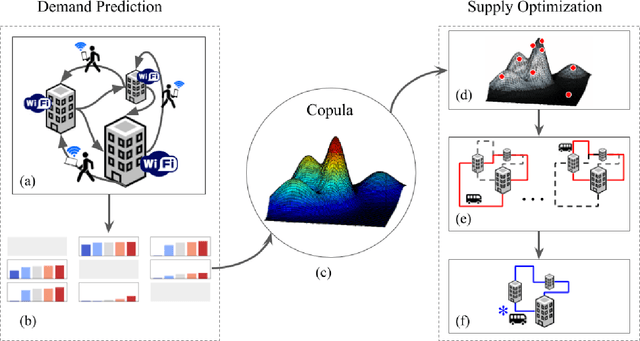

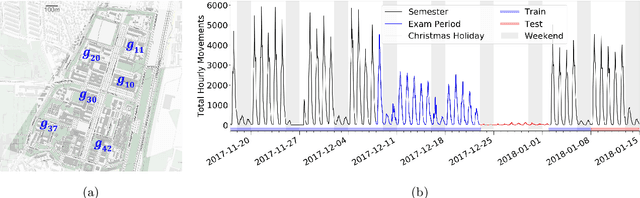

This study develops an online predictive optimization framework for operating a fleet of autonomous vehicles to enhance mobility in an area, where there exists a latent spatio-temporal distribution of demand for commuting between locations. The proposed framework integrates demand prediction and supply optimization in the network design problem. For demand prediction, our framework estimates a marginal demand distribution for each Origin-Destination pair of locations through Quantile Regression, using counts of crowd movements as a proxy for demand. The framework then combines these marginals into a joint demand distribution by constructing a Gaussian copula, which captures the structure of correlation between different Origin-Destination pairs. For supply optimization, we devise a demand-responsive service, based on linear programming, in which route structure and frequency vary according to the predicted demand. We evaluate our framework using a dataset of movement counts, aggregated from WiFi records of a university campus in Denmark, and the results show that our framework outperforms conventional methods for route optimization, which do not utilize the full predictive distribution.