 Add to Chrome
 Add to Firefox
 Add to Edge
Color Matters: Trigger Color Affects Success in Federated Backdoor Attacks
Jun 24, 2026
Federated learning is vulnerable to backdoor attacks in which malicious clients inject poisoned updates while preserving benign-task performance. In this paper, we study a semantics-driven backdoor mechanism in which attackers use natural visual accessories as triggers and manipulate only the trigger color while keeping the attack pipeline fixed. Our framework considers semantic trigger objects such as masks and sunglasses, instantiated in black and white variants, and evaluates their effect in a controlled federated learning setting. Malicious clients construct poisoned samples by applying a trigger to source-class images and relabeling them to an attacker-chosen target class, while benign clients train only on clean data. We analyze this mechanism under both a standard poisoning objective and a stronger SABLE-based objective that combines clean classification loss, triggered target loss, feature-separation loss in the penultimate representation space, and regularization to keep malicious updates close to the global model. This design enables the attack to remain effective while reducing excessive update drift. Experiments on a four-class CelebA hair-color task show that trigger color significantly changes attack success rate even when trigger semantics, placement, and poisoning budget are unchanged. White triggers are more effective for attacks targeting the blond class, whereas black triggers perform better for attacks targeting the black class. The same trend persists under robust aggregation, showing that trigger color is a meaningful factor in the operation, persistence, and evaluation of semantic backdoor mechanisms in federated learning.

Beyond Corner Patches: Semantics-Aware Backdoor Attack in Federated Learning
Mar 31, 2026Backdoor attacks on federated learning (FL) are most often evaluated with synthetic corner patches or out-of-distribution (OOD) patterns that are unlikely to arise in practice. In this paper, we revisit the backdoor threat to standard FL (a single global model) under a more realistic setting where triggers must be semantically meaningful, in-distribution, and visually plausible. We propose SABLE, a Semantics-Aware Backdoor for LEarning in federated settings, which constructs natural, content-consistent triggers (e.g., semantic attribute changes such as sunglasses) and optimizes an aggregation-aware malicious objective with feature separation and parameter regularization to keep attacker updates close to benign ones. We instantiate SABLE on CelebA hair-color classification and the German Traffic Sign Recognition Benchmark (GTSRB), poisoning only a small, interpretable subset of each malicious client's local data while otherwise following the standard FL protocol. Across heterogeneous client partitions and multiple aggregation rules (FedAvg, Trimmed Mean, MultiKrum, and FLAME), our semantics-driven triggers achieve high targeted attack success rates while preserving benign test accuracy. These results show that semantics-aligned backdoors remain a potent and practical threat in federated learning, and that robustness claims based solely on synthetic patch triggers can be overly optimistic.
Hubs and Spokes Learning: Efficient and Scalable Collaborative Machine Learning
Apr 29, 2025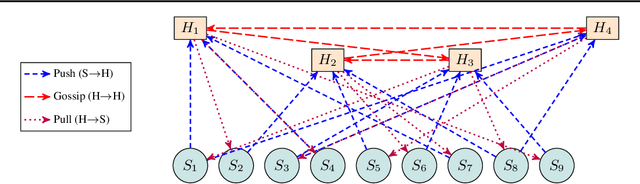
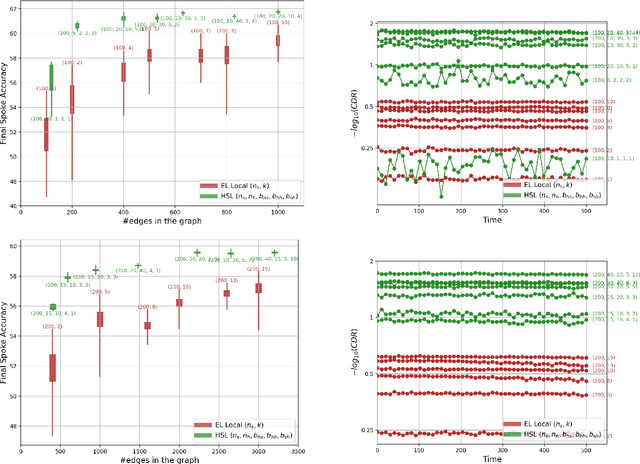
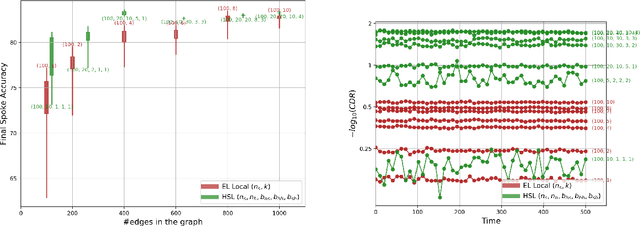
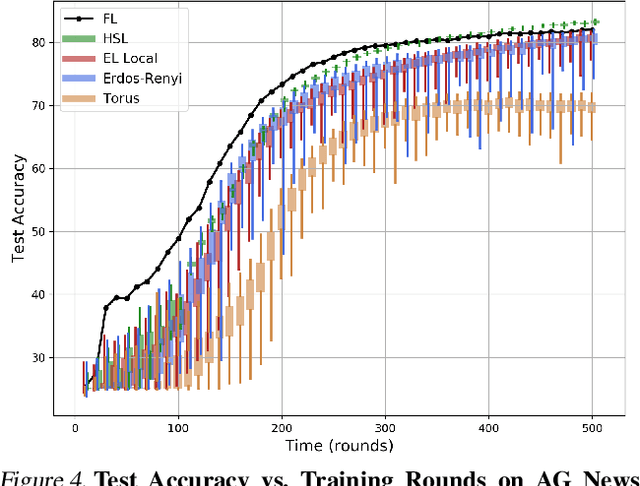
We introduce the Hubs and Spokes Learning (HSL) framework, a novel paradigm for collaborative machine learning that combines the strengths of Federated Learning (FL) and Decentralized Learning (P2PL). HSL employs a two-tier communication structure that avoids the single point of failure inherent in FL and outperforms the state-of-the-art P2PL framework, Epidemic Learning Local (ELL). At equal communication budgets (total edges), HSL achieves higher performance than ELL, while at significantly lower communication budgets, it can match ELL's performance. For instance, with only 400 edges, HSL reaches the same test accuracy that ELL achieves with 1000 edges for 100 peers (spokes) on CIFAR-10, demonstrating its suitability for resource-constrained systems. HSL also achieves stronger consensus among nodes after mixing, resulting in improved performance with fewer training rounds. We substantiate these claims through rigorous theoretical analyses and extensive experimental results, showcasing HSL's practicality for large-scale collaborative learning.