 Add to Chrome
 Add to Firefox
 Add to Edge
FALSIFYBENCH: Evaluating Inductive Reasoning in LLMs with Rule Discovery Games
Jun 03, 2026
Large language models (LLMs) are increasingly deployed as autonomous agents in scientific tasks. Yet whether these systems can effectively engage in forms of inductive reasoning relevant to scientific discovery remains an open question. In this work, we introduce FALSIFYBENCH, an evaluation framework for hypothesis-driven reasoning inspired by the classic Wason 2-4-6 task, in which agents must discover hidden semantic properties by iteratively proposing examples and receiving feedback. This task captures key elements of scientific reasoning: hypothesis generation, evidence gathering, and belief revision in response to both confirming and disconfirming evidence. Our evaluation of 12 LLMs across model families and scales shows that reasoning models are generally stronger scientific reasoners than instruction-tuned models, although no model comes close to optimal performance. The primary driver of success is the capacity for negative testing: models that actively seek to falsify their hypotheses consistently outperform those that primarily seek confirmation. Moreover, a fine-grained turn-level analysis, neglected in previous work, reveals that failure is tied to identifiable patterns in how models navigate the hypothesis space.

Exploiting Preference Elicitation in Interactive and User-centered Algorithmic Recourse: An Initial Exploration
Apr 08, 2024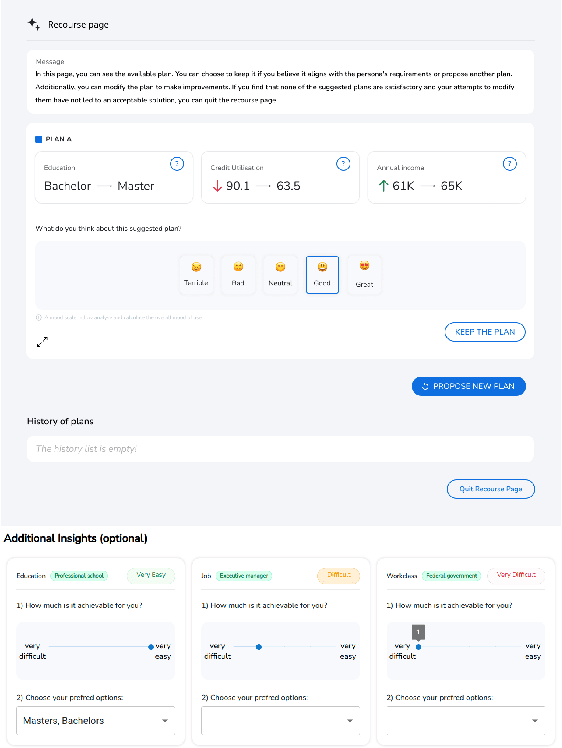
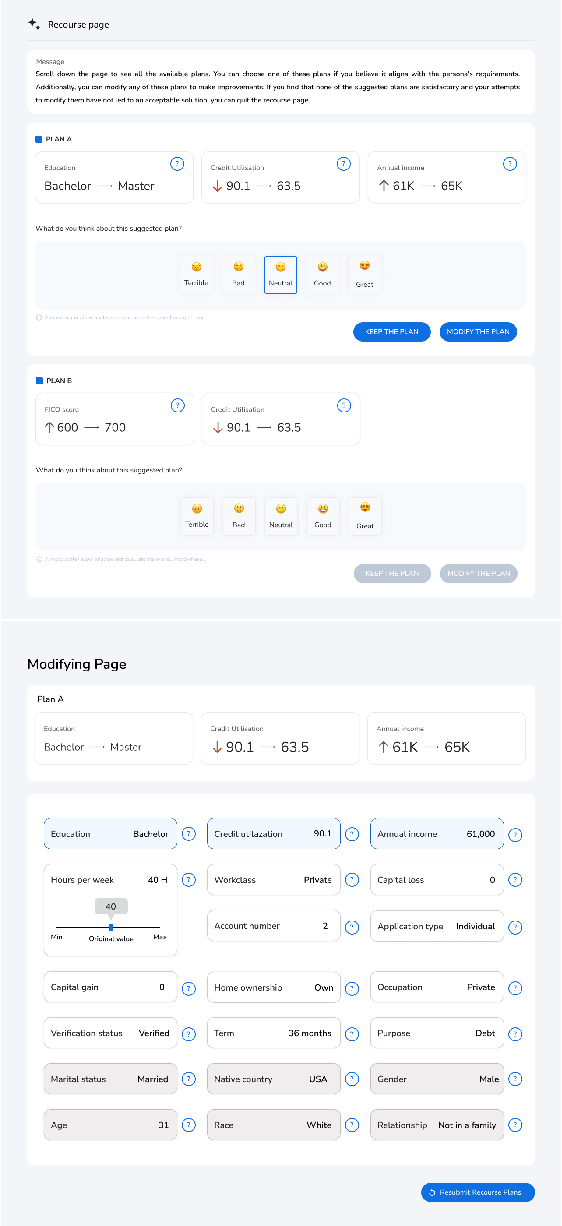
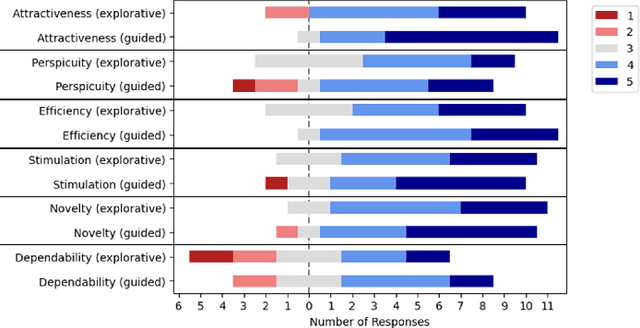
Algorithmic Recourse aims to provide actionable explanations, or recourse plans, to overturn potentially unfavourable decisions taken by automated machine learning models. In this paper, we propose an interaction paradigm based on a guided interaction pattern aimed at both eliciting the users' preferences and heading them toward effective recourse interventions. In a fictional task of money lending, we compare this approach with an exploratory interaction pattern based on a combination of alternative plans and the possibility of freely changing the configurations by the users themselves. Our results suggest that users may recognize that the guided interaction paradigm improves efficiency. However, they also feel less freedom to experiment with "what-if" scenarios. Nevertheless, the time spent on the purely exploratory interface tends to be perceived as a lack of efficiency, which reduces attractiveness, perspicuity, and dependability. Conversely, for the guided interface, more time on the interface seems to increase its attractiveness, perspicuity, and dependability while not impacting the perceived efficiency. That might suggest that this type of interfaces should combine these two approaches by trying to support exploratory behavior while gently pushing toward a guided effective solution.