 Add to Chrome
 Add to Firefox
 Add to Edge
Fabric Pneumatic Artificial Muscle-Based Head-Neck Exosuit: Design, Modeling, and Evaluation
Mar 13, 2026
Wearable exosuits assist human movement in tasks ranging from rehabilitation to daily activities; specifically, head-neck support is necessary for patients with certain neurological disorders. Rigid-link exoskeletons have shown to enable head-neck mobility compared to static braces, but their bulkiness and restrictive structure inspire designs using "soft" actuation methods. In this paper, we propose a fabric pneumatic artificial muscle-based exosuit design for head-neck support. We describe the design of our prototype and physics-based model, enabling us to derive actuator pressures required to compensate for gravitational load. Our modeled range of motion and workspace analysis indicate that the limited actuator lengths impose slight limitations (83% workspace coverage), and gravity compensation imposes a more significant limitation (43% workspace coverage). We introduce compression force along the neck as a novel, potentially comfort-related metric. We further apply our model to compare the torque output of various actuator placement configurations, allowing us to select a design with stability in lateral deviation and high axial rotation torques. The model correctly predicts trends in measured data where wrapping the actuators around the neck is not a significant factor. Our test dummy and human user demonstration confirm that the exosuit can provide functional head support and trajectory tracking, underscoring the potential of artificial muscle-based soft actuation for head-neck mobility assistance.
* Manuscript (8 pages, 5 tables, 7 figures) accepted to IEEE International Conference on Robotics and Automation 2026. Video attachment: https://youtu.be/iGuEbvCXgJ0?si=WqP2q-P_Mp1Brmfc

Tendon-based modelling, estimation and control for a simulated high-DoF anthropomorphic hand model
Jan 28, 2026Tendon-driven anthropomorphic robotic hands often lack direct joint angle sensing, as the integration of joint encoders can compromise mechanical compactness and dexterity. This paper presents a computational method for estimating joint positions from measured tendon displacements and tensions. An efficient kinematic modeling framework for anthropomorphic hands is first introduced based on the Denavit-Hartenberg convention. Using a simplified tendon model, a system of nonlinear equations relating tendon states to joint positions is derived and solved via a nonlinear optimization approach. The estimated joint angles are then employed for closed-loop control through a Jacobian-based proportional-integral (PI) controller augmented with a feedforward term, enabling gesture tracking without direct joint sensing. The effectiveness and limitations of the proposed estimation and control framework are demonstrated in the MuJoCo simulation environment using the Anatomically Correct Biomechatronic Hand, featuring five degrees of freedom for each long finger and six degrees of freedom for the thumb.
Soft Everting Prosthetic Hand and Comparison with Existing Body-Powered Terminal Devices
Mar 03, 2025In this paper, we explore the use of a soft gripper, specifically a soft inverting-everting toroidal hydrostat, as a prosthetic hand. We present a design of the gripper integrated into a body-powered elbow-driven system and evaluate its performance compared to similar body-powered terminal devices: the Kwawu 3D-printed hand and the Hosmer hook. Our experiments highlight advantages of the Everting hand, such as low required cable tension for operation (1.6 N for Everting, 30.0 N for Kwawu, 28.1 N for Hosmer), limited restriction on the elbow angle range, and secure grasping capability (peak pulling force required to remove an object: 15.8 N for Everting, 6.9 N for Kwawu, 4.0 N for Hosmer). In our pilot user study, six able-bodied participants performed standardized hand dexterity tests. With the Everting hand compared to the Kwawu hand, users transferred more blocks in one minute and completed three tasks (moving small common objects, simulated feeding with a spoon, and moving large empty cans) faster (p~$\leq$~0.05). With the Everting hand compared to the Hosmer hook, users moved large empty cans faster (p~$\leq$~0.05) and achieved similar performance on all other tasks. Overall, user preference leaned toward the Everting hand for its adaptable grip and ease of use, although its abilities could be improved in tasks requiring high precision such as writing with a pen, and in handling heavier objects such as large heavy cans.
Soft Wrist Exosuit Actuated by Fabric Pneumatic Artificial Muscles
Oct 27, 2023Recently, soft actuator-based exosuits have gained interest, due to their high strength-to-weight ratio, inherent safety, and low cost. We present a novel wrist exosuit actuated by fabric pneumatic artificial muscles that can move the wrist in flexion/extension and ulnar/radial deviation. We derive a model representing the torque exerted by the exosuit and introduce a model-based optimization methodology for the selection of placement parameters of the exosuit muscles. We evaluate the accuracy of the model by measuring the exosuit torques throughout the full range of wrist flexion/extension. When accounting for the displacement of the mounting points, the model predicts the exosuit torque with a mean absolute error of 0.279 Nm, which is 26.1% of the average measured torque. To explore the capabilities of the exosuit to move the human body, we measure its range of motion on a passive human wrist; the exosuit is able to achieve 55.0% of the active biological range in flexion, 69.1% in extension, 68.6% in ulnar deviation, and 68.4% in radial deviation. Finally, we demonstrate the device controlling the passive human wrist to move to a desired orientation in the flexion/extension plane and along a two-degree-of-freedom trajectory.
Hybrid Soft-Rigid Continuum Robot Inspired by Spider Monkey Tail
Jun 20, 2023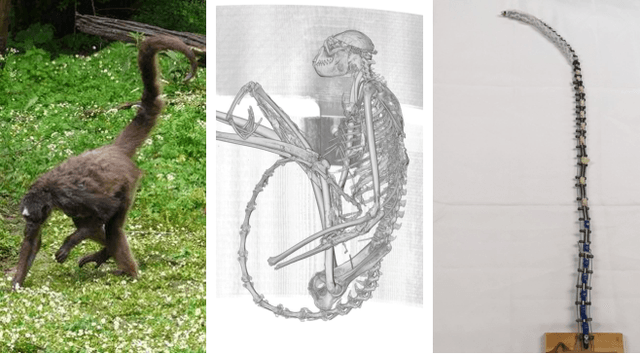
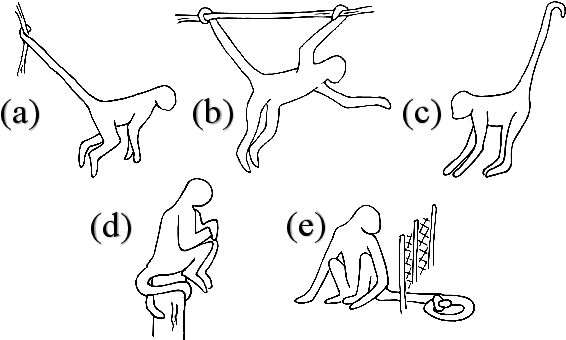

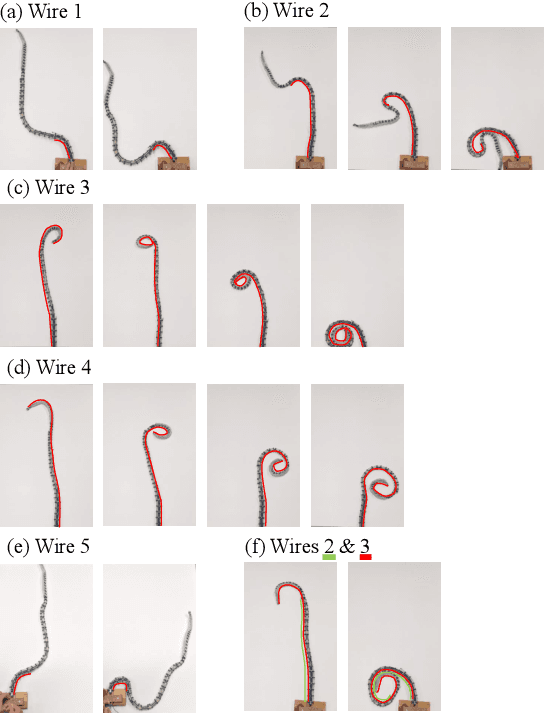
Spider monkeys (genus Ateles) have a prehensile tail that functions as a flexible, multipurpose fifth limb, enabling them to navigate complex terrains, grasp objects of various sizes, and swing between supports. Inspired by the spider monkey tail, we present a life size hybrid soft-rigid continuum robot designed to imitate the function of the tail. Our planar design has a rigid skeleton with soft elements at its joints that achieve decreasing stiffness along its length. Five manually-operated wires along this central structure control the motion of the tail to form a variety of possible shapes in the 2D plane. Our design also includes a skin-like silicone and fabric tail pad that moves with the tail's tip and assists with object grasping. We quantify the force required to pull various objects out of the robot's grasp and demonstrate that this force increases with the object diameter and the number of edges in a polygonal object. We demonstrate the robot's ability to grasp, move, and release objects of various diameters, as well as to navigate around obstacles, and to retrieve an object after passing under a low passageway.