 Add to Chrome
 Add to Firefox
 Add to Edge
First Estimation of Model Parameters for Neutrino-Induced Nucleon Knockout Using Simulation-Based Inference
Mar 10, 2026
To enable an accurate determination of oscillation parameters, accelerator-based neutrino experiments require detailed simulations of nuclear interaction physics in the GeV regime. While substantial effort from both theory and experiment is currently being invested to improve the fidelity of these simulations, their present deficiencies typically oblige experimental collaborations to resort to empirical tuning of simulation model parameters. As the precision requirements of the field continue to become more stringent, machine learning techniques may provide a powerful means of handling corresponding growth in the complexity of future neutrino interaction model tuning exercises. To study the suitability of simulation-based inference (SBI) for this physics application, in this paper we revisit a tuned configuration of the GENIE neutrino event generator that was originally developed by the MicroBooNE collaboration. Despite closely reproducing the adopted values of four physics parameters when confronted with the tuned cross-section predictions as input, we find that our trained SBI algorithm prefers modestly different values (within MicroBooNE's assigned uncertainties) and achieves slightly better goodness-of-fit when inference is run on the experimental data set originally used by MicroBooNE. We also find that our trained algorithm can create a fair approximation of an alternative neutrino scattering simulation, NuWro, that shares only a subset of its physics model parameters with GENIE.

Improving Neutrino Oscillation Measurements through Event Classification
Nov 14, 2025Precise neutrino energy reconstruction is essential for next-generation long-baseline oscillation experiments, yet current methods remain limited by large uncertainties in neutrino-nucleus interaction modeling. Even so, it is well established that different interaction channels produce systematically varying amounts of missing energy and therefore yield different reconstruction performance--information that standard calorimetric approaches do not exploit. We introduce a strategy that incorporates this structure by classifying events according to their underlying interaction type prior to energy reconstruction. Using supervised machine-learning techniques trained on labeled generator events, we leverage intrinsic kinematic differences among quasi-elastic scattering, meson-exchange current, resonance production, and deep-inelastic scattering processes. A cross-generator testing framework demonstrates that this classification approach is robust to microphysics mismodeling and, when applied to a simulated DUNE $ν_μ$ disappearance analysis, yields improved accuracy and sensitivity. These results highlight a practical path toward reducing reconstruction-driven systematics in future oscillation measurements.
wa-hls4ml: A Benchmark and Surrogate Models for hls4ml Resource and Latency Estimation
Nov 06, 2025
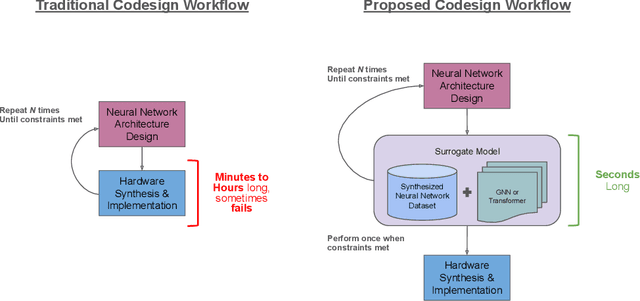
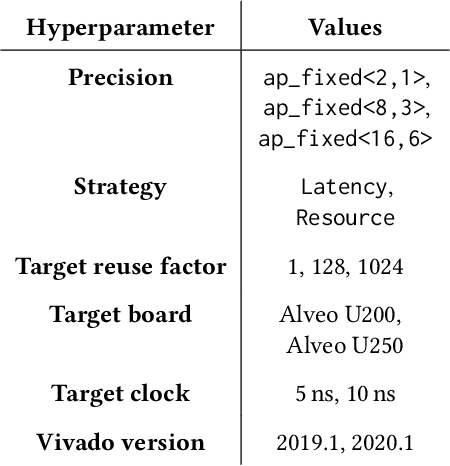
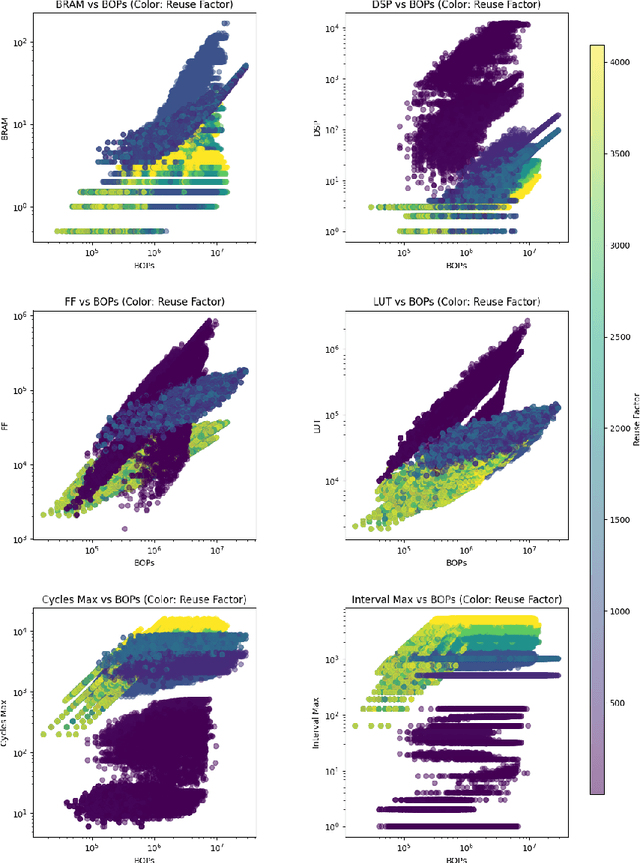
As machine learning (ML) is increasingly implemented in hardware to address real-time challenges in scientific applications, the development of advanced toolchains has significantly reduced the time required to iterate on various designs. These advancements have solved major obstacles, but also exposed new challenges. For example, processes that were not previously considered bottlenecks, such as hardware synthesis, are becoming limiting factors in the rapid iteration of designs. To mitigate these emerging constraints, multiple efforts have been undertaken to develop an ML-based surrogate model that estimates resource usage of ML accelerator architectures. We introduce wa-hls4ml, a benchmark for ML accelerator resource and latency estimation, and its corresponding initial dataset of over 680,000 fully connected and convolutional neural networks, all synthesized using hls4ml and targeting Xilinx FPGAs. The benchmark evaluates the performance of resource and latency predictors against several common ML model architectures, primarily originating from scientific domains, as exemplar models, and the average performance across a subset of the dataset. Additionally, we introduce GNN- and transformer-based surrogate models that predict latency and resources for ML accelerators. We present the architecture and performance of the models and find that the models generally predict latency and resources for the 75% percentile within several percent of the synthesized resources on the synthetic test dataset.
Machine Learning Neutrino-Nucleus Cross Sections
Dec 20, 2024
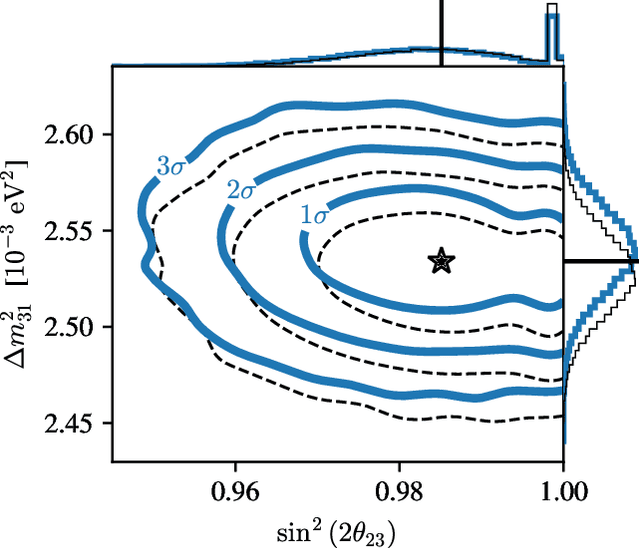
Neutrino-nucleus scattering cross sections are critical theoretical inputs for long-baseline neutrino oscillation experiments. However, robust modeling of these cross sections remains challenging. For a simple but physically motivated toy model of the DUNE experiment, we demonstrate that an accurate neural-network model of the cross section -- leveraging Standard Model symmetries -- can be learned from near-detector data. We then perform a neutrino oscillation analysis with simulated far-detector events, finding that the modeled cross section achieves results consistent with what could be obtained if the true cross section were known exactly. This proof-of-principle study highlights the potential of future neutrino near-detector datasets and data-driven cross-section models.