 Add to Chrome
 Add to Firefox
 Add to Edge
Improving Neutrino Oscillation Measurements through Event Classification
Nov 14, 2025
Precise neutrino energy reconstruction is essential for next-generation long-baseline oscillation experiments, yet current methods remain limited by large uncertainties in neutrino-nucleus interaction modeling. Even so, it is well established that different interaction channels produce systematically varying amounts of missing energy and therefore yield different reconstruction performance--information that standard calorimetric approaches do not exploit. We introduce a strategy that incorporates this structure by classifying events according to their underlying interaction type prior to energy reconstruction. Using supervised machine-learning techniques trained on labeled generator events, we leverage intrinsic kinematic differences among quasi-elastic scattering, meson-exchange current, resonance production, and deep-inelastic scattering processes. A cross-generator testing framework demonstrates that this classification approach is robust to microphysics mismodeling and, when applied to a simulated DUNE $ν_μ$ disappearance analysis, yields improved accuracy and sensitivity. These results highlight a practical path toward reducing reconstruction-driven systematics in future oscillation measurements.

Machine Learning Neutrino-Nucleus Cross Sections
Dec 20, 2024
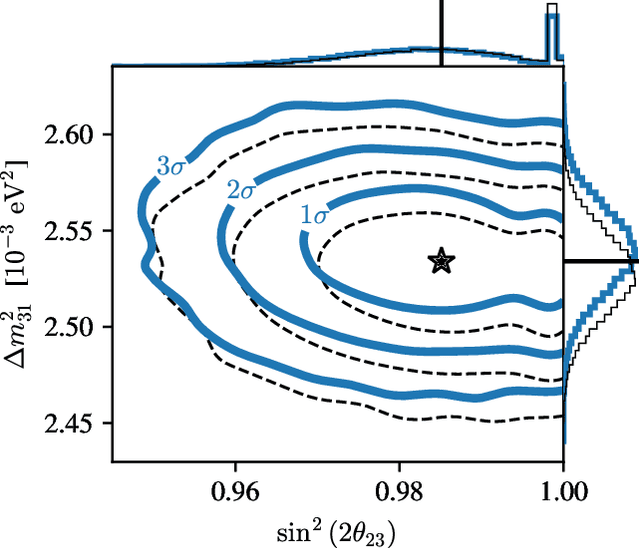
Neutrino-nucleus scattering cross sections are critical theoretical inputs for long-baseline neutrino oscillation experiments. However, robust modeling of these cross sections remains challenging. For a simple but physically motivated toy model of the DUNE experiment, we demonstrate that an accurate neural-network model of the cross section -- leveraging Standard Model symmetries -- can be learned from near-detector data. We then perform a neutrino oscillation analysis with simulated far-detector events, finding that the modeled cross section achieves results consistent with what could be obtained if the true cross section were known exactly. This proof-of-principle study highlights the potential of future neutrino near-detector datasets and data-driven cross-section models.