 Add to Chrome
 Add to Firefox
 Add to Edge
Knowledge Offloading: Decomposing LLMs into Sparse Backbones and Memory Modules
May 27, 2026
LLMs encode both general capabilities and domain-specific knowledge in a single set of parameters. We ask whether this capacity can be reorganized: keeping broadly useful computation in a shared backbone, while moving specialized knowledge into external memory modules. We propose \emph{knowledge offloading} (KOFF), a framework for decomposing a pretrained LLM into a sparse shared backbone and domain-specific memories. Starting from a frozen base model, we jointly learn a structured pruning mask and lightweight recovery modules, implemented as LoRA adapters and learned key-value caches. Across Llama and Qwen models from 3B to 8B, we find that non-trivial capacity can be moved out of the shared backbone without a large loss in model ability. At around 12\% global sparsity, KOFF preserves much of the unpruned model's performance, while pruning the same frozen model without memories degrades sharply. Ablations show that LoRA and learned KV memories are complementary, and specialization analyses suggest that the learned decomposition is meaningful: language-specific neurons are preferentially removed while language-general neurons largely remain in the backbone. These results suggest that knowledge can be reallocated between a shared core and swappable external memories.

[Re] FairDICE: A Gap Between Theory And Practice
Mar 03, 2026Offline Reinforcement Learning (RL) is an emerging field of RL in which policies are learned solely from demonstrations. Within offline RL, some environments involve balancing multiple objectives, but existing multi-objective offline RL algorithms do not provide an efficient way to find a fair compromise. FairDICE (see arXiv:2506.08062v2) seeks to fill this gap by adapting OptiDICE (an offline RL algorithm) to automatically learn weights for multiple objectives to e.g.\ incentivise fairness among objectives. As this would be a valuable contribution, this replication study examines the replicability of claims made regarding FairDICE. We find that many theoretical claims hold, but an error in the code reduces FairDICE to standard behaviour cloning in continuous environments, and many important hyperparameters were originally underspecified. After rectifying this, we show in experiments extending the original paper that FairDICE can scale to complex environments and high-dimensional rewards, though it can be reliant on (online) hyperparameter tuning. We conclude that FairDICE is a theoretically interesting method, but the experimental justification requires significant revision.
Concepts' Information Bottleneck Models
Feb 16, 2026Concept Bottleneck Models (CBMs) aim to deliver interpretable predictions by routing decisions through a human-understandable concept layer, yet they often suffer reduced accuracy and concept leakage that undermines faithfulness. We introduce an explicit Information Bottleneck regularizer on the concept layer that penalizes $I(X;C)$ while preserving task-relevant information in $I(C;Y)$, encouraging minimal-sufficient concept representations. We derive two practical variants (a variational objective and an entropy-based surrogate) and integrate them into standard CBM training without architectural changes or additional supervision. Evaluated across six CBM families and three benchmarks, the IB-regularized models consistently outperform their vanilla counterparts. Information-plane analyses further corroborate the intended behavior. These results indicate that enforcing a minimal-sufficient concept bottleneck improves both predictive performance and the reliability of concept-level interventions. The proposed regularizer offers a theoretic-grounded, architecture-agnostic path to more faithful and intervenable CBMs, resolving prior evaluation inconsistencies by aligning training protocols and demonstrating robust gains across model families and datasets.
Refining Joint Text and Source Code Embeddings for Retrieval Task with Parameter-Efficient Fine-Tuning
May 07, 2024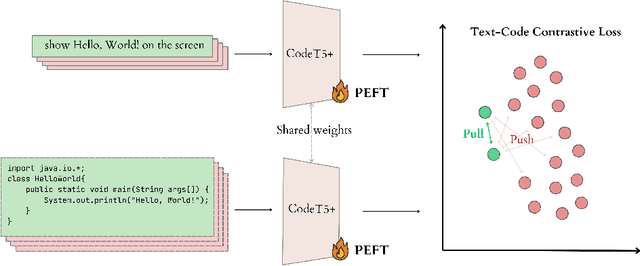

The latest developments in Natural Language Processing (NLP) have demonstrated remarkable progress in a code-text retrieval problem. As the Transformer-based models used in this task continue to increase in size, the computational costs and time required for end-to-end fine-tuning become substantial. This poses a significant challenge for adapting and utilizing these models when computational resources are limited. Motivated by these concerns, we propose a fine-tuning framework that leverages Parameter-Efficient Fine-Tuning (PEFT) techniques. Moreover, we adopt contrastive learning objectives to improve the quality of bimodal representations learned by transformer models. Additionally, for PEFT methods we provide extensive benchmarking, the lack of which has been highlighted as a crucial problem in the literature. Based on the thorough experimentation with the CodeT5+ model conducted on two datasets, we demonstrate that the proposed fine-tuning framework has the potential to improve code-text retrieval performance by tuning only 0.4% parameters at most.