 Add to Chrome
 Add to Firefox
 Add to Edge
TIER: Trajectory-Invariant Explanation Regularization for Membership Privacy
Jul 03, 2026
Explainability is central to building trustworthy AI, yet explanation interfaces can inadvertently provide adversaries with an expanded privacy-related attack surfaces. Recent studies show that advanced membership-inference attacks succeed by exploiting confidence-drop trajectories, induced through attribution-guided perturbations, as discriminative features, rather than directly using confidence scores or explanation vectors. Existing defenses against membership inference fail to directly mitigate such explanation-driven attacks. In this work, we investigate whether, during training, a model's own gradients can be leveraged as defense signals against such attacks, thereby aligning explanation profiles between members and non-members. To this end, we propose a Trajectory-Invariant Explanation Regularization (TIER) defense that penalizes erratic fluctuations in confidence drops simulated through gradient-guided perturbations and simultaneously minimizes the distributional shifts via KL-divergence. Unlike conventional adversarial training, which emphasizes label robustness, our approach targets explanation robustness by enforcing self-consistency through KL-divergence and reducing the variance of confidence drops between members and non-members. Extensive experiments confirm that our method effectively mitigates these attacks, delivering privacy protection while maintaining model utility and explanation fidelity.

DE-FIVE: Detecting Malicious Image Prompts via Fourier Features and Image Vector Embeddings
Jun 22, 2026Vision language models (VLMs) employ both visual and textual modalities to enable advanced vision-language inference. However, incorporating visual modalities expands the attack surface of VLMs, making them more susceptible to security threats such as adversarial perturbations and indirect prompt injection, wherein crafted malicious image prompts can elicit unintended model outputs. Existing defense methods against malicious image prompts remain insufficient as they typically demand extensive datasets for retraining or the deployment of additional, complex classifiers. Most critically, there is a profound lack of specialized defense mechanisms specifically targeting indirect prompt injections, a gap that serves as a primary motivation for this work. To address these limitations, we introduce DE-FIVE, a novel training-free framework for detecting malicious image prompts by leveraging Fourier features and the hidden state representations of the visual encoder (image vector embeddings) across perturbations. Specifically, we develop a hybrid detection strategy consisting of a black-box detector that operates on Fourier-domain features and a white-box detector that exploits image vector embeddings derived from only a few-shot malicious set. Extensive experiments demonstrate that the proposed framework consistently outperforms state-of-the-art baselines against malicious image prompts.
A Hybrid Deep Learning Anomaly Detection Framework for Intrusion Detection
Dec 02, 2022


Cyber intrusion attacks that compromise the users' critical and sensitive data are escalating in volume and intensity, especially with the growing connections between our daily life and the Internet. The large volume and high complexity of such intrusion attacks have impeded the effectiveness of most traditional defence techniques. While at the same time, the remarkable performance of the machine learning methods, especially deep learning, in computer vision, had garnered research interests from the cyber security community to further enhance and automate intrusion detections. However, the expensive data labeling and limitation of anomalous data make it challenging to train an intrusion detector in a fully supervised manner. Therefore, intrusion detection based on unsupervised anomaly detection is an important feature too. In this paper, we propose a three-stage deep learning anomaly detection based network intrusion attack detection framework. The framework comprises an integration of unsupervised (K-means clustering), semi-supervised (GANomaly) and supervised learning (CNN) algorithms. We then evaluated and showed the performance of our implemented framework on three benchmark datasets: NSL-KDD, CIC-IDS2018, and TON_IoT.
* Keywords: Cybersecurity, Anomaly Detection, Intrusion Detection, Deep Learning, Unsupervised Learning, Neural Networks; https://ieeexplore.ieee.org/document/9799486
Clustering based opcode graph generation for malware variant detection
Nov 18, 2022Malwares are the key means leveraged by threat actors in the cyber space for their attacks. There is a large array of commercial solutions in the market and significant scientific research to tackle the challenge of the detection and defense against malwares. At the same time, attackers also advance their capabilities in creating polymorphic and metamorphic malwares to make it increasingly challenging for existing solutions. To tackle this issue, we propose a methodology to perform malware detection and family attribution. The proposed methodology first performs the extraction of opcodes from malwares in each family and constructs their respective opcode graphs. We explore the use of clustering algorithms on the opcode graphs to detect clusters of malwares within the same malware family. Such clusters can be seen as belonging to different sub-family groups. Opcode graph signatures are built from each detected cluster. Hence, for each malware family, a group of signatures is generated to represent the family. These signatures are used to classify an unknown sample as benign or belonging to one the malware families. We evaluate our methodology by performing experiments on a dataset consisting of both benign files and malware samples belonging to a number of different malware families and comparing the results to existing approach.
* Keywords: malware detection and attribution, malware family, clustering, opcode graph, machine learning; https://ieeexplore.ieee.org/document/9647814
Intrusion Detection in Internet of Things using Convolutional Neural Networks
Nov 18, 2022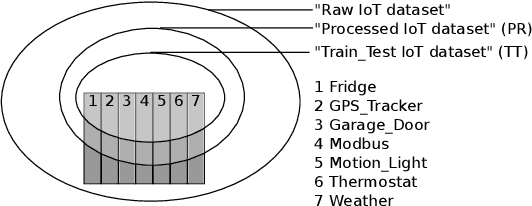


Internet of Things (IoT) has become a popular paradigm to fulfil needs of the industry such as asset tracking, resource monitoring and automation. As security mechanisms are often neglected during the deployment of IoT devices, they are more easily attacked by complicated and large volume intrusion attacks using advanced techniques. Artificial Intelligence (AI) has been used by the cyber security community in the past decade to automatically identify such attacks. However, deep learning methods have yet to be extensively explored for Intrusion Detection Systems (IDS) specifically for IoT. Most recent works are based on time sequential models like LSTM and there is short of research in CNNs as they are not naturally suited for this problem. In this article, we propose a novel solution to the intrusion attacks against IoT devices using CNNs. The data is encoded as the convolutional operations to capture the patterns from the sensors data along time that are useful for attacks detection by CNNs. The proposed method is integrated with two classical CNNs: ResNet and EfficientNet, where the detection performance is evaluated. The experimental results show significant improvement in both true positive rate and false positive rate compared to the baseline using LSTM.
* Keywords: Cybersecurity, Intrusion Detection, IoT, Deep Learning, Convolutional Neural Networks; https://ieeexplore.ieee.org/abstract/document/9647828