 Add to Chrome
 Add to Firefox
 Add to Edge
Trajectory-Anchor Optimization for Overconfident Thermal Visual Place Recognition: Zero-Leakage OOD Auditing and Kidnapped-Robot Recovery
Jul 06, 2026
Modern thermal visual place recognition (TIR-VPR) frontends based on foundation models achieve remarkable closed-set retrieval but suffer from an overconfident forced-matching failure mode. Under out-of-distribution (OOD) or unmapped conditions, they generate highly plausible yet false loop candidates without a drop in similarity scores. While classical multi-hypothesis tracking (MHT) backends can mitigate these ambiguities by maintaining divergent trajectory beliefs, their exponential computational overhead violates real-time robotic constraints. To bridge this gap, we present Trajectory-Anchor Optimization (TAO). To counter the combinatorial challenge of evaluating parallel hypotheses (e.g., K=100), TAO compresses multi-view temporal verification into a batched SE(2) Procrustes alignment problem. By leveraging tensor-level vectorization and single-invocation batched SVD, this formulation bypasses the dynamic tree expansion of MHT, guaranteeing a strictly bounded per-frame execution loop of O(KN). Under a strict zero-leakage evaluation protocol, we show that while a passive geometric backend cannot mathematically separate metric localization errors from coherent hallucinations at a micro-scale (<5m) due to local visual ambiguities, TAO serves as an efficient fail-safe filter at a macro-scale. Within a 5m radius, hallucinations often possess a locally consistent geometry that deceives rigid alignment. However, beyond this threshold, the K=100 disparate hypotheses disperse spatially across the global map. This dispersion breaks the rigid temporal co-visibility constraint within the sliding window (N=20), causing the joint optimization residual to escalate sharply. Consequently, TAO establishes a distinct macroscopic convergence basin (10m) where multi-view geometric consistency reliably isolates catastrophic topological breaks and suppresses critical false acceptances.

SLAM: Structured and Localized Analytic Manifold Adaptation for Lifelong VPR
Jul 06, 2026Visual Place Recognition (VPR) in lifelong deployment requires continuous adaptation to new environments without catastrophic forgetting. In this paper, we propose SLAM, a Structured and Localized Analytic Manifold adaptation framework. Our framework elegantly unifies uncertainty-aware smoothing via Unscented transformation, topological space partitioning through a Gaussian Mixture Model (GMM), and $H_\infty$ robust bound optimization into a singular, unified closed-form analytical recursion. Exhaustive ablation studies demonstrate that while the synergistic combination of uncertainty smoothing and localized mapping (U+G configuration) achieves the state-of-the-art nominal accuracy of 27.5%, the full deployment of the $H_\infty$ bound does not require an architectural split; rather, it introduces a mathematically guaranteed minimax robust bound. This formulation enables the system to seamlessly modulate the intrinsic trade-off between nominal placement precision and worst-case disturbance attenuation through a single regularization parameter.
FlatManifold: Robust Continual Learning under Severe Label Noise and Domain Shifts via Intrinsic Manifold Flattening
Jul 06, 2026In non-stationary streaming environments, simultaneously adapting to complex, non-linear domain shifts via continual learning while mitigating the catastrophic effects of severe, uncalibrated label noise poses a fundamental mathematical challenge. In this paper, we propose \FlatManifold{}, a novel, streamlined robust continual learning framework that utilizes a Nyström manifold flattening map based on the kernel trick and projection onto an orthogonalized Reproducing Kernel Hilbert Space (RKHS). Unlike traditional methods that rely on complex, error-prone sample-filtering pipelines, the proposed approach exploits the intrinsic mathematical robustness of the flattened space itself. By mapping feature distributions onto a fixed orthogonal target topology with a ridge regularizer, the framework naturally smoothes and counteracts the influence of extreme label noise during the optimization process. Concurrently, catastrophic forgetting is prevented via a continual topology brake term that leverages the covariance matrix of past experiences. Extensive evaluation on real-world multi-session robotics datasets demonstrates that even under severe conditions featuring 40\% symmetric label noise, \FlatManifold{} successfully mitigates gradient corruption. Under extreme cross-session domain shifts spanning various seasons and lighting conditions, the proposed framework establishes high generalization capabilities, significantly outperforming standard sequential optimization baselines and proving that structural linearization itself serves as a powerful mathematical barrier against distributed label corruption.
FlatVPR: Plug-and-play Geo-linear Residual Adapter for Geometric Rectification of Foundation Model Feature Manifolds
Jun 01, 2026This paper proposes ``FlatVPR,'' a novel geometric rectification paradigm that effectively bridges the trade-off between map lightweightness and localization accuracy in visual place recognition (VPR) by enforcing a feature manifold structure where any descriptor between two adjacent anchors $\mathbf{z}_A$ and $\mathbf{z}_B$ can be accurately reconstructed via linear interpolation $\hat{\mathbf{z}}_{pseudo} = (1-t)\mathbf{z}_A + t\mathbf{z}_B$, where $t \in [0,1]$ denotes the relative position. While state-of-the-art foundation models such as DINOv2-ViT-S/14 provide robust semantic features, their latent manifolds exhibit prominent curvature, projecting uniform linear motion in physical space onto highly non-linear trajectories in the feature space, which hinders reliable reconstruction under sparse anchor conditions. To enable the aforementioned interpolation-based reconstruction, we introduce a residual transformation $\hat{\mathbf{z}} = \mathbf{z} + \text{Res}(\mathbf{z})$ to the raw foundation features $\mathbf{z}$, where $\text{Res}(\cdot)$ represents a learnable adapter. Our method explicitly suppresses manifold curvature using a mathematically grounded Pullback Flatness Loss that minimizes the deviation of intermediate features from the linear segment connecting adjacent anchors, thereby minimizing the intrinsic curvature of the manifold. Through this spatial flattening, map construction is formulated within an Expectation-Maximization (EM) framework, decoupled into a continuous M-step for manifold adaptation and a conceptual E-step for optimal anchor selection guidelines. Experiments on the NCLT dataset demonstrate that the application of our adapter leads to significant performance improvements even under extremely sparse anchor conditions with 100m intervals and extreme seasonal changes.
A Dual-Stream Transformer Architecture for Illumination-Invariant TIR-LiDAR Person Tracking
Apr 01, 2026Robust person tracking is a critical capability for autonomous mobile robots operating in diverse and unpredictable environments. While RGB-D tracking has shown high precision, its performance severely degrades under challenging illumination conditions, such as total darkness or intense backlighting. To achieve all-weather robustness, this paper proposes a novel Thermal-Infrared and Depth (TIR-D) tracking architecture that leverages the standard sensor suite of SLAM-capable robots, namely LiDAR and TIR cameras. A major challenge in TIR-D tracking is the scarcity of annotated multi-modal datasets. To address this, we introduce a sequential knowledge transfer strategy that evolves structural priors from a large-scale thermal-trained model into the TIR-D domain. By employing a differential learning rate strategy -- referred to as ``Fine-grained Differential Learning Rate Strategy'' -- we effectively preserve pre-trained feature extraction capabilities while enabling rapid adaptation to geometric depth cues. Experimental results demonstrate that our proposed TIR-D tracker achieves superior performance, with an Average Overlap (AO) of 0.700 and a Success Rate (SR) of 58.7\%, significantly outperforming conventional RGB-transfer and single-modality baselines. Our approach provides a practical and resource-efficient solution for robust human-following in all-weather robotics applications.
From Reactive to Map-Based AI: Tuned Local LLMs for Semantic Zone Inference in Object-Goal Navigation
Mar 09, 2026Object-Goal Navigation (ObjectNav) requires an agent to find and navigate to a target object category in unknown environments. While recent Large Language Model (LLM)-based agents exhibit zero-shot reasoning, they often rely on a "reactive" paradigm that lacks explicit spatial memory, leading to redundant exploration and myopic behaviors. To address these limitations, we propose a transition from reactive AI to "Map-Based AI" by integrating LLM-based semantic inference with a hybrid topological-grid mapping system. Our framework employs a fine-tuned Llama-2 model via Low-Rank Adaptation (LoRA) to infer semantic zone categories and target existence probabilities from verbalized object observations. In this study, a "zone" is defined as a functional area described by the set of observed objects, providing crucial semantic co-occurrence cues for finding the target. This semantic information is integrated into a topological graph, enabling the agent to prioritize high-probability areas and perform systematic exploration via Traveling Salesman Problem (TSP) optimization. Evaluations in the AI2-THOR simulator demonstrate that our approach significantly outperforms traditional frontier exploration and reactive LLM baselines, achieving a superior Success Rate (SR) and Success weighted by Path Length (SPL).
Pole-centric Descriptors for Robust Robot Localization: Evaluation under Pole-at-Distance (PaD) Observations using the Small Pole Landmark (SPL) Dataset
Dec 29, 2025While pole-like structures are widely recognized as stable geometric anchors for long-term robot localization, their identification reliability degrades significantly under Pole-at-Distance (Pad) observations typical of large-scale urban environments. This paper shifts the focus from descriptor design to a systematic investigation of descriptor robustness. Our primary contribution is the establishment of a specialized evaluation framework centered on the Small Pole Landmark (SPL) dataset. This dataset is constructed via an automated tracking-based association pipeline that captures multi-view, multi-distance observations of the same physical landmarks without manual annotation. Using this framework, we present a comparative analysis of Contrastive Learning (CL) and Supervised Learning (SL) paradigms. Our findings reveal that CL induces a more robust feature space for sparse geometry, achieving superior retrieval performance particularly in the 5--10m range. This work provides an empirical foundation and a scalable methodology for evaluating landmark distinctiveness in challenging real-world scenarios.
MOON: Multi-Objective Optimization-Driven Object-Goal Navigation Using a Variable-Horizon Set-Orienteering Planner
May 19, 2025Object-goal navigation (ON) enables autonomous robots to locate and reach user-specified objects in previously unknown environments, offering promising applications in domains such as assistive care and disaster response. Existing ON methods -- including training-free approaches, reinforcement learning, and zero-shot planners -- generally depend on active exploration to identify landmark objects (e.g., kitchens or desks), followed by navigation toward semantically related targets (e.g., a specific mug). However, these methods often lack strategic planning and do not adequately address trade-offs among multiple objectives. To overcome these challenges, we propose a novel framework that formulates ON as a multi-objective optimization problem (MOO), balancing frontier-based knowledge exploration with knowledge exploitation over previously observed landmarks; we call this framework MOON (MOO-driven ON). We implement a prototype MOON system that integrates three key components: (1) building on QOM [IROS05], a classical ON system that compactly and discriminatively encodes landmarks based on their semantic relevance to the target; (2) integrating StructNav [RSS23], a recently proposed training-free planner, to enhance the navigation pipeline; and (3) introducing a variable-horizon set orienteering problem formulation to enable global optimization over both exploration and exploitation strategies. This work represents an important first step toward developing globally optimized, next-generation object-goal navigation systems.
LGR: LLM-Guided Ranking of Frontiers for Object Goal Navigation
Mar 26, 2025Object Goal Navigation (OGN) is a fundamental task for robots and AI, with key applications such as mobile robot image databases (MRID). In particular, mapless OGN is essential in scenarios involving unknown or dynamic environments. This study aims to enhance recent modular mapless OGN systems by leveraging the commonsense reasoning capabilities of large language models (LLMs). Specifically, we address the challenge of determining the visiting order in frontier-based exploration by framing it as a frontier ranking problem. Our approach is grounded in recent findings that, while LLMs cannot determine the absolute value of a frontier, they excel at evaluating the relative value between multiple frontiers viewed within a single image using the view image as context. We dynamically manage the frontier list by adding and removing elements, using an LLM as a ranking model. The ranking results are represented as reciprocal rank vectors, which are ideal for multi-view, multi-query information fusion. We validate the effectiveness of our method through evaluations in Habitat-Sim.
Dynamic-Dark SLAM: RGB-Thermal Cooperative Robot Vision Strategy for Multi-Person Tracking in Both Well-Lit and Low-Light Scenes
Mar 17, 2025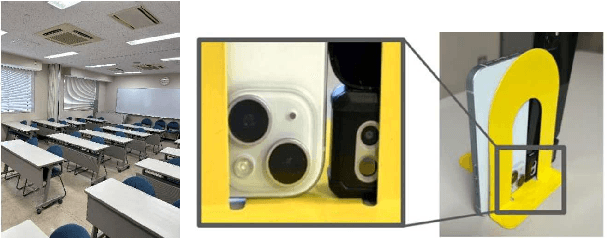
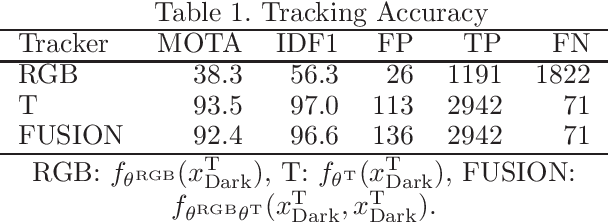
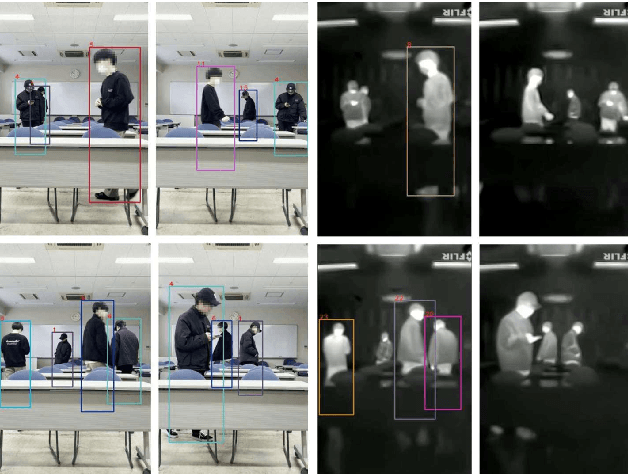
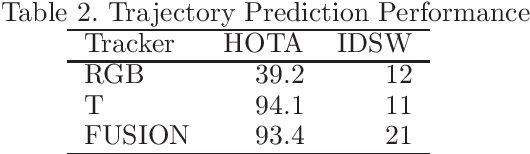
In robot vision, thermal cameras have significant potential for recognizing humans even in complete darkness. However, their application to multi-person tracking (MPT) has lagged due to data scarcity and difficulties in individual identification. In this study, we propose a cooperative MPT system that utilizes co-located RGB and thermal cameras, using pseudo-annotations (bounding boxes + person IDs) to train RGB and T trackers. Evaluation experiments demonstrate that the T tracker achieves remarkable performance in both bright and dark scenes. Furthermore, results suggest that a tracker-switching approach using a binary brightness classifier is more suitable than a tracker-fusion approach for information integration. This study marks a crucial first step toward ``Dynamic-Dark SLAM," enabling effective recognition, understanding, and reconstruction of individuals, occluding objects, and traversable areas in dynamic environments, both bright and dark.