 Add to Chrome
 Add to Firefox
 Add to Edge
Gemma 4 Technical Report
Jul 02, 2026
We introduce Gemma 4, a new generation of open-weight, natively multimodal language models in the Gemma model family. Designed to advance compute efficiency and reasoning, the Gemma 4 model suite features dense and Mixture-of-Experts architectures, ranging from 2.3B to 31B parameters. Alongside improved vision and audio encoders for all model sizes, we propose a unified, encoder-free architecture for our 12B model, which ingests raw audio and image patches. Furthermore, we integrate a thinking mode, enabling Gemma models to generate reasoning traces prior to responding. We improve inference speed, memory, and compute efficiency, as well as long-context abilities through critical design choices. Gemma 4 establishes a leap in performance across STEM, multimodal, and long-context benchmarks, and rivals larger, frontier open models in human-rated tasks.

Are you speaking my languages? On spoken language adherence in multimodal LLMs
Jun 15, 2026While Large Language Model (LLM) based Automatic Speech Recognition (ASR) enables seamless multilingual use, models often misidentify the output language, compromising transcription fidelity and downstream application quality. To preserve flexibility and code-switching capabilities, we propose a soft prompting approach that hints at potential spoken languages without strictly constraining the output. We formally define this challenge as a lack of language adherence, introduce a novel metric to quantify violations, and evaluate three mitigation strategies: (1) zero-shot prompting for robust guidance under uncertainty, (2) supervised fine-tuning (SFT) to improve prompt adherence, and (3) Chain-of-Thought (CoT) reasoning to enforce adherence during decoding. We present a comparative analysis of these methods across multiple languages, evaluating effectiveness in reducing the language violation while maintaining overall ASR performance. Finally, we discuss trade-offs to guide strategy selection under various compute constraints.
Spelling Correction through Rewriting of Non-Autoregressive ASR Lattices
Sep 24, 2024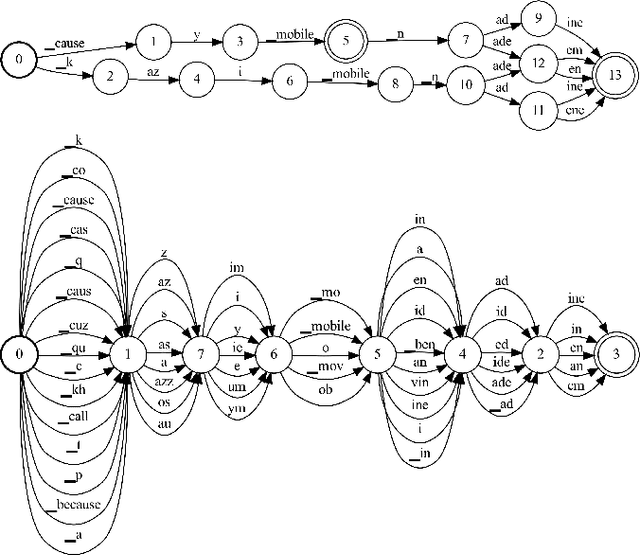
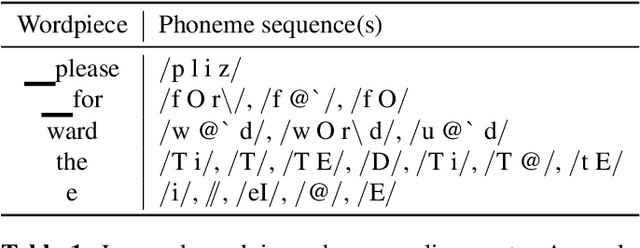
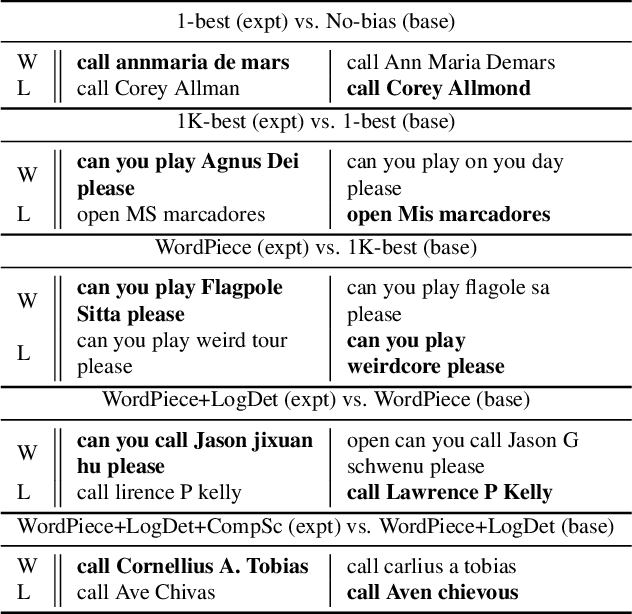
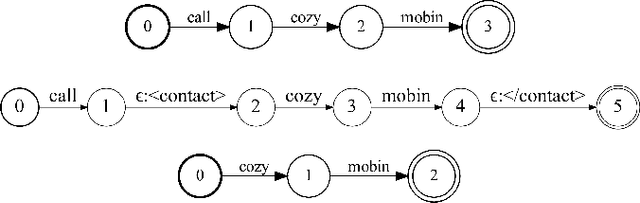
For end-to-end Automatic Speech Recognition (ASR) models, recognizing personal or rare phrases can be hard. A promising way to improve accuracy is through spelling correction (or rewriting) of the ASR lattice, where potentially misrecognized phrases are replaced with acoustically similar and contextually relevant alternatives. However, rewriting is challenging for ASR models trained with connectionist temporal classification (CTC) due to noisy hypotheses produced by a non-autoregressive, context-independent beam search. We present a finite-state transducer (FST) technique for rewriting wordpiece lattices generated by Transformer-based CTC models. Our algorithm performs grapheme-to-phoneme (G2P) conversion directly from wordpieces into phonemes, avoiding explicit word representations and exploiting the richness of the CTC lattice. Our approach requires no retraining or modification of the ASR model. We achieved up to a 15.2% relative reduction in sentence error rate (SER) on a test set with contextually relevant entities.