 Add to Chrome
 Add to Firefox
 Add to Edge
EgoInfinity: A Web-Scale 4D Hand-Object Interaction Data Engine for Any-View Robot Retargeting and Video-to-Action Robot Learning
Jun 16, 2026
Internet videos constitute the largest reservoir of embodied human manipulation knowledge, yet converting arbitrary RGB footage into actionable robot training data remains a major bottleneck. Existing lab- or factory-collected datasets are narrow in scale and diversity, limiting open-world robot learning. Instead of proposing a static dataset, we introduce EgoInfinity, a universal 4D hand-object interaction data engine that enables web-scale data generation for robot retargeting and learning. EgoInfinity is a modular engine integrating perception, segmentation, reconstruction, interaction-aware refinement, and retargeting to automate this traditionally unscalable video-to-action problem without human-in-the-loop annotation. Its modular design lets the engine continuously benefit from advances in any incorporated component. With EgoInfinity, in-the-wild human manipulation videos are lifted into agent-agnostic, metric 4D hand-object representations, including hand trajectories, 6-DoF object poses, and contact-relevant states. Rather than naively connecting standalone components, EgoInfinity combines cross-module metric calibration with interaction-aware refinement to improve physical reliability, reducing drift and contact inconsistencies common in pure visual reconstruction. We further propose a novel motion retargeter that compiles the recovered 3D hand motions into executable joint trajectories for diverse robot morphologies, enabling video-to-action retargeting on any robot from arbitrary viewpoints and shot sizes (e.g., the human body is only partially visible). We validate EgoInfinity across perception fidelity, kinematic feasibility, contact consistency, cross-embodiment generalization, and real-robot skill acquisition (e.g., grasping, cutting, wiping, and pouring), demonstrating a scalable bridge from internet videos to executable robot behavior for open-world robot learning.

Zero-Shot Sim-to-Real Robot Learning: A Dexterous Manipulation Study on Reactive Catching
May 10, 2026Dexterous manipulation is physics-intensive and highly sensitive to modeling errors and perception noise, making sim-to-real transfer prohibitively challenging. Domain randomization (DR) is commonly used to improve the robustness of learned policies for such tasks, but conventional DR randomizes one instance per episode, offering very limited exposure to the variability of real-world dynamics. To this end, we propose Domain-Randomized Instance Set (DRIS), which represents and propagates a set of randomized instances simultaneously, providing richer approximation of uncertain dynamics and enabling policies to learn actions that account for multiple possible outcomes. Supported by theoretical analysis, we show that DRIS yields more robust policies and alleviates the need for real-world fine-tuning, even with a modest number of instances (e.g., 10). We demonstrate this on a challenging reactive catching task. Unlike traditional catching setups that use end-effectors designed to mechanically stabilize the object (e.g., curved or enclosing surfaces), our system uses a flat plate that offers no passive stabilization, making the task highly sensitive to noise and requiring rapid reactive motions. The learned policies exhibit strong robustness to uncertainties and achieve reliable zero-shot sim-to-real transfer.
ManiDreams: An Open-Source Library for Robust Object Manipulation via Uncertainty-aware Task-specific Intuitive Physics
Mar 18, 2026Dynamics models, whether simulators or learned world models, have long been central to robotic manipulation, but most focus on minimizing prediction error rather than confronting a more fundamental challenge: real-world manipulation is inherently uncertain. We argue that robust manipulation under uncertainty is fundamentally an integration problem: uncertainties must be represented, propagated, and constrained within the planning loop, not merely suppressed during training. We present and open-source ManiDreams, a modular framework for uncertainty-aware manipulation planning over intuitive physics models. It realizes this integration through composable abstractions for distributional state representation, backend-agnostic dynamics prediction, and declarative constraint specification for action optimization. The framework explicitly addresses three sources of uncertainty: perceptual, parametric, and structural. It wraps any base policy with a sample-predict-constrain loop that evaluates candidate actions against distributional outcomes, adding robustness without retraining. Experiments on ManiSkill tasks show that ManiDreams maintains robust performance under various perturbations where the RL baseline degrades significantly. Runnable examples on pushing, picking, catching, and real-world deployment demonstrate flexibility across different policies, optimizers, physics backends, and executors. The framework is publicly available at https://github.com/Rice-RobotPI-Lab/ManiDreams
ManipulationNet: An Infrastructure for Benchmarking Real-World Robot Manipulation with Physical Skill Challenges and Embodied Multimodal Reasoning
Mar 04, 2026Dexterous manipulation enables robots to purposefully alter the physical world, transforming them from passive observers into active agents in unstructured environments. This capability is the cornerstone of physical artificial intelligence. Despite decades of advances in hardware, perception, control, and learning, progress toward general manipulation systems remains fragmented due to the absence of widely adopted standard benchmarks. The central challenge lies in reconciling the variability of the real world with the reproducibility and authenticity required for rigorous scientific evaluation. To address this, we introduce ManipulationNet, a global infrastructure that hosts real-world benchmark tasks for robotic manipulation. ManipulationNet delivers reproducible task setups through standardized hardware kits, and enables distributed performance evaluation via a unified software client that delivers real-time task instructions and collects benchmarking results. As a persistent and scalable infrastructure, ManipulationNet organizes benchmark tasks into two complementary tracks: 1) the Physical Skills Track, which evaluates low-level physical interaction skills, and 2) the Embodied Reasoning Track, which tests high-level reasoning and multimodal grounding abilities. This design fosters the systematic growth of an interconnected network of real-world abilities and skills, paving the path toward general robotic manipulation. By enabling comparable manipulation research in the real world at scale, this infrastructure establishes a sustainable foundation for measuring long-term scientific progress and identifying capabilities ready for real-world deployment.
B4P: Simultaneous Grasp and Motion Planning for Object Placement via Parallelized Bidirectional Forests and Path Repair
Apr 06, 2025Robot pick and place systems have traditionally decoupled grasp, placement, and motion planning to build sequential optimization pipelines with the assumption that the individual components will be able to work together. However, this separation introduces sub-optimality, as grasp choices may limit or even prohibit feasible motions for a robot to reach the target placement pose, particularly in cluttered environments with narrow passages. To this end, we propose a forest-based planning framework to simultaneously find grasp configurations and feasible robot motions that explicitly satisfy downstream placement configurations paired with the selected grasps. Our proposed framework leverages a bidirectional sampling-based approach to build a start forest, rooted at the feasible grasp regions, and a goal forest, rooted at the feasible placement regions, to facilitate the search through randomly explored motions that connect valid pairs of grasp and placement trees. We demonstrate that the framework's inherent parallelism enables superlinear speedup, making it scalable for applications for redundant robot arms (e.g., 7 Degrees of Freedom) to work efficiently in highly cluttered environments. Extensive experiments in simulation demonstrate the robustness and efficiency of the proposed framework in comparison with multiple baselines under diverse scenarios.
ARC-Calib: Autonomous Markerless Camera-to-Robot Calibration via Exploratory Robot Motions
Mar 18, 2025Camera-to-robot (also known as eye-to-hand) calibration is a critical component of vision-based robot manipulation. Traditional marker-based methods often require human intervention for system setup. Furthermore, existing autonomous markerless calibration methods typically rely on pre-trained robot tracking models that impede their application on edge devices and require fine-tuning for novel robot embodiments. To address these limitations, this paper proposes a model-based markerless camera-to-robot calibration framework, ARC-Calib, that is fully autonomous and generalizable across diverse robots and scenarios without requiring extensive data collection or learning. First, exploratory robot motions are introduced to generate easily trackable trajectory-based visual patterns in the camera's image frames. Then, a geometric optimization framework is proposed to exploit the coplanarity and collinearity constraints from the observed motions to iteratively refine the estimated calibration result. Our approach eliminates the need for extra effort in either environmental marker setup or data collection and model training, rendering it highly adaptable across a wide range of real-world autonomous systems. Extensive experiments are conducted in both simulation and the real world to validate its robustness and generalizability.
Collision-inclusive Manipulation Planning for Occluded Object Grasping via Compliant Robot Motions
Dec 09, 2024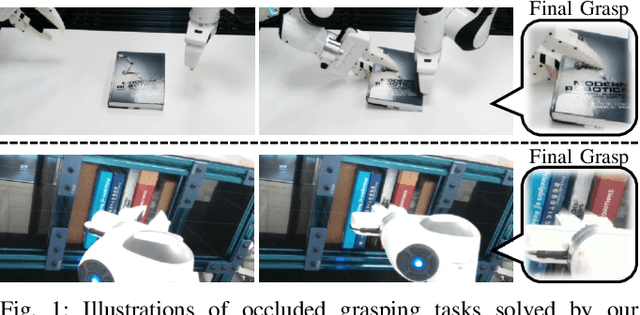
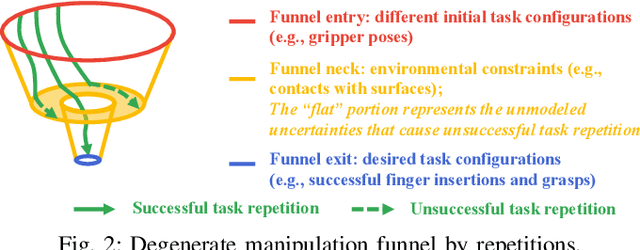
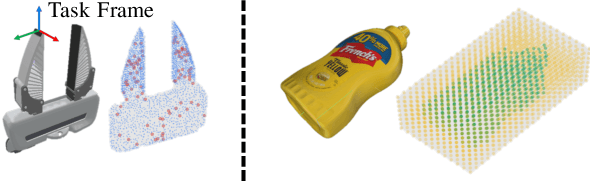
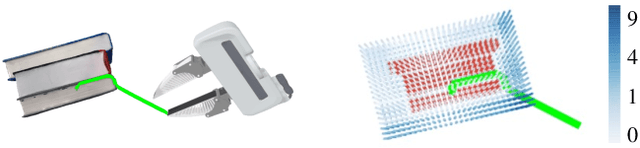
Traditional robotic manipulation mostly focuses on collision-free tasks. In practice, however, many manipulation tasks (e.g., occluded object grasping) require the robot to intentionally collide with the environment to reach a desired task configuration. By enabling compliant robot motions, collisions between the robot and the environment are allowed and can thus be exploited, but more physical uncertainties are introduced. To address collision-rich problems such as occluded object grasping while handling the involved uncertainties, we propose a collision-inclusive planning framework that can transition the robot to a desired task configuration via roughly modeled collisions absorbed by Cartesian impedance control. By strategically exploiting the environmental constraints and exploring inside a manipulation funnel formed by task repetitions, our framework can effectively reduce physical and perception uncertainties. With real-world evaluations on both single-arm and dual-arm setups, we show that our framework is able to efficiently address various realistic occluded grasping problems where a feasible grasp does not initially exist.
Caging in Time: A Framework for Robust Object Manipulation under Uncertainties and Limited Robot Perception
Oct 21, 2024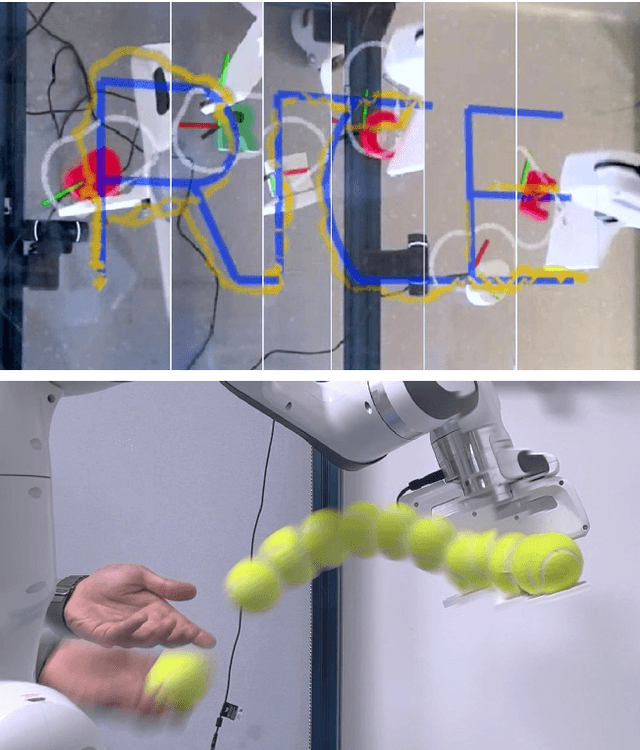


Real-world object manipulation has been commonly challenged by physical uncertainties and perception limitations. Being an effective strategy, while caging configuration-based manipulation frameworks have successfully provided robust solutions, they are not broadly applicable due to their strict requirements on the availability of multiple robots, widely distributed contacts, or specific geometries of the robots or the objects. To this end, this work proposes a novel concept, termed Caging in Time, to allow caging configurations to be formed even if there is just one robot engaged in a task. This novel concept can be explained by an insight that even if a caging configuration is needed to constrain the motion of an object, only a small portion of the cage is actively manipulating at a time. As such, we can switch the configuration of the robot strategically so that by collapsing its configuration in time, we will see a cage formed and its necessary portion active whenever needed. We instantiate our Caging in Time theory on challenging quasistatic and dynamic manipulation tasks, showing that Caging in Time can be achieved in general state spaces including geometry-based and energy-based spaces. With extensive experiments, we show robust and accurate manipulation, in an open-loop manner, without requiring detailed knowledge of the object geometry or physical properties, nor realtime accurate feedback on the manipulation states. In addition to being an effective and robust open-loop manipulation solution, the proposed theory can be a supplementary strategy to other manipulation systems affected by uncertain or limited robot perception.
UNO Push: Unified Nonprehensile Object Pushing via Non-Parametric Estimation and Model Predictive Control
Mar 20, 2024Nonprehensile manipulation through precise pushing is an essential skill that has been commonly challenged by perception and physical uncertainties, such as those associated with contacts, object geometries, and physical properties. For this, we propose a unified framework that jointly addresses system modeling, action generation, and control. While most existing approaches either heavily rely on a priori system information for analytic modeling, or leverage a large dataset to learn dynamic models, our framework approximates a system transition function via non-parametric learning only using a small number of exploratory actions (ca. 10). The approximated function is then integrated with model predictive control to provide precise pushing manipulation. Furthermore, we show that the approximated system transition functions can be robustly transferred across novel objects while being online updated to continuously improve the manipulation accuracy. Through extensive experiments on a real robot platform with a set of novel objects and comparing against a state-of-the-art baseline, we show that the proposed unified framework is a light-weight and highly effective approach to enable precise pushing manipulation all by itself. Our evaluation results illustrate that the system can robustly ensure millimeter-level precision and can straightforwardly work on any novel object.
Interactive Robot-Environment Self-Calibration via Compliant Exploratory Actions
Mar 19, 2024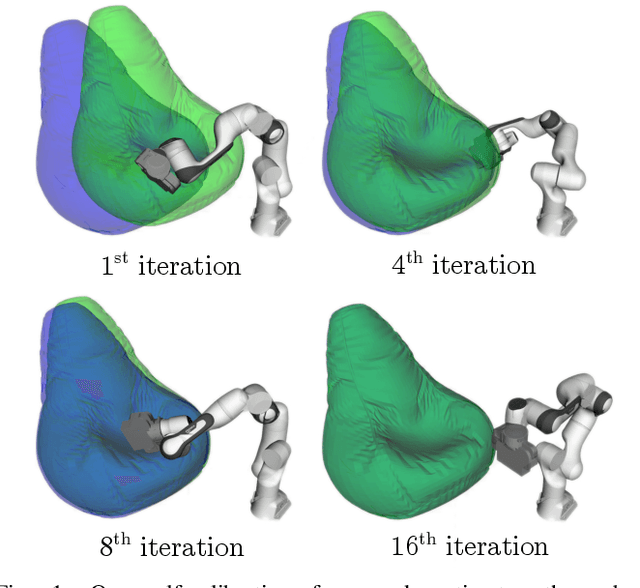
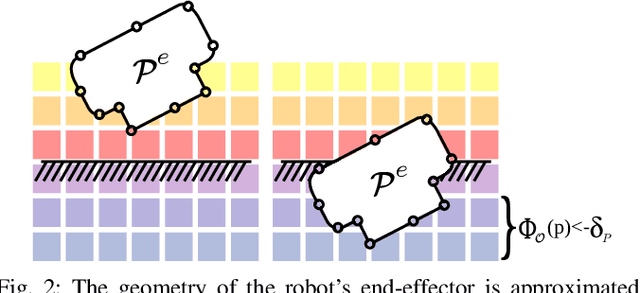
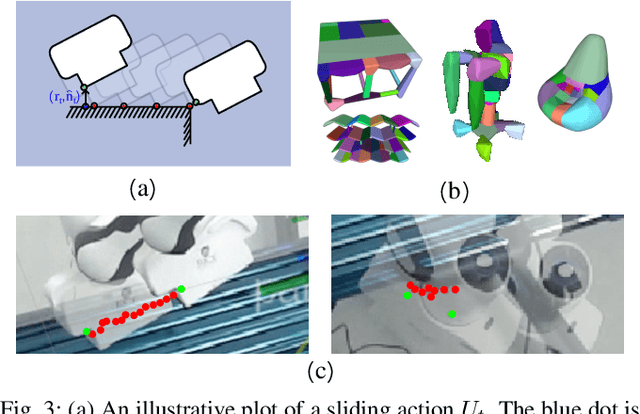

Calibrating robots into their workspaces is crucial for manipulation tasks. Existing calibration techniques often rely on sensors external to the robot (cameras, laser scanners, etc.) or specialized tools. This reliance complicates the calibration process and increases the costs and time requirements. Furthermore, the associated setup and measurement procedures require significant human intervention, which makes them more challenging to operate. Using the built-in force-torque sensors, which are nowadays a default component in collaborative robots, this work proposes a self-calibration framework where robot-environmental spatial relations are automatically estimated through compliant exploratory actions by the robot itself. The self-calibration approach converges, verifies its own accuracy, and terminates upon completion, autonomously purely through interactive exploration of the environment's geometries. Extensive experiments validate the effectiveness of our self-calibration approach in accurately establishing the robot-environment spatial relationships without the need for additional sensing equipment or any human intervention.