 Add to Chrome
 Add to Firefox
 Add to Edge
Learned JPEG Compression for DNN Vision
Jun 15, 2026
JPEG, a lossy image compression technique designed for human viewers, has maintained its dominance for decades. However, in the era of artificial intelligence (AI), a substantial portion of image data, often compressed by JPEG, is and will continue to be consumed by deep neural networks (DNNs) instead of humans, thus creating a need to optimize JPEG for DNN inference performance. To this end, we propose learned JPEG compression for DNN vision (J4D), a novel training framework for determining JPEG encoding parameters to minimize compression rate while maximizing DNN inference performance. The major challenge of solving this optimization problem lies in representing the JPEG codec and compression rate in closed form. By incorporating a differentiable soft quantizer based on a probabilistic quantization scheme, we not only obtain a differentiable proxy for the JPEG codec, but are also able to compute the entropy of the coded source analytically, which is a close estimate of the actual compression rate. Equipped with both the differentiable JPEG codec and the information-theoretic rate estimator, we are then able to solve the aforementioned optimization problem with backpropagation. After training, the learned encoding parameters will be subsequently used in actual JPEG encoding based on probabilistic quantization. Extensive experimental results across multiple datasets and DNN architectures demonstrate that J4D consistently and significantly outperforms the default JPEG and other competitive JPEG codecs optimized for DNNs. Notably, compared to the default JPEG, J4D achieves an increase in accuracy by as much as 11.60% at the same rate, or a reduction of compression rate up to 80.05% at the same accuracy. Additionally, with the help of J4D, we show the potential to design universal JPEG encoding parameters for various DNN architectures for the first time.

JPEG Inspired Deep Learning
Oct 09, 2024



Although it is traditionally believed that lossy image compression, such as JPEG compression, has a negative impact on the performance of deep neural networks (DNNs), it is shown by recent works that well-crafted JPEG compression can actually improve the performance of deep learning (DL). Inspired by this, we propose JPEG-DL, a novel DL framework that prepends any underlying DNN architecture with a trainable JPEG compression layer. To make the quantization operation in JPEG compression trainable, a new differentiable soft quantizer is employed at the JPEG layer, and then the quantization operation and underlying DNN are jointly trained. Extensive experiments show that in comparison with the standard DL, JPEG-DL delivers significant accuracy improvements across various datasets and model architectures while enhancing robustness against adversarial attacks. Particularly, on some fine-grained image classification datasets, JPEG-DL can increase prediction accuracy by as much as 20.9%. Our code is available on https://github.com/JpegInspiredDl/JPEG-Inspired-DL.git.
Knowledge Distillation Based on Transformed Teacher Matching
Feb 17, 2024
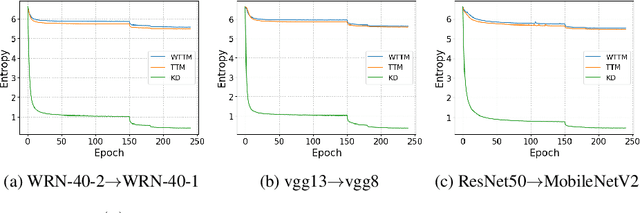
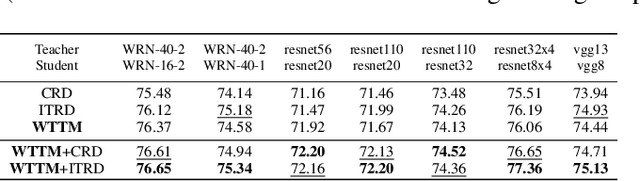

As a technique to bridge logit matching and probability distribution matching, temperature scaling plays a pivotal role in knowledge distillation (KD). Conventionally, temperature scaling is applied to both teacher's logits and student's logits in KD. Motivated by some recent works, in this paper, we drop instead temperature scaling on the student side, and systematically study the resulting variant of KD, dubbed transformed teacher matching (TTM). By reinterpreting temperature scaling as a power transform of probability distribution, we show that in comparison with the original KD, TTM has an inherent R\'enyi entropy term in its objective function, which serves as an extra regularization term. Extensive experiment results demonstrate that thanks to this inherent regularization, TTM leads to trained students with better generalization than the original KD. To further enhance student's capability to match teacher's power transformed probability distribution, we introduce a sample-adaptive weighting coefficient into TTM, yielding a novel distillation approach dubbed weighted TTM (WTTM). It is shown, by comprehensive experiments, that although WTTM is simple, it is effective, improves upon TTM, and achieves state-of-the-art accuracy performance. Our source code is available at https://github.com/zkxufo/TTM.