 Add to Chrome
 Add to Firefox
 Add to Edge
Learned JPEG Compression for DNN Vision
Jun 15, 2026
JPEG, a lossy image compression technique designed for human viewers, has maintained its dominance for decades. However, in the era of artificial intelligence (AI), a substantial portion of image data, often compressed by JPEG, is and will continue to be consumed by deep neural networks (DNNs) instead of humans, thus creating a need to optimize JPEG for DNN inference performance. To this end, we propose learned JPEG compression for DNN vision (J4D), a novel training framework for determining JPEG encoding parameters to minimize compression rate while maximizing DNN inference performance. The major challenge of solving this optimization problem lies in representing the JPEG codec and compression rate in closed form. By incorporating a differentiable soft quantizer based on a probabilistic quantization scheme, we not only obtain a differentiable proxy for the JPEG codec, but are also able to compute the entropy of the coded source analytically, which is a close estimate of the actual compression rate. Equipped with both the differentiable JPEG codec and the information-theoretic rate estimator, we are then able to solve the aforementioned optimization problem with backpropagation. After training, the learned encoding parameters will be subsequently used in actual JPEG encoding based on probabilistic quantization. Extensive experimental results across multiple datasets and DNN architectures demonstrate that J4D consistently and significantly outperforms the default JPEG and other competitive JPEG codecs optimized for DNNs. Notably, compared to the default JPEG, J4D achieves an increase in accuracy by as much as 11.60% at the same rate, or a reduction of compression rate up to 80.05% at the same accuracy. Additionally, with the help of J4D, we show the potential to design universal JPEG encoding parameters for various DNN architectures for the first time.

JPEG Inspired Deep Learning
Oct 09, 2024



Although it is traditionally believed that lossy image compression, such as JPEG compression, has a negative impact on the performance of deep neural networks (DNNs), it is shown by recent works that well-crafted JPEG compression can actually improve the performance of deep learning (DL). Inspired by this, we propose JPEG-DL, a novel DL framework that prepends any underlying DNN architecture with a trainable JPEG compression layer. To make the quantization operation in JPEG compression trainable, a new differentiable soft quantizer is employed at the JPEG layer, and then the quantization operation and underlying DNN are jointly trained. Extensive experiments show that in comparison with the standard DL, JPEG-DL delivers significant accuracy improvements across various datasets and model architectures while enhancing robustness against adversarial attacks. Particularly, on some fine-grained image classification datasets, JPEG-DL can increase prediction accuracy by as much as 20.9%. Our code is available on https://github.com/JpegInspiredDl/JPEG-Inspired-DL.git.
High Performance Convolution Using Sparsity and Patterns for Inference in Deep Convolutional Neural Networks
Apr 16, 2021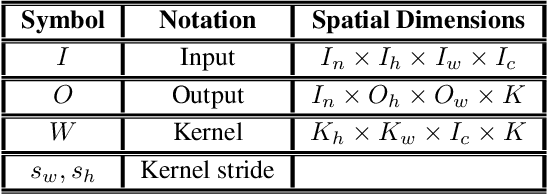
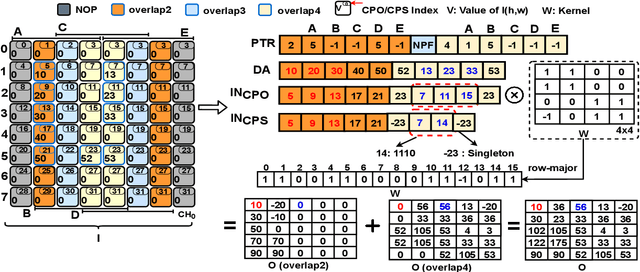
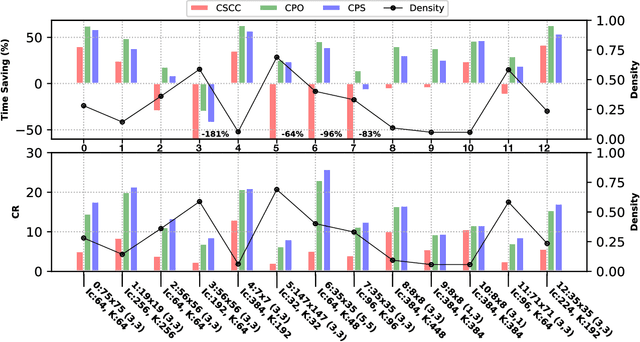
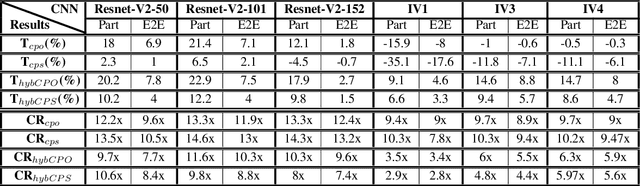
Deploying deep Convolutional Neural Networks (CNNs) is impacted by their memory footprint and speed requirements, which mainly come from convolution. Widely-used convolution algorithms, im2col and MEC, produce a lowered matrix from an activation map by redundantly storing the map's elements included at horizontal and/or vertical kernel overlappings without considering the sparsity of the map. Using the sparsity of the map, this paper proposes two new convolution algorithms dubbed Compressed Pattern Overlap (CPO) and Compressed Pattern Sets (CPS) that simultaneously decrease the memory footprint and increase the inference speed while preserving the accuracy. CPO recognizes non-zero elements (NZEs) at horizontal and vertical overlappings in the activation maps. CPS further improves the memory savings of CPO by compressing the index positions of neighboring NZEs. In both algorithms, channels/regions of the activation maps with all zeros are skipped. Then, CPO/CPS performs convolution via Sparse Matrix-Vector Multiplication (SpMv) done on their sparse representations. Experimental results conducted on CPUs show that average per-layer time savings reach up to 63% and Compression Ratio (CR) up to 26x with respect to im2col. In some layers, our average per layer CPO/CPS time savings are better by 28% and CR is better by 9.2x than the parallel implementation of MEC. For a given CNN's inference, we offline select for each convolution layer the best convolutional algorithm in terms of time between either CPO or CPS and im2col. Our algorithms were selected up to 56% of the non-pointwise convolutional layers. Our offline selections yield CNN inference time savings up to 9% and CR up to 10x.