 Add to Chrome
 Add to Firefox
 Add to Edge
Let's Split Up: Zero-Shot Classifier Edits for Fine-Grained Video Understanding
Feb 18, 2026
Video recognition models are typically trained on fixed taxonomies which are often too coarse, collapsing distinctions in object, manner or outcome under a single label. As tasks and definitions evolve, such models cannot accommodate emerging distinctions and collecting new annotations and retraining to accommodate such changes is costly. To address these challenges, we introduce category splitting, a new task where an existing classifier is edited to refine a coarse category into finer subcategories, while preserving accuracy elsewhere. We propose a zero-shot editing method that leverages the latent compositional structure of video classifiers to expose fine-grained distinctions without additional data. We further show that low-shot fine-tuning, while simple, is highly effective and benefits from our zero-shot initialization. Experiments on our new video benchmarks for category splitting demonstrate that our method substantially outperforms vision-language baselines, improving accuracy on the newly split categories without sacrificing performance on the rest. Project page: https://kaitingliu.github.io/Category-Splitting/.

HD-EPIC: A Highly-Detailed Egocentric Video Dataset
Feb 06, 2025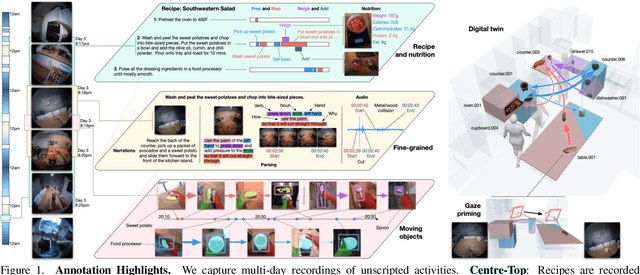
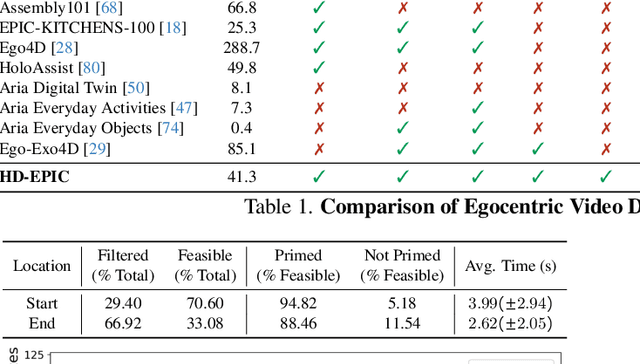
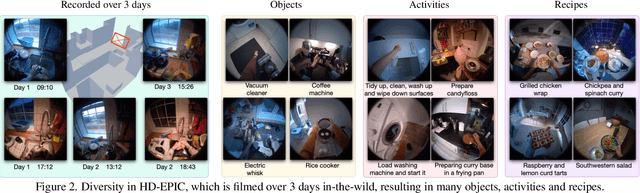
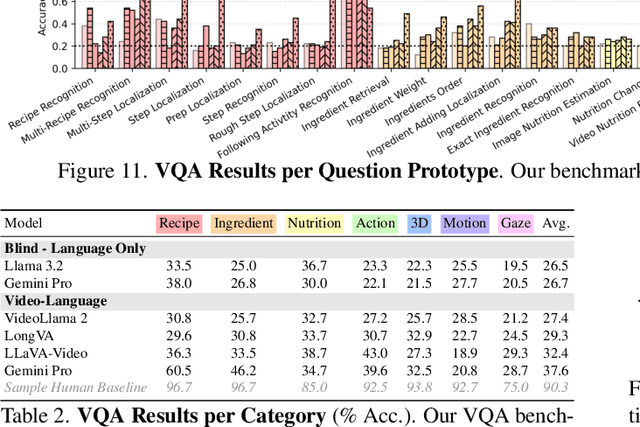
We present a validation dataset of newly-collected kitchen-based egocentric videos, manually annotated with highly detailed and interconnected ground-truth labels covering: recipe steps, fine-grained actions, ingredients with nutritional values, moving objects, and audio annotations. Importantly, all annotations are grounded in 3D through digital twinning of the scene, fixtures, object locations, and primed with gaze. Footage is collected from unscripted recordings in diverse home environments, making HDEPIC the first dataset collected in-the-wild but with detailed annotations matching those in controlled lab environments. We show the potential of our highly-detailed annotations through a challenging VQA benchmark of 26K questions assessing the capability to recognise recipes, ingredients, nutrition, fine-grained actions, 3D perception, object motion, and gaze direction. The powerful long-context Gemini Pro only achieves 38.5% on this benchmark, showcasing its difficulty and highlighting shortcomings in current VLMs. We additionally assess action recognition, sound recognition, and long-term video-object segmentation on HD-EPIC. HD-EPIC is 41 hours of video in 9 kitchens with digital twins of 413 kitchen fixtures, capturing 69 recipes, 59K fine-grained actions, 51K audio events, 20K object movements and 37K object masks lifted to 3D. On average, we have 263 annotations per minute of our unscripted videos.