 Add to Chrome
 Add to Firefox
 Add to Edge
ReasonEdit: Editing Vision-Language Models using Human Reasoning
Feb 03, 2026
Model editing aims to correct errors in large, pretrained models without altering unrelated behaviors. While some recent works have edited vision-language models (VLMs), no existing editors tackle reasoning-heavy tasks, which typically require humans and models to reason about images. We therefore propose ReasonEdit, the first VLM editor to let users explain their reasoning during editing, introducing a new, practical model editing setup. ReasonEdit continuously stores human reasoning in a codebook, and retrieves only relevant facts during inference using a novel topology-balanced multimodal embedding method inspired by network science. Across four VLMs on multiple rationale-based visual question answering datasets, ReasonEdit achieves state-of-the-art editing performance, ultimately showing that using human reasoning during editing greatly improves edit generalization.

Coarse race data conceals disparities in clinical risk score performance
Apr 18, 2023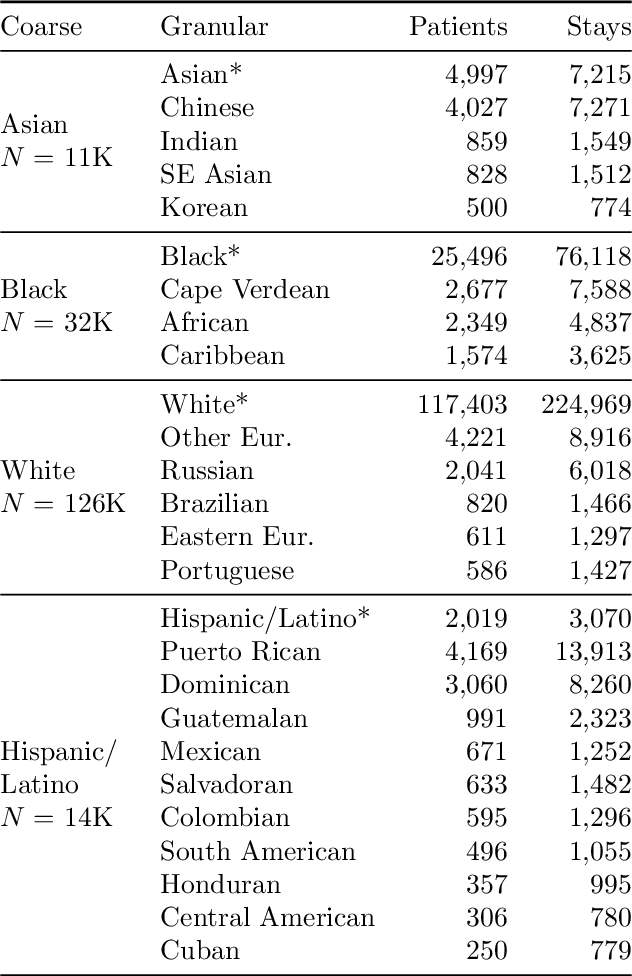
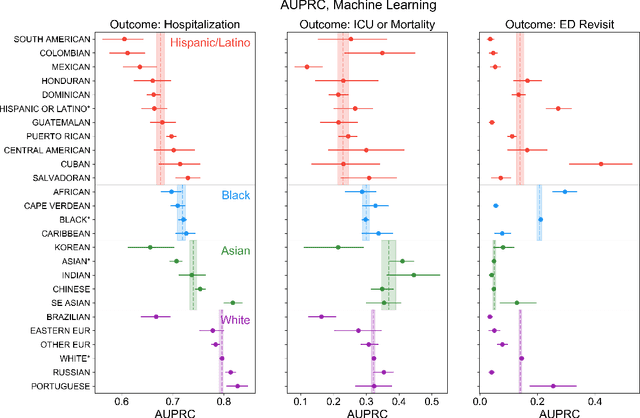
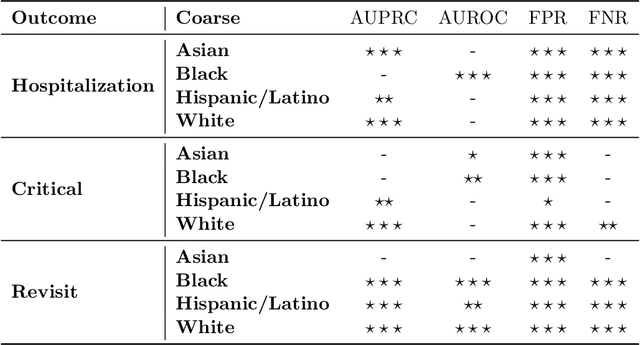
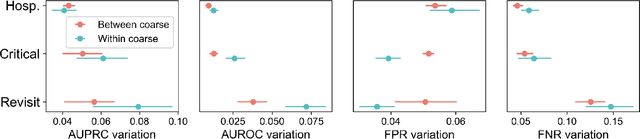
Healthcare data in the United States often records only a patient's coarse race group: for example, both Indian and Chinese patients are typically coded as ``Asian.'' It is unknown, however, whether this coarse coding conceals meaningful disparities in the performance of clinical risk scores across granular race groups. Here we show that it does. Using data from 418K emergency department visits, we assess clinical risk score performance disparities across granular race groups for three outcomes, five risk scores, and four performance metrics. Across outcomes and metrics, we show that there are significant granular disparities in performance within coarse race categories. In fact, variation in performance metrics within coarse groups often exceeds the variation between coarse groups. We explore why these disparities arise, finding that outcome rates, feature distributions, and the relationships between features and outcomes all vary significantly across granular race categories. Our results suggest that healthcare providers, hospital systems, and machine learning researchers should strive to collect, release, and use granular race data in place of coarse race data, and that existing analyses may significantly underestimate racial disparities in performance.