 Add to Chrome
 Add to Firefox
 Add to Edge
Bridging the Simulation-to-Experiment Gap with Generative Models using Adversarial Distribution Alignment
Apr 01, 2026
A fundamental challenge in science and engineering is the simulation-to-experiment gap. While we often possess prior knowledge of physical laws, these physical laws can be too difficult to solve exactly for complex systems. Such systems are commonly modeled using simulators, which impose computational approximations. Meanwhile, experimental measurements more faithfully represent the real world, but experimental data typically consists of observations that only partially reflect the system's full underlying state. We propose a data-driven distribution alignment framework that bridges this simulation-to-experiment gap by pre-training a generative model on fully observed (but imperfect) simulation data, then aligning it with partial (but real) observations of experimental data. While our method is domain-agnostic, we ground our approach in the physical sciences by introducing Adversarial Distribution Alignment (ADA). This method aligns a generative model of atomic positions -- initially trained on a simulated Boltzmann distribution -- with the distribution of experimental observations. We prove that our method recovers the target observable distribution, even with multiple, potentially correlated observables. We also empirically validate our framework on synthetic, molecular, and experimental protein data, demonstrating that it can align generative models with diverse observables. Our code is available at https://kaityrusnelson.com/ada/.

EventFlow: Forecasting Continuous-Time Event Data with Flow Matching
Oct 09, 2024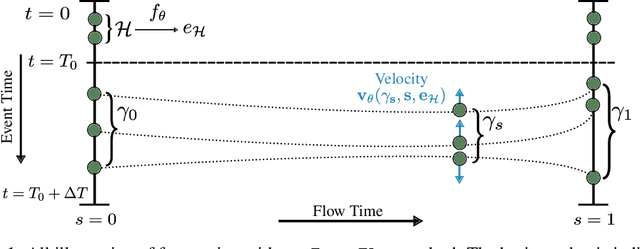
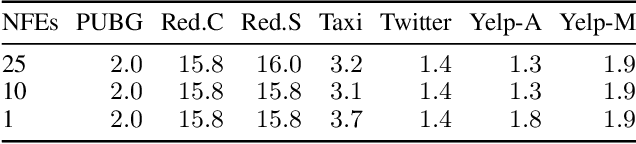
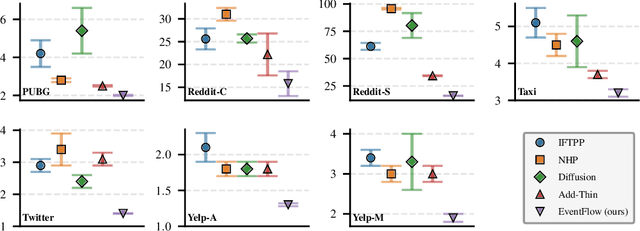
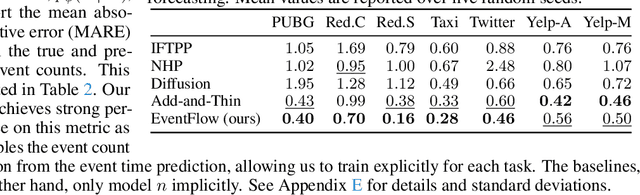
Continuous-time event sequences, in which events occur at irregular intervals, are ubiquitous across a wide range of industrial and scientific domains. The contemporary modeling paradigm is to treat such data as realizations of a temporal point process, and in machine learning it is common to model temporal point processes in an autoregressive fashion using a neural network. While autoregressive models are successful in predicting the time of a single subsequent event, their performance can be unsatisfactory in forecasting longer horizons due to cascading errors. We propose EventFlow, a non-autoregressive generative model for temporal point processes. Our model builds on the flow matching framework in order to directly learn joint distributions over event times, side-stepping the autoregressive process. EventFlow is likelihood-free, easy to implement and sample from, and either matches or surpasses the performance of state-of-the-art models in both unconditional and conditional generation tasks on a set of standard benchmarks