 Add to Chrome
 Add to Firefox
 Add to Edge
Architecting Secure AI Agents: Perspectives on System-Level Defenses Against Indirect Prompt Injection Attacks
Mar 31, 2026
AI agents, predominantly powered by large language models (LLMs), are vulnerable to indirect prompt injection, in which malicious instructions embedded in untrusted data can trigger dangerous agent actions. This position paper discusses our vision for system-level defenses against indirect prompt injection attacks. We articulate three positions: (1) dynamic replanning and security policy updates are often necessary for dynamic tasks and realistic environments; (2) certain context-dependent security decisions would still require LLMs (or other learned models), but should only be made within system designs that strictly constrain what the model can observe and decide; (3) in inherently ambiguous cases, personalization and human interaction should be treated as core design considerations. In addition to our main positions, we discuss limitations of existing benchmarks that can create a false sense of utility and security. We also highlight the value of system-level defenses, which serve as the skeleton of agentic systems by structuring and controlling agent behaviors, integrating rule-based and model-based security checks, and enabling more targeted research on model robustness and human interaction.

More than you've asked for: A Comprehensive Analysis of Novel Prompt Injection Threats to Application-Integrated Large Language Models
Feb 23, 2023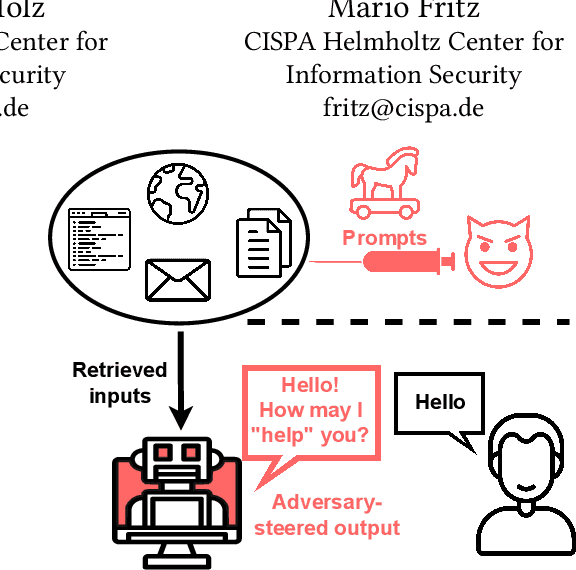
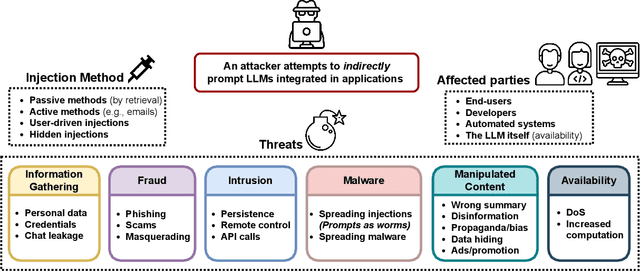
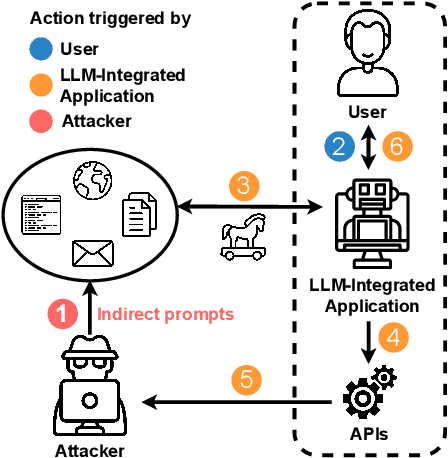
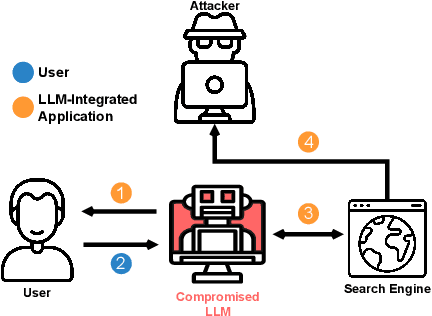
We are currently witnessing dramatic advances in the capabilities of Large Language Models (LLMs). They are already being adopted in practice and integrated into many systems, including integrated development environments (IDEs) and search engines. The functionalities of current LLMs can be modulated via natural language prompts, while their exact internal functionality remains implicit and unassessable. This property, which makes them adaptable to even unseen tasks, might also make them susceptible to targeted adversarial prompting. Recently, several ways to misalign LLMs using Prompt Injection (PI) attacks have been introduced. In such attacks, an adversary can prompt the LLM to produce malicious content or override the original instructions and the employed filtering schemes. Recent work showed that these attacks are hard to mitigate, as state-of-the-art LLMs are instruction-following. So far, these attacks assumed that the adversary is directly prompting the LLM. In this work, we show that augmenting LLMs with retrieval and API calling capabilities (so-called Application-Integrated LLMs) induces a whole new set of attack vectors. These LLMs might process poisoned content retrieved from the Web that contains malicious prompts pre-injected and selected by adversaries. We demonstrate that an attacker can indirectly perform such PI attacks. Based on this key insight, we systematically analyze the resulting threat landscape of Application-Integrated LLMs and discuss a variety of new attack vectors. To demonstrate the practical viability of our attacks, we implemented specific demonstrations of the proposed attacks within synthetic applications. In summary, our work calls for an urgent evaluation of current mitigation techniques and an investigation of whether new techniques are needed to defend LLMs against these threats.