 Add to Chrome
 Add to Firefox
 Add to Edge
GAIA-v2-LILT: Multilingual Adaptation of Agent Benchmark beyond Translation
Apr 27, 2026
Agent benchmarks remain largely English-centric, while their multilingual versions are often built with machine translation (MT) and limited post-editing. We argue that, for agentic tasks, this minimal workflow can easily break benchmark validity through query-answer misalignment or culturally off-target context. We propose a refined workflow for adapting English benchmarks into multiple languages with explicit functional alignment, cultural alignment, and difficulty calibration using both automated checks and human review. Using this workflow, we introduce GAIA-v2-LILT, a re-audited multilingual extension of GAIA covering five non-English languages. In experiments, our workflow improves agent success rates by up to 32.7% over minimally translated versions, bringing the closest audited setting to within 3.1% of English performance while substantial gaps remain in many other cases. This indicates that a substantial share of the multilingual performance gap is benchmark-induced measurement error, motivating task-level alignment when adapting English benchmarks across languages. The data is available as part of the MAPS package at https://huggingface.co/datasets/Fujitsu-FRE/MAPS/viewer/GAIA-v2-LILT. We also release the code used in our experiments at https://github.com/lilt/gaia-v2-lilt.

Cross-lingual Human-Preference Alignment for Neural Machine Translation with Direct Quality Optimization
Sep 26, 2024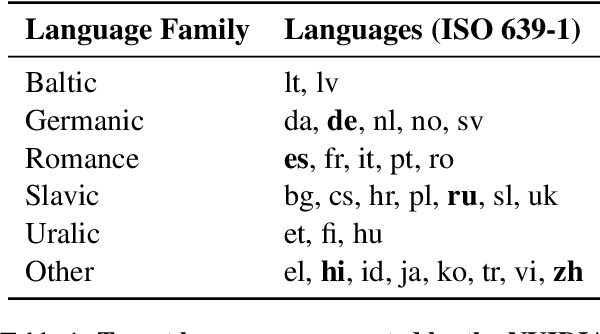
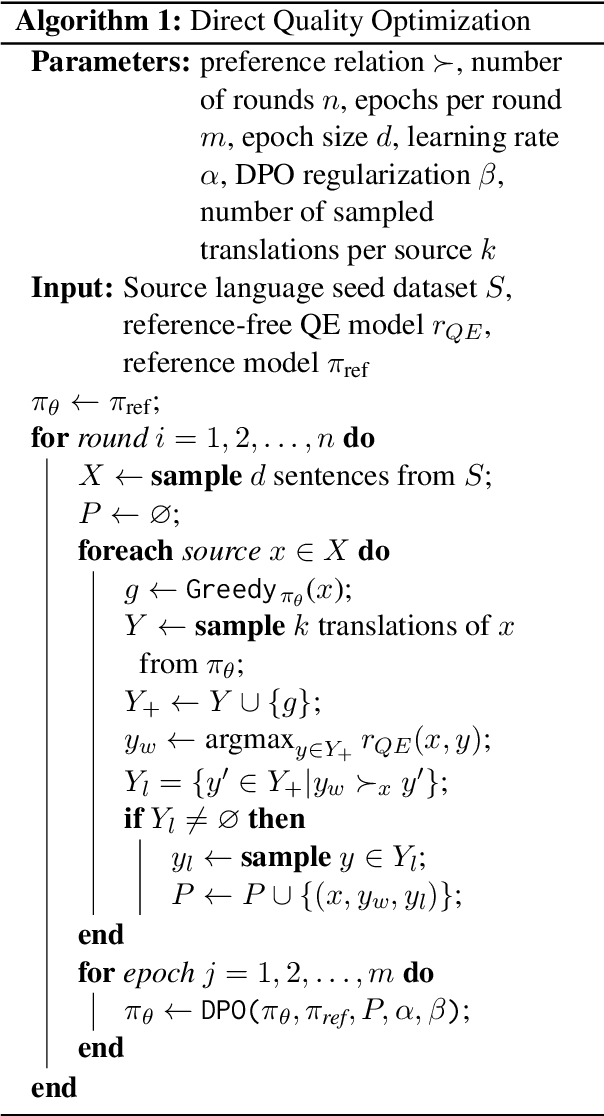
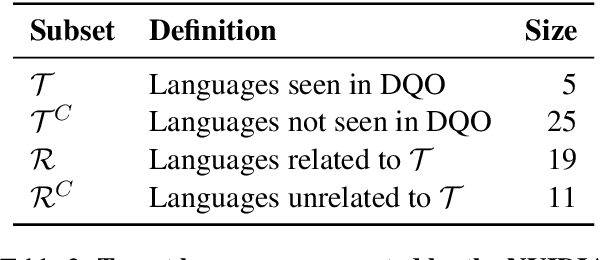
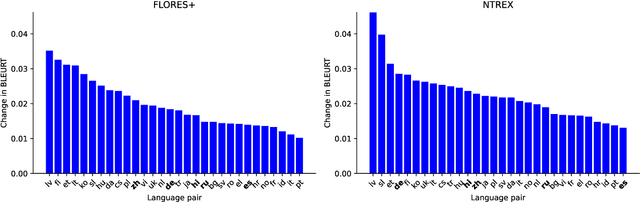
Reinforcement Learning from Human Feedback (RLHF) and derivative techniques like Direct Preference Optimization (DPO) are task-alignment algorithms used to repurpose general, foundational models for specific tasks. We show that applying task-alignment to neural machine translation (NMT) addresses an existing task--data mismatch in NMT, leading to improvements across all languages of a multilingual model, even when task-alignment is only applied to a subset of those languages. We do so by introducing Direct Quality Optimization (DQO), a variant of DPO leveraging a pre-trained translation quality estimation model as a proxy for human preferences, and verify the improvements with both automatic metrics and human evaluation.
Neural Machine Translation Models Can Learn to be Few-shot Learners
Sep 15, 2023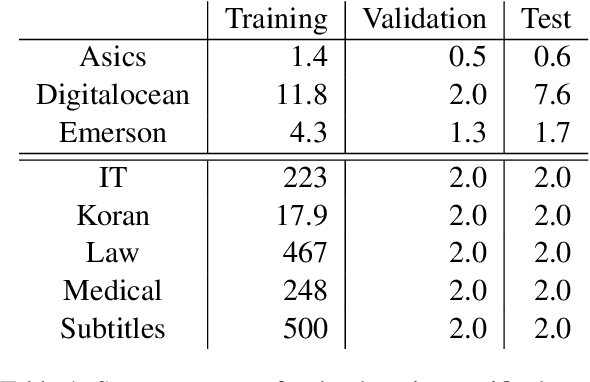

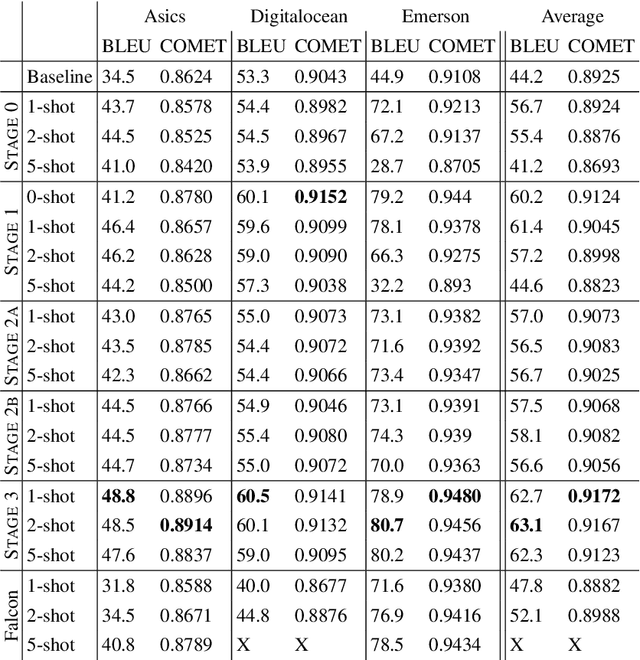
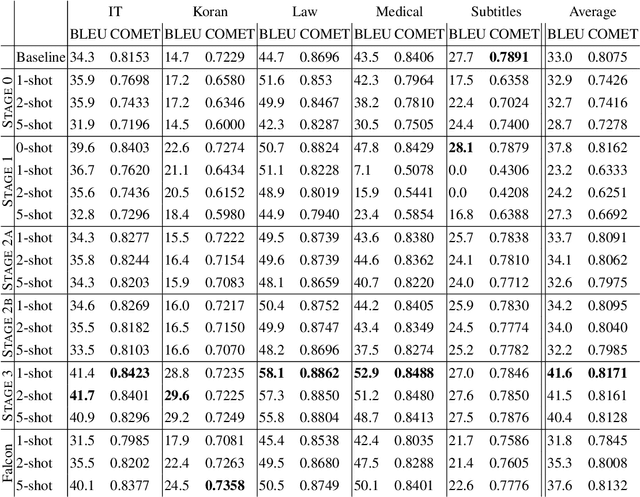
The emergent ability of Large Language Models to use a small number of examples to learn to perform in novel domains and tasks, also called in-context learning (ICL). In this work, we show that a much smaller model can be trained to perform ICL by fine-tuning towards a specialized training objective, exemplified on the task of domain adaptation for neural machine translation. With this capacity for ICL, the model can take advantage of relevant few-shot examples to adapt its output towards the domain. We compare the quality of this domain adaptation to traditional supervised techniques and ICL with a 40B-parameter Large Language Model. Our approach allows efficient batch inference on a mix of domains and outperforms state-of-the-art baselines in terms of both translation quality and immediate adaptation rate, i.e. the ability to reproduce a specific term after being shown a single example.