 Add to Chrome
 Add to Firefox
 Add to Edge
Rule-Based Spatial Mixture-of-Experts U-Net for Explainable Edge Detection
Feb 04, 2026
Deep learning models like U-Net and its variants, have established state-of-the-art performance in edge detection tasks and are used by Generative AI services world-wide for their image generation models. However, their decision-making processes remain opaque, operating as "black boxes" that obscure the rationale behind specific boundary predictions. This lack of transparency is a critical barrier in safety-critical applications where verification is mandatory. To bridge the gap between high-performance deep learning and interpretable logic, we propose the Rule-Based Spatial Mixture-of-Experts U-Net (sMoE U-Net). Our architecture introduces two key innovations: (1) Spatially-Adaptive Mixture-of-Experts (sMoE) blocks integrated into the decoder skip connections, which dynamically gate between "Context" (smooth) and "Boundary" (sharp) experts based on local feature statistics; and (2) a Takagi-Sugeno-Kang (TSK) Fuzzy Head that replaces the standard classification layer. This fuzzy head fuses deep semantic features with heuristic edge signals using explicit IF-THEN rules. We evaluate our method on the BSDS500 benchmark, achieving an Optimal Dataset Scale (ODS) F-score of 0.7628, effectively matching purely deep baselines like HED (0.7688) while outperforming the standard U-Net (0.7437). Crucially, our model provides pixel-level explainability through "Rule Firing Maps" and "Strategy Maps," allowing users to visualize whether an edge was detected due to strong gradients, high semantic confidence, or specific logical rule combinations.

A Comparative Study of Adversarial Robustness in CNN and CNN-ANFIS Architectures
Feb 02, 2026Convolutional Neural Networks (CNNs) achieve strong image classification performance but lack interpretability and are vulnerable to adversarial attacks. Neuro-fuzzy hybrids such as DCNFIS replace fully connected CNN classifiers with Adaptive Neuro-Fuzzy Inference Systems (ANFIS) to improve interpretability, yet their robustness remains underexplored. This work compares standard CNNs (ConvNet, VGG, ResNet18) with their ANFIS-augmented counterparts on MNIST, Fashion-MNIST, CIFAR-10, and CIFAR-100 under gradient-based (PGD) and gradient-free (Square) attacks. Results show that ANFIS integration does not consistently improve clean accuracy and has architecture-dependent effects on robustness: ResNet18-ANFIS exhibits improved adversarial robustness, while VGG-ANFIS often underperforms its baseline. These findings suggest that neuro-fuzzy augmentation can enhance robustness in specific architectures but is not universally beneficial.
Fuzzy-RRT for Obstacle Avoidance in a 2-DOF Semi-Autonomous Surgical Robotic Arm
Apr 24, 2025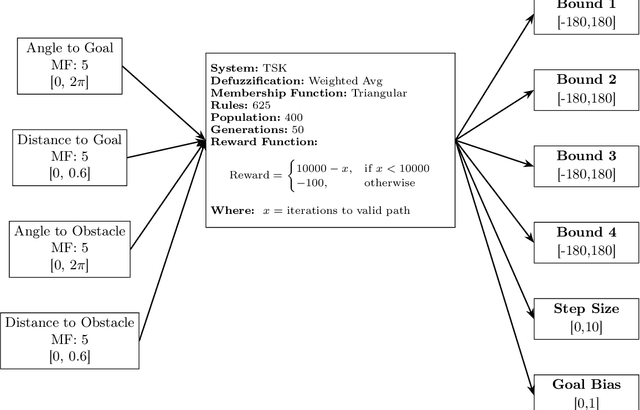
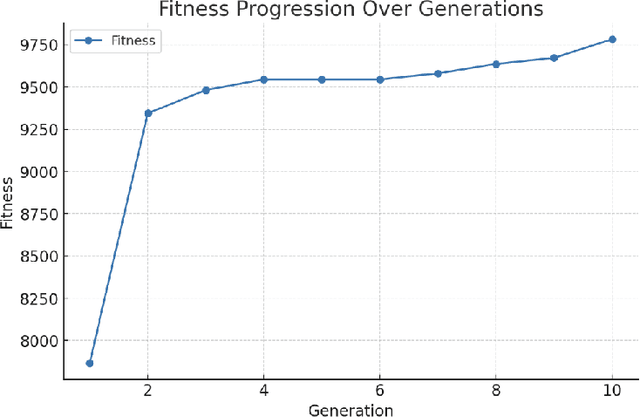
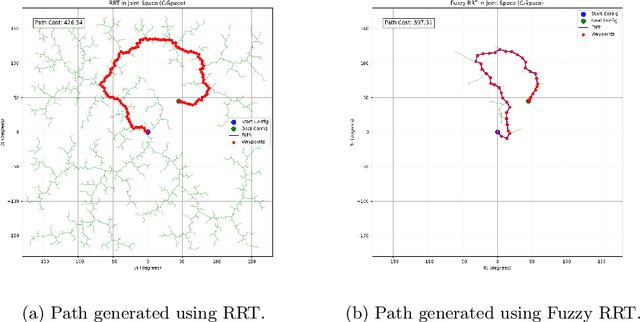
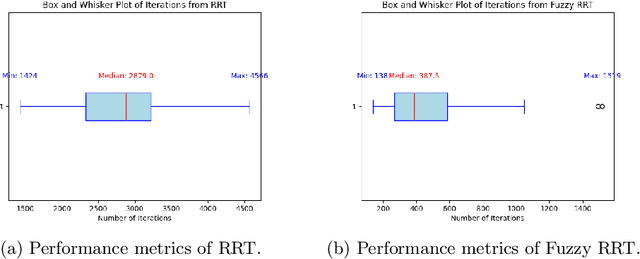
AI-driven semi-autonomous robotic surgery is essential for addressing the medical challenges of long-duration interplanetary missions, where limited crew sizes and communication delays restrict traditional surgical approaches. Current robotic surgery systems require full surgeon control, demanding extensive expertise and limiting feasibility in space. We propose a novel adaptation of the Fuzzy Rapidly-exploring Random Tree algorithm for obstacle avoidance and collaborative control in a two-degree-of-freedom robotic arm modeled on the Miniaturized Robotic-Assisted surgical system. It was found that the Fuzzy Rapidly-exploring Random Tree algorithm resulted in an 743 percent improvement to path search time and 43 percent improvement to path cost.