 Add to Chrome
 Add to Firefox
 Add to Edge
AI Sandbox: Technical Report
Aug 02, 2026
Collaborative AI experimentation across industry and academia requires platforms that enable rapid prototyping while preserving controlled access, tenant separation, and transparent workflows. Despite growing interest in AI sandboxes, there is still limited practical guidance on how to design and implement platforms that integrate experimentation capabilities with governance requirements. This work presents the design and implementation of a governance-aware, multi-tenant AI sandbox for structured experimentation and the generation of reusable evaluation evidence across projects and stakeholder groups. The sandbox was developed within an industry-academia collaboration based on requirements that were iteratively refined with industrial partners. Its reference architecture separates the multi-tenant user interface from the backend control plane and places execution and data-management functions in dedicated layers. The platform supports governed user onboarding, project-centered collaboration, managed access to AI services, approval workflows, audit logging, and traceable experimentation. Experiment configurations, contextual information, and governance decisions are stored as persistent records, allowing evidence and outcomes to be compared and reused across projects. The development process provides practical lessons for deploying and extending governance-aware AI sandbox platforms in collaborative research and industrial environments.

Vibe Coding in Practice: Flow, Technical Debt, and Guidelines for Sustainable Use
Dec 11, 2025Vibe Coding (VC) is a form of software development assisted by generative AI, in which developers describe the intended functionality or logic via natural language prompts, and the AI system generates the corresponding source code. VC can be leveraged for rapid prototyping or developing the Minimum Viable Products (MVPs); however, it may introduce several risks throughout the software development life cycle. Based on our experience from several internally developed MVPs and a review of recent industry reports, this article analyzes the flow-debt tradeoffs associated with VC. The flow-debt trade-off arises when the seamless code generation occurs, leading to the accumulation of technical debt through architectural inconsistencies, security vulnerabilities, and increased maintenance overhead. These issues originate from process-level weaknesses, biases in model training data, a lack of explicit design rationale, and a tendency to prioritize quick code generation over human-driven iterative development. Based on our experiences, we identify and explain how current model, platform, and hardware limitations contribute to these issues, and propose countermeasures to address them, informing research and practice towards more sustainable VC approaches.
Developing Retrieval Augmented Generation (RAG) based LLM Systems from PDFs: An Experience Report
Oct 21, 2024
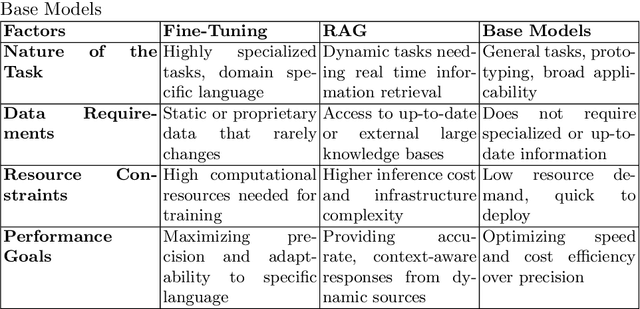
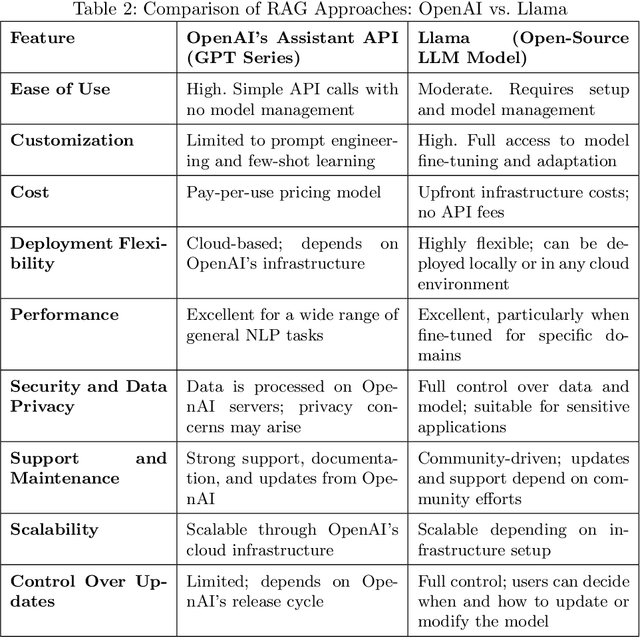
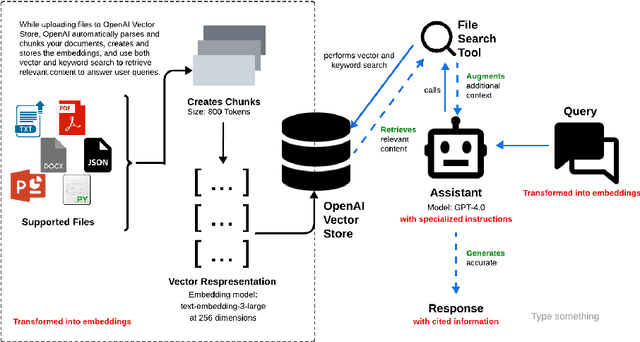
This paper presents an experience report on the development of Retrieval Augmented Generation (RAG) systems using PDF documents as the primary data source. The RAG architecture combines generative capabilities of Large Language Models (LLMs) with the precision of information retrieval. This approach has the potential to redefine how we interact with and augment both structured and unstructured knowledge in generative models to enhance transparency, accuracy, and contextuality of responses. The paper details the end-to-end pipeline, from data collection, preprocessing, to retrieval indexing and response generation, highlighting technical challenges and practical solutions. We aim to offer insights to researchers and practitioners developing similar systems using two distinct approaches: OpenAI's Assistant API with GPT Series and Llama's open-source models. The practical implications of this research lie in enhancing the reliability of generative AI systems in various sectors where domain-specific knowledge and real-time information retrieval is important. The Python code used in this work is also available at: https://github.com/GPT-Laboratory/RAG-LLM-Development-Guidebook-from-PDFs.