 Add to Chrome
 Add to Firefox
 Add to Edge
Is Natural Always Appropriate? Investigating Naturalness and Appropriateness Across Different Domains for TTS Evaluation
Jun 30, 2026
Text-to-speech (TTS) evaluation is an open challenge. While the primary target was "naturalness," recent fidelity gains shifted focus toward "appropriateness" and whether speech is correct for its context. In this work, we examine how perception changes when the expected downstream use varies. We measure the appropriateness and human-likeness of five SOTA TTS systems across five domains: AI assistant, reader, actor, animated character, and spontaneous speaker. Results show appropriateness varies across domains independently of naturalness. While systems shine at reading, expressive domains remain challenging, and optimizing for one can degrade others. Furthermore, naturalness scores tend to penalize stylized speech while rewarding spontaneity. Finally, our study also highlights blind spots in one-size-fits-all evaluation metrics across more expressive domains. We demonstrate that TTS performance is not "solved" but depends on the target domain, requiring context-aware evaluation.

Users and Wizards in Conversations: How WoZ Interface Choices Define Human-Robot Interactions
Mar 30, 2026In this paper, we investigated how the choice of a Wizard-of-Oz (WoZ) interface affects communication with a robot from both the user's and the wizard's perspective. In a conversational setting, we used three WoZ interfaces with varying levels of dialogue input and output restrictions: a) a restricted perception GUI that showed fixed-view video and ASR transcripts and let the wizard trigger pre-scripted utterances and gestures; b) an unrestricted perception GUI that added real-time audio from the participant and the robot c) a VR telepresence interface that streamed immersive stereo video and audio to the wizard and forwarded the wizard's spontaneous speech, gaze and facial expressions to the robot. We found that the interaction mediated by the VR interface was preferred by users in terms of robot features and perceived social presence. For the wizards, the VR condition turned out to be the most demanding but elicited a higher social connection with the users. VR interface also induced the most connected interaction in terms of inter-speaker gaps and overlaps, while Restricted GUI induced the least connected flow and the largest silences. Given these results, we argue for more WoZ studies using telepresence interfaces. These studies better reflect the robots of tomorrow and offer a promising path to automation based on naturalistic contextualized verbal and non-verbal behavioral data.
Human-Robot Interaction Conversational User Enjoyment Scale (HRI CUES)
May 02, 2024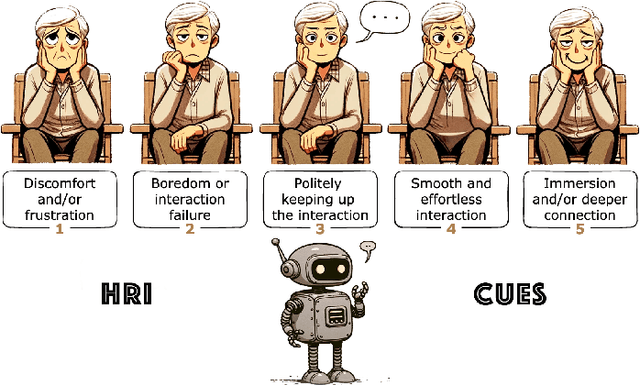
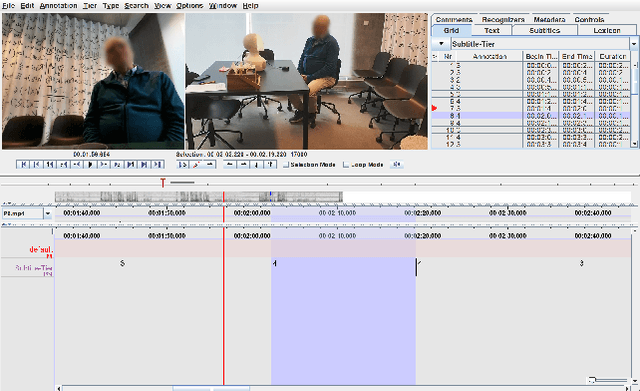
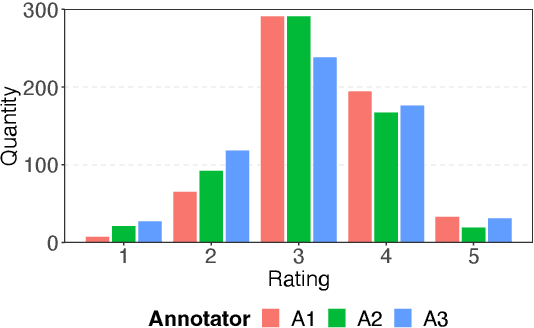
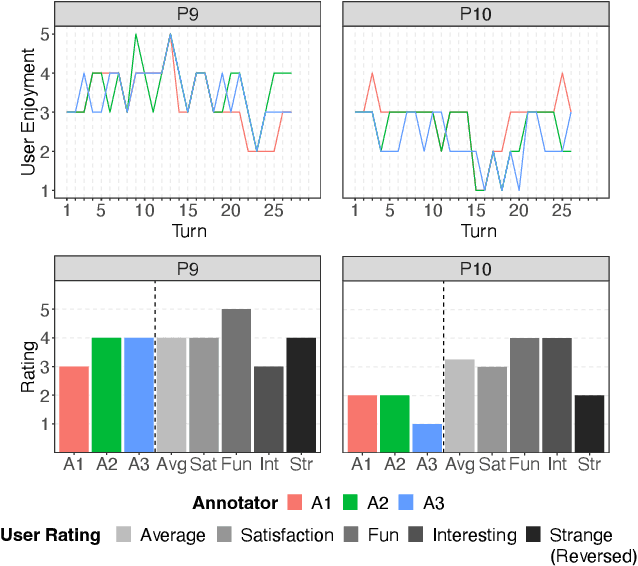
Understanding user enjoyment is crucial in human-robot interaction (HRI), as it can impact interaction quality and influence user acceptance and long-term engagement with robots, particularly in the context of conversations with social robots. However, current assessment methods rely solely on self-reported questionnaires, failing to capture interaction dynamics. This work introduces the Human-Robot Interaction Conversational User Enjoyment Scale (HRI CUES), a novel scale for assessing user enjoyment from an external perspective during conversations with a robot. Developed through rigorous evaluations and discussions of three annotators with relevant expertise, the scale provides a structured framework for assessing enjoyment in each conversation exchange (turn) alongside overall interaction levels. It aims to complement self-reported enjoyment from users and holds the potential for autonomously identifying user enjoyment in real-time HRI. The scale was validated on 25 older adults' open-domain dialogue with a companion robot that was powered by a large language model for conversations, corresponding to 174 minutes of data, showing moderate to good alignment. Additionally, the study offers insights into understanding the nuances and challenges of assessing user enjoyment in robot interactions, and provides guidelines on applying the scale to other domains.