 Add to Chrome
 Add to Firefox
 Add to Edge
Users and Wizards in Conversations: How WoZ Interface Choices Define Human-Robot Interactions
Mar 30, 2026
In this paper, we investigated how the choice of a Wizard-of-Oz (WoZ) interface affects communication with a robot from both the user's and the wizard's perspective. In a conversational setting, we used three WoZ interfaces with varying levels of dialogue input and output restrictions: a) a restricted perception GUI that showed fixed-view video and ASR transcripts and let the wizard trigger pre-scripted utterances and gestures; b) an unrestricted perception GUI that added real-time audio from the participant and the robot c) a VR telepresence interface that streamed immersive stereo video and audio to the wizard and forwarded the wizard's spontaneous speech, gaze and facial expressions to the robot. We found that the interaction mediated by the VR interface was preferred by users in terms of robot features and perceived social presence. For the wizards, the VR condition turned out to be the most demanding but elicited a higher social connection with the users. VR interface also induced the most connected interaction in terms of inter-speaker gaps and overlaps, while Restricted GUI induced the least connected flow and the largest silences. Given these results, we argue for more WoZ studies using telepresence interfaces. These studies better reflect the robots of tomorrow and offer a promising path to automation based on naturalistic contextualized verbal and non-verbal behavioral data.

Happily Error After: Framework Development and User Study for Correcting Robot Perception Errors in Virtual Reality
Jun 26, 2023
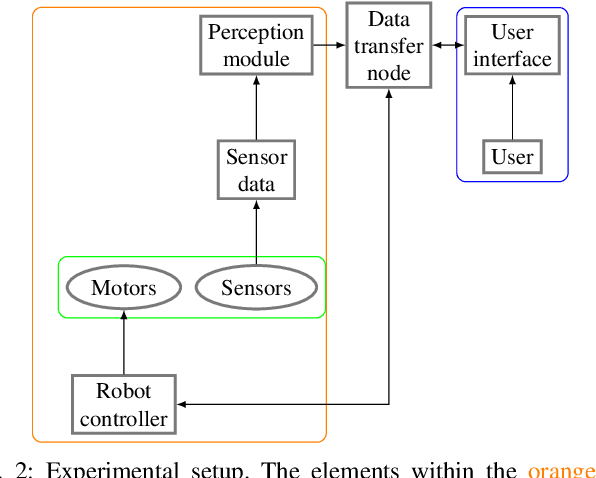
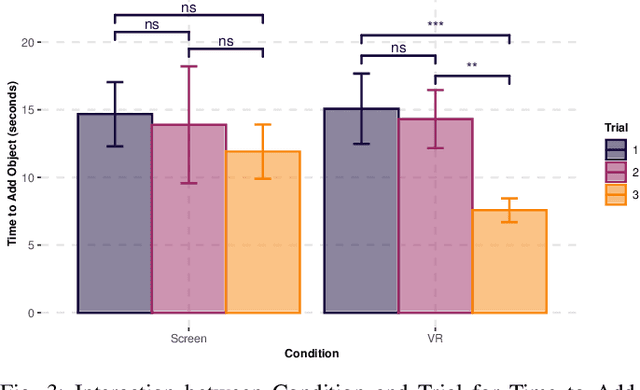

While we can see robots in more areas of our lives, they still make errors. One common cause of failure stems from the robot perception module when detecting objects. Allowing users to correct such errors can help improve the interaction and prevent the same errors in the future. Consequently, we investigate the effectiveness of a virtual reality (VR) framework for correcting perception errors of a Franka Panda robot. We conducted a user study with 56 participants who interacted with the robot using both VR and screen interfaces. Participants learned to collaborate with the robot faster in the VR interface compared to the screen interface. Additionally, participants found the VR interface more immersive, enjoyable, and expressed a preference for using it again. These findings suggest that VR interfaces may offer advantages over screen interfaces for human-robot interaction in erroneous environments.
What you see is what you get: A VR Framework for Correcting Robot Errors
Jan 17, 2023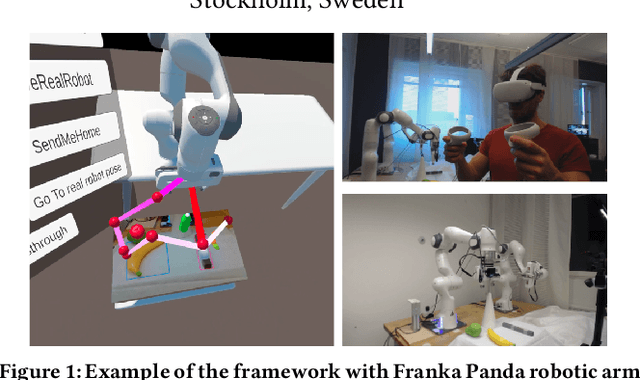


Many solutions tailored for intuitive visualization or teleoperation of virtual, augmented and mixed (VAM) reality systems are not robust to robot failures, such as the inability to detect and recognize objects in the environment or planning unsafe trajectories. In this paper, we present a novel virtual reality (VR) framework where users can (i) recognize when the robot has failed to detect a real-world object, (ii) correct the error in VR, (iii) modify proposed object trajectories and, (iv) implement behaviors on a real-world robot. Finally, we propose a user study aimed at testing the efficacy of our framework. Project materials can be found in the OSF repository.