 Add to Chrome
 Add to Firefox
 Add to Edge
Skinned Motion Retargeting with Spatially Adaptive Interaction Guidance
May 19, 2026
Retargeting motion across characters with varying body shapes while preserving interaction semantics, such as self-contact and near-body proximity, remains a challenging problem. While recent geometry-aware approaches address this by maintaining spatial relationships between predefined corresponding regions, their reliance on static correspondences often struggles when the target character exhibits exaggerated body proportions. In this paper, we present a geometry-aware motion retargeting framework that preserves interaction semantics by performing proximity matching over spatially adaptive anchors. Unlike prior methods with static anchor definitions, the proposed method dynamically repositions anchors to reachable regions on the target character. This is achieved via a Transformer-based anchor refinement strategy that predicts anchor displacements and constrains the translated anchors to remain on the target character geometry through differentiable soft projection. By incorporating pose-dependent spatial structures from the source character, the adapted anchors provide structurally coherent guidance for interaction-aware retargeting. Conditioned on these anchors, a graph-based autoencoder predicts target skeletal motion that preserves the spatial configuration of the source. To encourage task-aligned optimization between anchor adaptation and motion retargeting, we adopt an alternating training scheme in which each module is optimized in turn. Through extensive evaluations, we demonstrate that our method outperforms state-of-the-art approaches in preserving interaction fidelity across diverse character geometries.

Stylized Text-to-Motion Generation via Hypernetwork-Driven Low-Rank Adaptation
May 13, 2026Text-driven motion diffusion models are capable of generating realistic human motions, but text alone often struggles to express fine-level nuances of motion, commonly referred to as style. Recent approaches have tackled this challenge by attaching a style injection mechanism to a pretrained text-driven diffusion model. Existing stylization methods, however, either require style-specific fine-tuning of existing models or rely on heavy ControlNet-based architectures, limiting efficiency and generalization to unseen styles. We propose a lightweight style conditioning framework that dynamically modulates a pretrained diffusion model through hypernetwork-generated LoRA parameters. A style reference motion is encoded into a global style embedding, which is mapped by a hypernetwork to low-rank updates applied at each denoising step of the diffusion model. By structuring the style latent space with a supervised contrastive loss, our framework reliably captures diverse stylistic attributes, improves generalization to unseen styles, and supports optimization-based guidance without requiring predefined style categories. Experiments on the HumanML3D and 100STYLE datasets show state-of-the-art stylization results, while achieving improved stylization for unseen styles.
StyleID: A Perception-Aware Dataset and Metric for Stylization-Agnostic Facial Identity Recognition
Apr 23, 2026Creative face stylization aims to render portraits in diverse visual idioms such as cartoons, sketches, and paintings while retaining recognizable identity. However, current identity encoders, which are typically trained and calibrated on natural photographs, exhibit severe brittleness under stylization. They often mistake changes in texture or color palette for identity drift or fail to detect geometric exaggerations. This reveals the lack of a style-agnostic framework to evaluate and supervise identity consistency across varying styles and strengths. To address this gap, we introduce StyleID, a human perception-aware dataset and evaluation framework for facial identity under stylization. StyleID comprises two datasets: (i) StyleBench-H, a benchmark that captures human same-different verification judgments across diffusion- and flow-matching-based stylization at multiple style strengths, and (ii) StyleBench-S, a supervision set derived from psychometric recognition-strength curves obtained through controlled two-alternative forced-choice (2AFC) experiments. Leveraging StyleBench-S, we fine-tune existing semantic encoders to align their similarity orderings with human perception across styles and strengths. Experiments demonstrate that our calibrated models yield significantly higher correlation with human judgments and enhanced robustness for out-of-domain, artist drawn portraits. All of our datasets, code, and pretrained models are publicly available at https://kwanyun.github.io/StyleID_page/
ComVi: Context-Aware Optimized Comment Display in Video Playback
Mar 27, 2026On general video-sharing platforms like YouTube, comments are displayed independently of video playback. As viewers often read comments while watching a video, they may encounter ones referring to moments unrelated to the current scene, which can reveal spoilers and disrupt immersion. To address this problem, we present ComVi, a novel system that displays comments at contextually relevant moments, enabling viewers to see time-synchronized comments and video content together. We first map all comments to relevant video timestamps by computing audio-visual correlation, then construct the comment sequence through an optimization that considers temporal relevance, popularity (number of likes), and display duration for comfortable reading. In a user study, ComVi provided a significantly more engaging experience than conventional video interfaces (i.e., YouTube and Danmaku), with 71.9% of participants selecting ComVi as their most preferred interface.
X-AVDT: Audio-Visual Cross-Attention for Robust Deepfake Detection
Mar 09, 2026The surge of highly realistic synthetic videos produced by contemporary generative systems has significantly increased the risk of malicious use, challenging both humans and existing detectors. Against this backdrop, we take a generator-side view and observe that internal cross-attention mechanisms in these models encode fine-grained speech-motion alignment, offering useful correspondence cues for forgery detection. Building on this insight, we propose X-AVDT, a robust and generalizable deepfake detector that probes generator-internal audio-visual signals accessed via DDIM inversion to expose these cues. X-AVDT extracts two complementary signals: (i) a video composite capturing inversion-induced discrepancies, and (ii) an audio-visual cross-attention feature reflecting modality alignment enforced during generation. To enable faithful cross-generator evaluation, we further introduce MMDF, a new multimodal deepfake dataset spanning diverse manipulation types and rapidly evolving synthesis paradigms, including GANs, diffusion, and flow-matching. Extensive experiments demonstrate that X-AVDT achieves leading performance on MMDF and generalizes strongly to external benchmarks and unseen generators, outperforming existing methods with accuracy improved by 13.1%. Our findings highlight the importance of leveraging internal audio-visual consistency cues for robustness to future generators in deepfake detection.
Deep Learning Based Facial Retargeting Using Local Patches
Jan 13, 2026In the era of digital animation, the quest to produce lifelike facial animations for virtual characters has led to the development of various retargeting methods. While the retargeting facial motion between models of similar shapes has been very successful, challenges arise when the retargeting is performed on stylized or exaggerated 3D characters that deviate significantly from human facial structures. In this scenario, it is important to consider the target character's facial structure and possible range of motion to preserve the semantics assumed by the original facial motions after the retargeting. To achieve this, we propose a local patch-based retargeting method that transfers facial animations captured in a source performance video to a target stylized 3D character. Our method consists of three modules. The Automatic Patch Extraction Module extracts local patches from the source video frame. These patches are processed through the Reenactment Module to generate correspondingly re-enacted target local patches. The Weight Estimation Module calculates the animation parameters for the target character at every frame for the creation of a complete facial animation sequence. Extensive experiments demonstrate that our method can successfully transfer the semantic meaning of source facial expressions to stylized characters with considerable variations in facial feature proportion.
* Eurographics 25
Neural Face Skinning for Mesh-agnostic Facial Expression Cloning
May 28, 2025
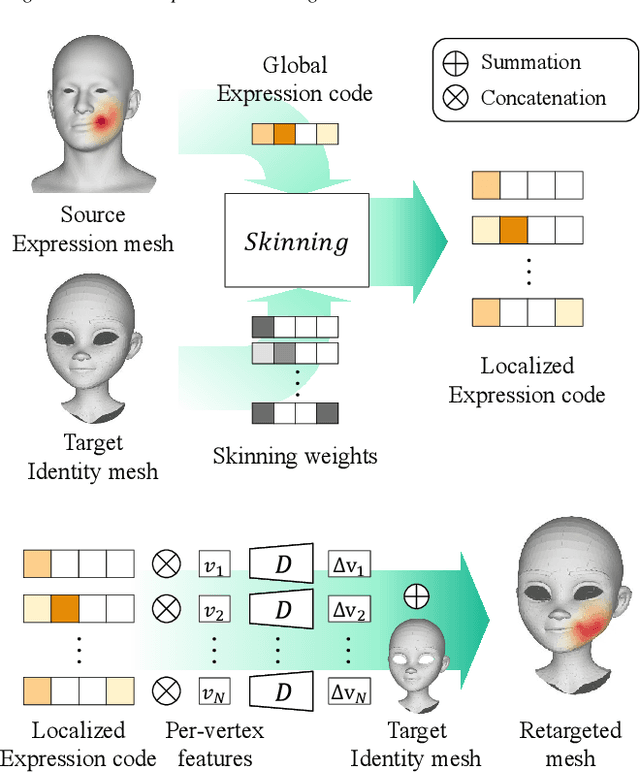
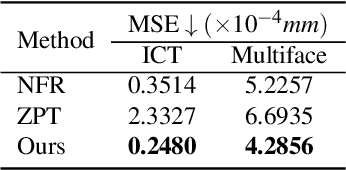
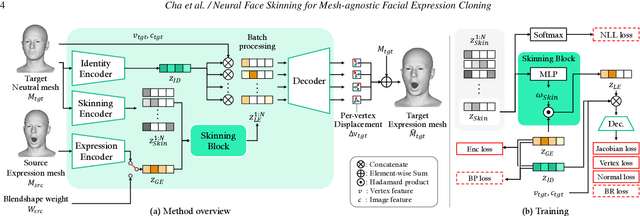
Accurately retargeting facial expressions to a face mesh while enabling manipulation is a key challenge in facial animation retargeting. Recent deep-learning methods address this by encoding facial expressions into a global latent code, but they often fail to capture fine-grained details in local regions. While some methods improve local accuracy by transferring deformations locally, this often complicates overall control of the facial expression. To address this, we propose a method that combines the strengths of both global and local deformation models. Our approach enables intuitive control and detailed expression cloning across diverse face meshes, regardless of their underlying structures. The core idea is to localize the influence of the global latent code on the target mesh. Our model learns to predict skinning weights for each vertex of the target face mesh through indirect supervision from predefined segmentation labels. These predicted weights localize the global latent code, enabling precise and region-specific deformations even for meshes with unseen shapes. We supervise the latent code using Facial Action Coding System (FACS)-based blendshapes to ensure interpretability and allow straightforward editing of the generated animation. Through extensive experiments, we demonstrate improved performance over state-of-the-art methods in terms of expression fidelity, deformation transfer accuracy, and adaptability across diverse mesh structures.
SALAD: Skeleton-aware Latent Diffusion for Text-driven Motion Generation and Editing
Mar 18, 2025
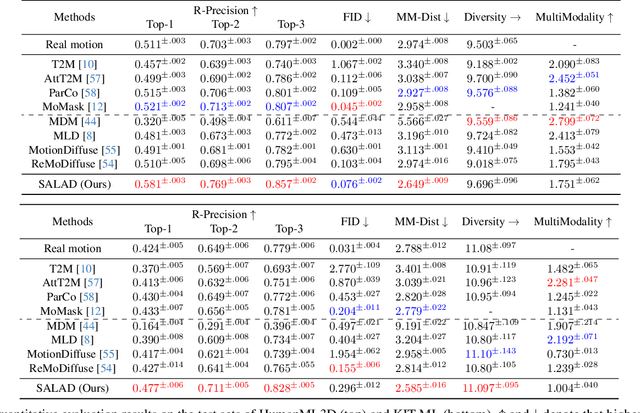

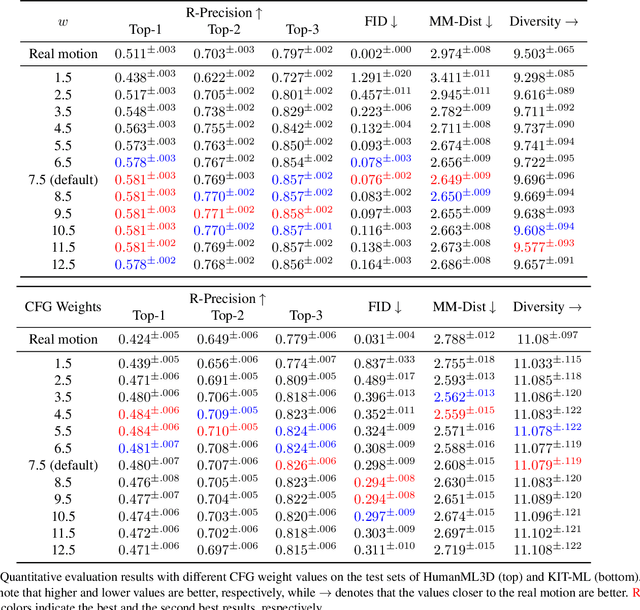
Text-driven motion generation has advanced significantly with the rise of denoising diffusion models. However, previous methods often oversimplify representations for the skeletal joints, temporal frames, and textual words, limiting their ability to fully capture the information within each modality and their interactions. Moreover, when using pre-trained models for downstream tasks, such as editing, they typically require additional efforts, including manual interventions, optimization, or fine-tuning. In this paper, we introduce a skeleton-aware latent diffusion (SALAD), a model that explicitly captures the intricate inter-relationships between joints, frames, and words. Furthermore, by leveraging cross-attention maps produced during the generation process, we enable attention-based zero-shot text-driven motion editing using a pre-trained SALAD model, requiring no additional user input beyond text prompts. Our approach significantly outperforms previous methods in terms of text-motion alignment without compromising generation quality, and demonstrates practical versatility by providing diverse editing capabilities beyond generation. Code is available at project page.
ASMR: Adaptive Skeleton-Mesh Rigging and Skinning via 2D Generative Prior
Mar 17, 2025Despite the growing accessibility of skeletal motion data, integrating it for animating character meshes remains challenging due to diverse configurations of both skeletons and meshes. Specifically, the body scale and bone lengths of the skeleton should be adjusted in accordance with the size and proportions of the mesh, ensuring that all joints are accurately positioned within the character mesh. Furthermore, defining skinning weights is complicated by variations in skeletal configurations, such as the number of joints and their hierarchy, as well as differences in mesh configurations, including their connectivity and shapes. While existing approaches have made efforts to automate this process, they hardly address the variations in both skeletal and mesh configurations. In this paper, we present a novel method for the automatic rigging and skinning of character meshes using skeletal motion data, accommodating arbitrary configurations of both meshes and skeletons. The proposed method predicts the optimal skeleton aligned with the size and proportion of the mesh as well as defines skinning weights for various mesh-skeleton configurations, without requiring explicit supervision tailored to each of them. By incorporating Diffusion 3D Features (Diff3F) as semantic descriptors of character meshes, our method achieves robust generalization across different configurations. To assess the performance of our method in comparison to existing approaches, we conducted comprehensive evaluations encompassing both quantitative and qualitative analyses, specifically examining the predicted skeletons, skinning weights, and deformation quality.
AnyMoLe: Any Character Motion In-betweening Leveraging Video Diffusion Models
Mar 11, 2025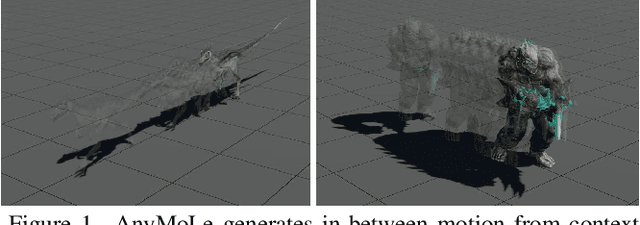
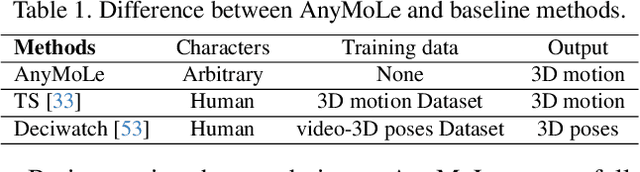
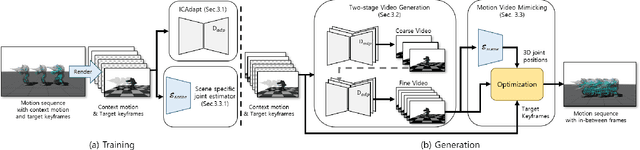

Despite recent advancements in learning-based motion in-betweening, a key limitation has been overlooked: the requirement for character-specific datasets. In this work, we introduce AnyMoLe, a novel method that addresses this limitation by leveraging video diffusion models to generate motion in-between frames for arbitrary characters without external data. Our approach employs a two-stage frame generation process to enhance contextual understanding. Furthermore, to bridge the domain gap between real-world and rendered character animations, we introduce ICAdapt, a fine-tuning technique for video diffusion models. Additionally, we propose a ``motion-video mimicking'' optimization technique, enabling seamless motion generation for characters with arbitrary joint structures using 2D and 3D-aware features. AnyMoLe significantly reduces data dependency while generating smooth and realistic transitions, making it applicable to a wide range of motion in-betweening tasks.