 Add to Chrome
 Add to Firefox
 Add to Edge
Skinned Motion Retargeting with Spatially Adaptive Interaction Guidance
May 19, 2026
Retargeting motion across characters with varying body shapes while preserving interaction semantics, such as self-contact and near-body proximity, remains a challenging problem. While recent geometry-aware approaches address this by maintaining spatial relationships between predefined corresponding regions, their reliance on static correspondences often struggles when the target character exhibits exaggerated body proportions. In this paper, we present a geometry-aware motion retargeting framework that preserves interaction semantics by performing proximity matching over spatially adaptive anchors. Unlike prior methods with static anchor definitions, the proposed method dynamically repositions anchors to reachable regions on the target character. This is achieved via a Transformer-based anchor refinement strategy that predicts anchor displacements and constrains the translated anchors to remain on the target character geometry through differentiable soft projection. By incorporating pose-dependent spatial structures from the source character, the adapted anchors provide structurally coherent guidance for interaction-aware retargeting. Conditioned on these anchors, a graph-based autoencoder predicts target skeletal motion that preserves the spatial configuration of the source. To encourage task-aligned optimization between anchor adaptation and motion retargeting, we adopt an alternating training scheme in which each module is optimized in turn. Through extensive evaluations, we demonstrate that our method outperforms state-of-the-art approaches in preserving interaction fidelity across diverse character geometries.

SALAD: Skeleton-aware Latent Diffusion for Text-driven Motion Generation and Editing
Mar 18, 2025
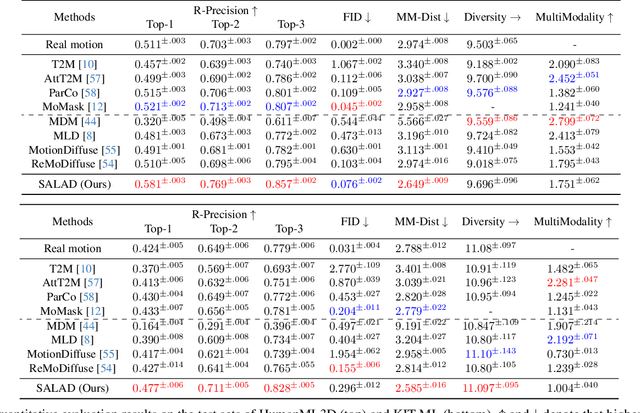

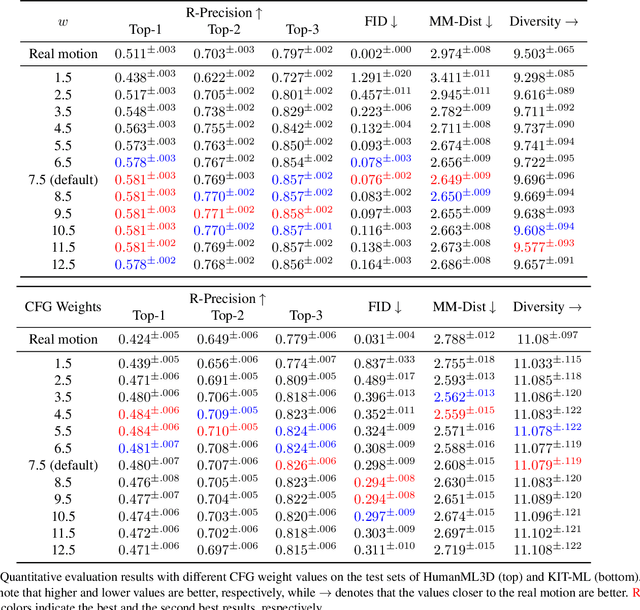
Text-driven motion generation has advanced significantly with the rise of denoising diffusion models. However, previous methods often oversimplify representations for the skeletal joints, temporal frames, and textual words, limiting their ability to fully capture the information within each modality and their interactions. Moreover, when using pre-trained models for downstream tasks, such as editing, they typically require additional efforts, including manual interventions, optimization, or fine-tuning. In this paper, we introduce a skeleton-aware latent diffusion (SALAD), a model that explicitly captures the intricate inter-relationships between joints, frames, and words. Furthermore, by leveraging cross-attention maps produced during the generation process, we enable attention-based zero-shot text-driven motion editing using a pre-trained SALAD model, requiring no additional user input beyond text prompts. Our approach significantly outperforms previous methods in terms of text-motion alignment without compromising generation quality, and demonstrates practical versatility by providing diverse editing capabilities beyond generation. Code is available at project page.