 Add to Chrome
 Add to Firefox
 Add to Edge
Individual Control Barrier Functions-Guided Diffusion Model for Safe Offline Multi-Agent Reinforcement Learning
Jun 10, 2026
Offline reinforcement learning allows control policies to be learned directly from data without online interaction, making it suitable for safety-critical tasks. Recent studies have applied diffusion models to offline reinforcement learning to leverage their strong capacity for modeling complex data distributions. However, existing approaches primarily focus on single-agent settings, leaving the safety challenges in multi-agent environments largely unexplored. In this work, we propose a safe offline multi-agent reinforcement learning algorithm that embeds neural individual control barrier functions into the diffusion model to enhance safety during trajectory generation, with control policies recovered through inverse dynamics. We evaluate our algorithm across diverse benchmarks, demonstrating substantial safety improvements while maintaining competitive rewards.

Priority-Driven Control and Communication in Decentralized Multi-Agent Systems via Reinforcement Learning
May 11, 2026Event-triggered control provides a mechanism for avoiding excessive use of constrained communication bandwidth in networked multi-agent systems. However, most existing methods rely on accurate system models, which may be unavailable in practice. In this work, we propose a model-free, priority-driven reinforcement learning algorithm that learns communication priorities and control policies jointly from data in decentralized multi-agent systems. By learning communication priorities, we circumvent the hybrid action space typical in event-triggered control with binary communication decisions. We evaluate our algorithm on benchmark tasks and demonstrate that it outperforms the baseline method.
Learning State-Space Models for Mapping Spatial Motion Patterns
Sep 01, 2023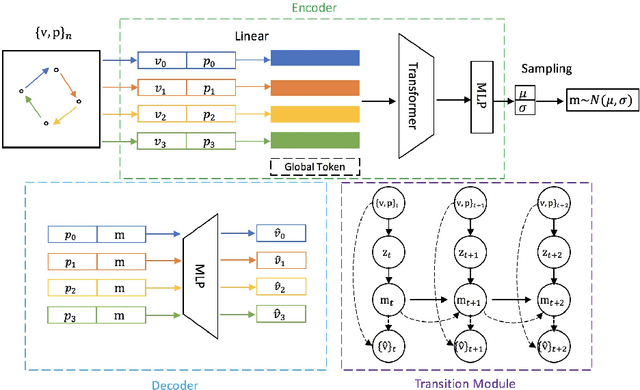
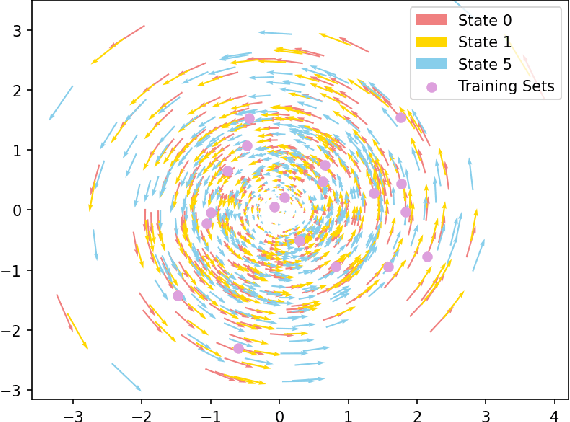
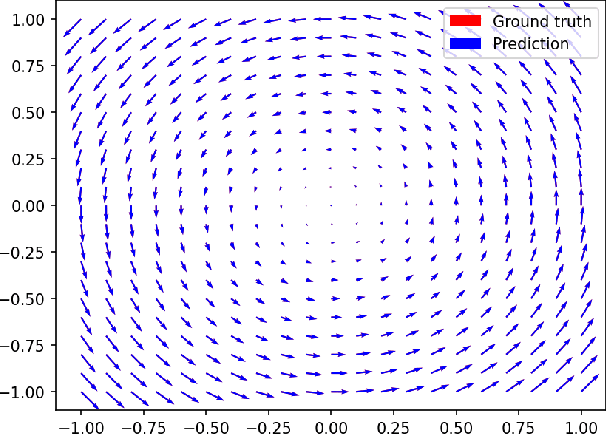
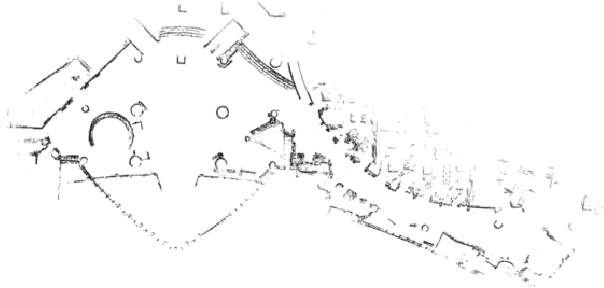
Mapping the surrounding environment is essential for the successful operation of autonomous robots. While extensive research has focused on mapping geometric structures and static objects, the environment is also influenced by the movement of dynamic objects. Incorporating information about spatial motion patterns can allow mobile robots to navigate and operate successfully in populated areas. In this paper, we propose a deep state-space model that learns the map representations of spatial motion patterns and how they change over time at a certain place. To evaluate our methods, we use two different datasets: one generated dataset with specific motion patterns and another with real-world pedestrian data. We test the performance of our model by evaluating its learning ability, mapping quality, and application to downstream tasks. The results demonstrate that our model can effectively learn the corresponding motion pattern, and has the potential to be applied to robotic application tasks.