 Add to Chrome
 Add to Firefox
 Add to Edge
Joint Visibility Analysis of RIS in Non-Terrestrial Networks through Stochastic Geometry
Jun 20, 2026
Non-Terrestrial networks (NTNs) are a key theme in upcoming 6G communications, especially for ubiquitous coverage. Urban environments, comprising of high rise buildings often result in blocking the line of sight (LoS) path between the user equipment (UE) and the NTN base station (NTN-BS). In this paper we investigate the situation where reconfigurable intelligent surfaces (RIS) are deployed on the building roof-tops to ensure multi-hop connectivity between the UE and the NTN-BS. In such a scenario, it becomes crucial to statistically study the LoS visibility of the RIS from the UE as well as from the NTN-BS, hence termed as joint visibility. In this work, accounting for the dual stochasticity arising from the locations of the RIS deployed buildings and the respective random building heights, we statistically study the probability of joint RIS visibility in a two-dimensional (2D) scenario considering a deterministic location of the NTN-BS. Further, we study the joint RIS visibility statistics conditional on the UE-NTN link being LoS or non-LoS. For the RISs deployed as a point point process (PPP) having exponentially distributed heights, the expected RISs jointly visible under the unconditional and conditional geometric settings are derived in closed form. Interestingly, in the 2D setting, the maximum expected RISs jointly visible, unconditionally, is twice the Basel number $(π^2/ 6)$. The simulated results are analyzed over building density, average building height, the altitude and position of the NTN-BS. We also illustrate probability heatmaps, demonstrating the strongest chance to have a RIS used conditioned on the system geometry. This study is expected to be useful in planning the deployment of RIS in urban areas, improving the signal and for assessing economic aspects.

Low-Earth Orbit Satellite Network Analysis: Coverage under Distance-Dependent Shadowing
Sep 06, 2024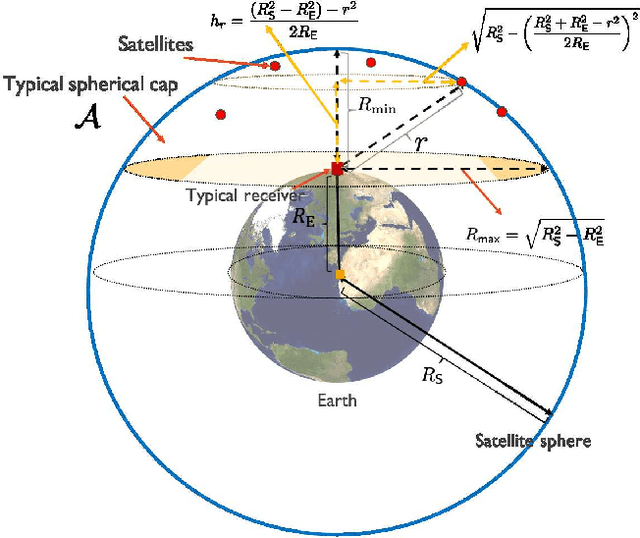
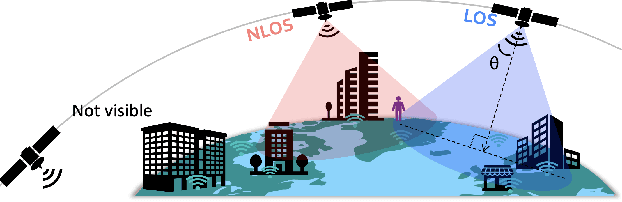
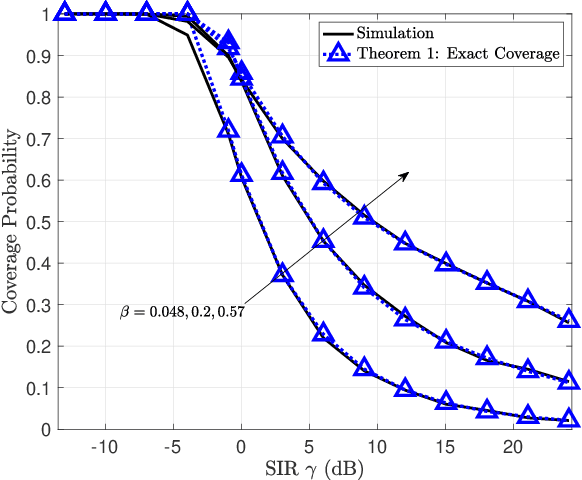
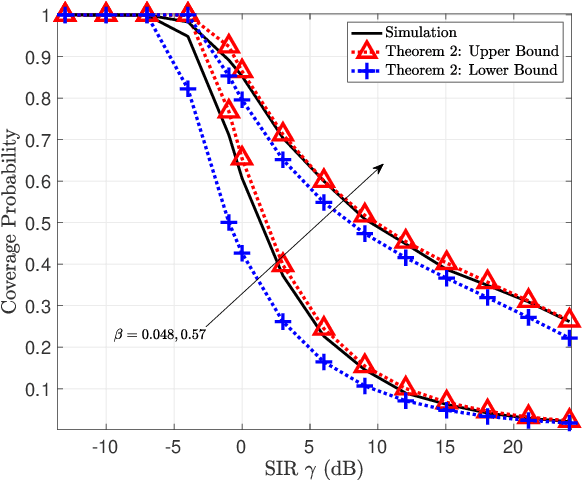
This paper offers a thorough analysis of the coverage performance of Low Earth Orbit (LEO) satellite networks using a strongest satellite association approach, with a particular emphasis on shadowing effects modeled through a Poisson point process (PPP)-based network framework. We derive an analytical expression for the coverage probability, which incorporates key system parameters and a distance-dependent shadowing probability function, explicitly accounting for both line-of-sight and non-line-of-sight propagation channels. To enhance the practical relevance of our findings, we provide both lower and upper bounds for the coverage probability and introduce a closed-form solution based on a simplified shadowing model. Our analysis reveals several important network design insights, including the enhancement of coverage probability by distance-dependent shadowing effects and the identification of an optimal satellite altitude that balances beam gain benefits with interference drawbacks. Notably, our PPP-based network model shows strong alignment with other established models, confirming its accuracy and applicability across a variety of satellite network configurations. The insights gained from our analysis are valuable for optimizing LEO satellite deployment strategies and improving network performance in diverse scenarios.