 Add to Chrome
 Add to Firefox
 Add to Edge
Joint Visibility Analysis of RIS in Non-Terrestrial Networks through Stochastic Geometry
Jun 20, 2026
Non-Terrestrial networks (NTNs) are a key theme in upcoming 6G communications, especially for ubiquitous coverage. Urban environments, comprising of high rise buildings often result in blocking the line of sight (LoS) path between the user equipment (UE) and the NTN base station (NTN-BS). In this paper we investigate the situation where reconfigurable intelligent surfaces (RIS) are deployed on the building roof-tops to ensure multi-hop connectivity between the UE and the NTN-BS. In such a scenario, it becomes crucial to statistically study the LoS visibility of the RIS from the UE as well as from the NTN-BS, hence termed as joint visibility. In this work, accounting for the dual stochasticity arising from the locations of the RIS deployed buildings and the respective random building heights, we statistically study the probability of joint RIS visibility in a two-dimensional (2D) scenario considering a deterministic location of the NTN-BS. Further, we study the joint RIS visibility statistics conditional on the UE-NTN link being LoS or non-LoS. For the RISs deployed as a point point process (PPP) having exponentially distributed heights, the expected RISs jointly visible under the unconditional and conditional geometric settings are derived in closed form. Interestingly, in the 2D setting, the maximum expected RISs jointly visible, unconditionally, is twice the Basel number $(π^2/ 6)$. The simulated results are analyzed over building density, average building height, the altitude and position of the NTN-BS. We also illustrate probability heatmaps, demonstrating the strongest chance to have a RIS used conditioned on the system geometry. This study is expected to be useful in planning the deployment of RIS in urban areas, improving the signal and for assessing economic aspects.

Adaptive Multi-UAV Relay Deployment Framework in Satellite Aerial Ground Integrated Systems
Apr 22, 2026The sixth generation (6G) communication networks are expected to provide high data rates, ultra-reliable communication, and massive connectivity, especially in challenging environments such as dense urban areas and disaster-affected regions. However, traditional terrestrial-only networks face significant challenges in these scenarios, including signal blockages from high-rise buildings, traffic congestion, and dynamic user distributions. To address these limitations, we propose the adaptive multi-UAV deployment (AMUD) framework within satellite air-ground integrated networks (SAGINs). The AMUD framework dynamically deploys amplify-and-forward multiple unmanned aerial vehicle relay (UAVr) in with low Earth orbit (LEO) satellites to improve coverage, alleviate congestion, and ensure reliable communication in non-line-of-sight and high-demand conditions. We formulate an optimization problem that aims to jointly maximize the energy efficiency of the total network and the total capacity while ensuring the fairness of the total capacity and satisfying the users' requirements. The simulation results demonstrate that AMUD improves the total capacity of the network, improves the total energy efficiency, and increases the fairness of the capacity compared to traditional LEO satellite and ground base station (LEO-GBS) only systems.
Timing advance and Doppler shift estimation in LEO satellite networks: A recursive Bayesian study
Jun 10, 2025Low earth orbit (LEO) satellite based non-terrestrial networks are a key theme of the upcoming 6G networks. These space networks are proposed to be used for high-mobility use-cases like airplanes and vehicles. The initial access process between a base station (BS) and a user equipment (UE) involves timing advance (TA) value computation at the BS, requiring precise BS location information at the UE. It becomes more challenging in LEO satellite networks due to the fast moving LEO satellites and large pathloss, in addition to the mobile UE. This paper aims to compute the TA and Doppler shift experienced at the UE by modeling the joint system dynamics in a LEO satellite-mobile UE network through an extended Kalman filter (EKF) based recursive Bayesian framework. The framework accurately models the joint system dynamics by considering the LEO satellite acceleration. It constructs the Jacobian to linearize the inherent non-linearities present in the motion. Probabilistic insights regarding the state-update and propagation are also provided. The analytical framework factors in the limited satellite visibility at the UE and the satellite-UE geometry w.r.t. the earth center. The proposed framework is also useful when the satellite and UE clocks are not in sync, with the corresponding clock drift a function of the measured time difference of arrivals. Our results showcase the efficacy and robustness of the proposed EKF framework to estimate the TA and Doppler shift, even at very high UE speeds. The work is expected to be extremely useful in realizing LEO satellite based non-terrestrial networks.
Cooperative UAV-Relay based Satellite Aerial Ground Integrated Networks
Oct 09, 2024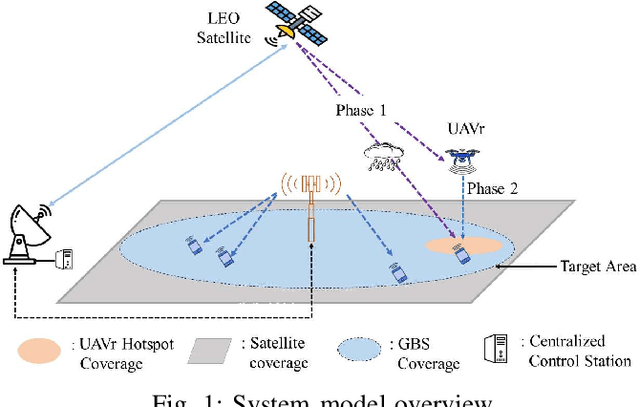
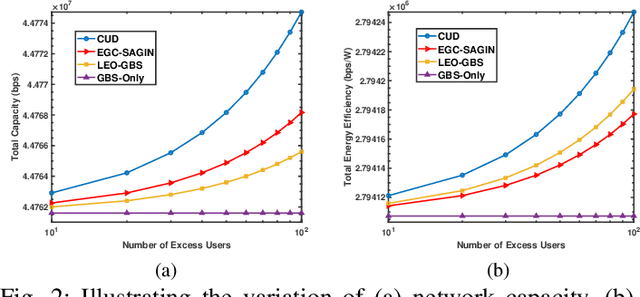
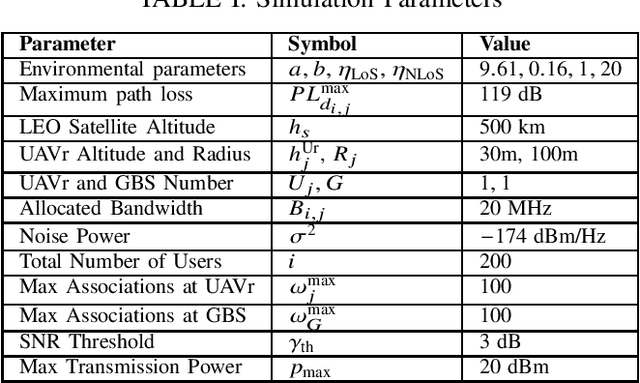
In the post-fifth generation (5G) era, escalating user quality of service (QoS) strains terrestrial network capacity, especially in urban areas with dynamic traffic distributions. This paper introduces a novel cooperative unmanned aerial vehicle relay-based deployment (CUD) framework in satellite air-ground integrated networks (SAGIN). The CUD strategy deploys an unmanned aerial vehicle-based relay (UAVr) in an amplify-andforward (AF) mode to enhance user QoS when terrestrial base stations fall short of network capacity. By combining low earth orbit (LEO) satellite and UAVr signals using cooperative diversity, the CUD framework enhances the signal to noise ratio (SNR) at the user. Comparative evaluations against existing frameworks reveal performance improvements, demonstrating the effectiveness of the CUD framework in addressing the evolving demands of next-generation networks.