 Add to Chrome
 Add to Firefox
 Add to Edge
SynCraft: Guiding Large Language Models to Predict Edit Sequences for Molecular Synthesizability Optimization
Dec 23, 2025
Generative artificial intelligence has revolutionized the exploration of chemical space, yet a critical bottleneck remains that a substantial fraction of generated molecules is synthetically inaccessible. Current solutions, such as post-hoc filtering or projection-based methods, often compromise structural novelty or disrupt key pharmacophores by forcing molecules into pre-defined synthetic templates. Herein, we introduce SynCraft, a reasoning-based framework that reframes synthesizability optimization not as a sequence translation task, but as a precise structural editing problem. Leveraging the emergent reasoning capabilities of Large Language Models, SynCraft navigates the "synthesis cliff" where minimal structural modifications yield significant gains in synthetic feasibility. By predicting executable sequences of atom-level edits rather than generating SMILES strings directly, SynCraft circumvents the syntactic fragility of LLMs while harnessing their chemical intuition. Extensive benchmarks demonstrate that SynCraft outperforms state-of-the-art baselines in generating synthesizable analogs with high structural fidelity. Furthermore, through interaction-aware prompting, SynCraft successfully replicates expert medicinal chemistry intuition in editing PLK1 inhibitors and rescuing high-scoring but previously discarded RIPK1 candidates in previous molecular generation literatures.

A Scientific Reasoning Model for Organic Synthesis Procedure Generation
Dec 15, 2025Solving computer-aided synthesis planning is essential for enabling fully automated, robot-assisted synthesis workflows and improving the efficiency of drug discovery. A key challenge, however, is bridging the gap between computational route design and practical laboratory execution, particularly the accurate prediction of viable experimental procedures for each synthesis step. In this work, we present QFANG, a scientific reasoning language model capable of generating precise, structured experimental procedures directly from reaction equations, with explicit chain-of-thought reasoning. To develop QFANG, we curated a high-quality dataset comprising 905,990 chemical reactions paired with structured action sequences, extracted and processed from patent literature using large language models. We introduce a Chemistry-Guided Reasoning (CGR) framework that produces chain-of-thought data grounded in chemical knowledge at scale. The model subsequently undergoes supervised fine-tuning to elicit complex chemistry reasoning. Finally, we apply Reinforcement Learning from Verifiable Rewards (RLVR) to further enhance procedural accuracy. Experimental results demonstrate that QFANG outperforms advanced general-purpose reasoning models and nearest-neighbor retrieval baselines, measured by traditional NLP similarity metrics and a chemically aware evaluator using an LLM-as-a-judge. Moreover, QFANG generalizes to certain out-of-domain reaction classes and adapts to variations in laboratory conditions and user-specific constraints. We believe that QFANG's ability to generate high-quality synthesis procedures represents an important step toward bridging the gap between computational synthesis planning and fully automated laboratory synthesis.
Retro-BLEU: Quantifying Chemical Plausibility of Retrosynthesis Routes through Reaction Template Sequence Analysis
Nov 08, 2023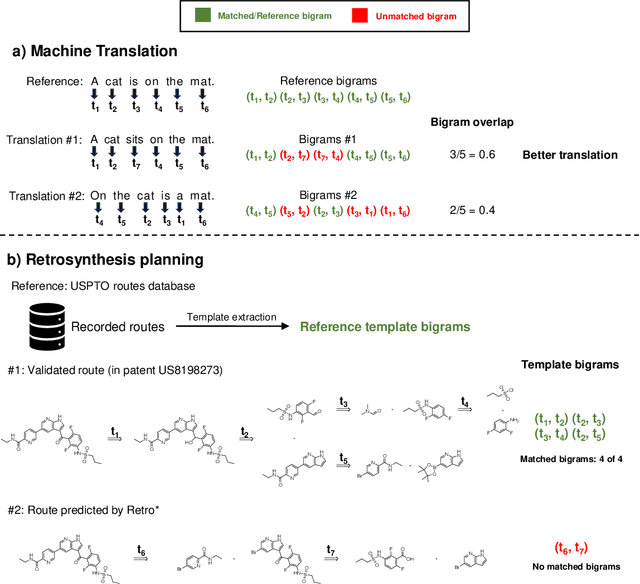
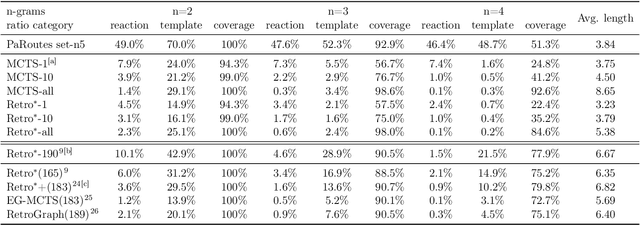
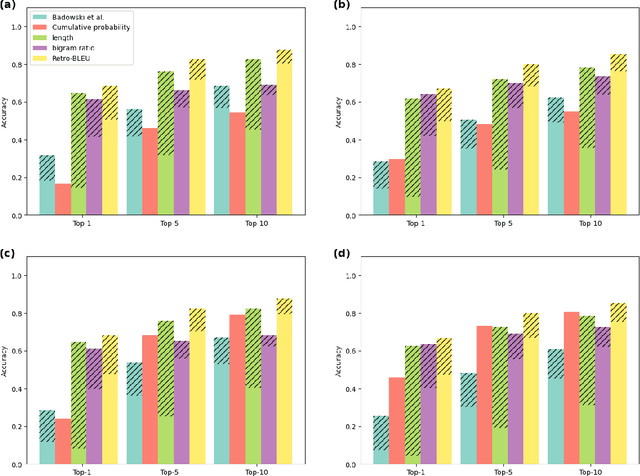
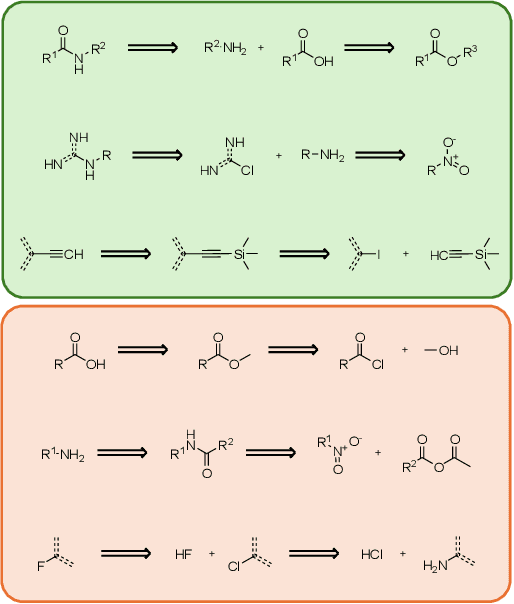
Computer-assisted methods have emerged as valuable tools for retrosynthesis analysis. However, quantifying the plausibility of generated retrosynthesis routes remains a challenging task. We introduce Retro-BLEU, a statistical metric adapted from the well-established BLEU score in machine translation, to evaluate the plausibility of retrosynthesis routes based on reaction template sequences analysis. We demonstrate the effectiveness of Retro-BLEU by applying it to a diverse set of retrosynthesis routes generated by state-of-the-art algorithms and compare the performance with other evaluation metrics. The results show that Retro-BLEU is capable of differentiating between plausible and implausible routes. Furthermore, we provide insights into the strengths and weaknesses of Retro-BLEU, paving the way for future developments and improvements in this field.