 Add to Chrome
 Add to Firefox
 Add to Edge
TAPS: Target-Aware Prefix Tree Selection for Diffusion-Drafted Speculative Decoding
May 30, 2026
Using a diffusion model for parallel drafting is a promising approach for speculative decoding. By predicting tokens at multiple future positions in a single forward pass, diffusion drafters substantially reduce drafting latency. However, this shifts the bottleneck to verification: verifying a single sequence limits acceptance length, while verifying large draft trees incurs excessive target-model latency. We identify a key mismatch in existing draft-tree methods: existing diffusion-tree methods rank nodes by the marginal probability, ignoring that verification is prefix-conditioned. As a result, they may verify unreachable descendants of rejected prefixes, increasing latency with limited acceptance gains. To address this, we propose TAPS, a target-aware prefix selection method that turns diffusion marginals into path-conditioned acceptance estimates. TAPS then selects a compact prefix-closed subtree under a fixed verification budget, improving the acceptance-cost tradeoff rather than simply expanding the draft tree. Experiments across diverse datasets and model families demonstrate that TAPS achieves up to 7.9x lossless end-to-end speedup over vanilla autoregressive decoding, outperforming state-of-the-art DFlash and DDTree by 1.36x and 1.74x respectively. Our work is available at https://anonymous.4open.science/r/TAPS-EMNLP2026-53DD

Transparent Shape from Single Polarization Images
Apr 20, 2022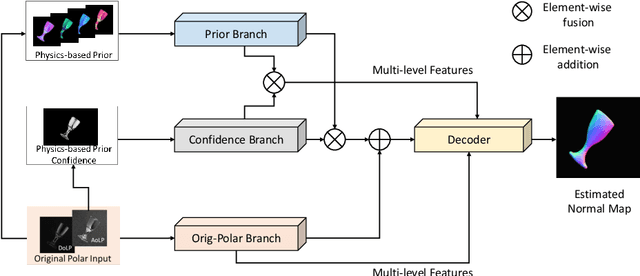
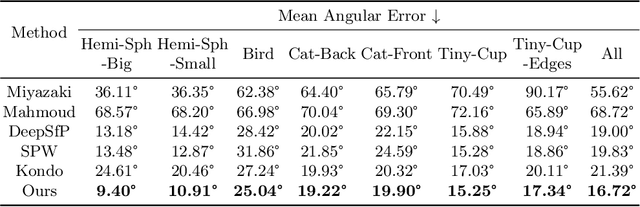
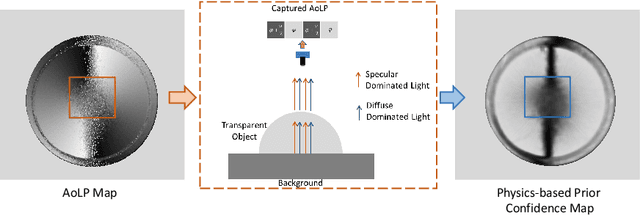
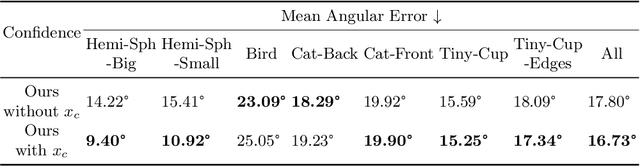
This paper presents a data-driven approach for transparent shape from polarization. Due to the inherent high transmittance, the previous shape from polarization(SfP) methods based on specular reflection model have difficulty in estimating transparent shape, and the lack of datasets for transparent SfP also limits the application of the data-driven approach. Hence, we construct the transparent SfP dataset which consists of both synthetic and real-world datasets. To determine the reliability of the physics-based reflection model, we define the physics-based prior confidence by exploiting the inherent fault of polarization information, then we propose a multi-branch fusion network to embed the confidence. Experimental results show that our approach outperforms other SfP methods. Compared with the previous method, the mean and median angular error of our approach are reduced from $19.00^\circ$ and $14.91^\circ$ to $16.72^\circ$ and $13.36^\circ$, and the accuracy $11.25^\circ, 22.5^\circ, 30^\circ$ are improved from $38.36\%, 77.36\%, 87.48\%$ to $45.51\%, 78.86\%, 89.98\%$, respectively.