 Add to Chrome
 Add to Firefox
 Add to Edge
Discover Fast Power Allocation Solution for Multi-Target Tracking via AlphaEvolve Evolution
May 03, 2026
Efficient radar resource allocation is a fundamental yet computationally challenging problem, as optimal solutions typically require iterative optimization with high complexity. Motivated by the need for real-time scheduling, robust generalization, and low data dependency, this paper proposes a novel paradigm that leverages large language model (LLM)-guided evolutionary search (AlphaEvolve) to autonomously discover a closed-form power allocation solution for multi-target tracking. The approach encodes high-dimensional radar states into physically inspired features, then evolves a compact and interpretable scoring function, which is transformed to feasible power allocations via a deterministic constraint-satisfying transformation. Extensive experiments demonstrate that the discovered closed-form solution achieves near-optimal tracking accuracy (average relative performance loss of only $1.51\%$), reliable generalization across diverse scenarios and target counts, and over three orders of magnitude speedup compared to conventional iterative solvers. These results highlight the potential of LLM-guided symbolic search to revolutionize not only radar resource management but also broader classes of engineering optimization problems.

Multi-frame Detection via Graph Neural Networks: A Link Prediction Approach
Oct 17, 2024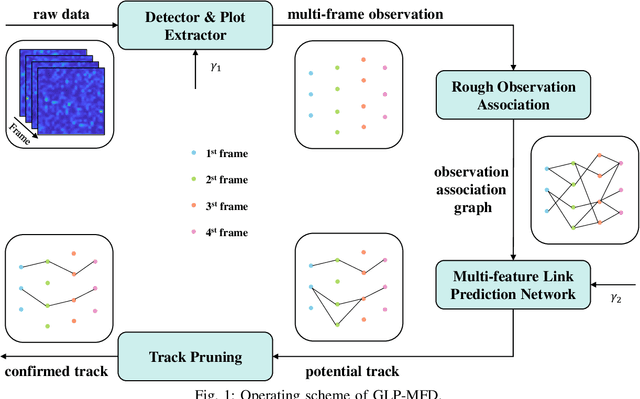


Multi-frame detection algorithms can effectively utilize the correlation between consecutive echoes to improve the detection performance of weak targets. Existing efficient multi-frame detection algorithms are typically based on three sequential steps: plot extraction via a relative low primary threshold, track search and track detection. However, these three-stage processing algorithms may result in a notable loss of detection performance and do not fully leverage the available echo information across frames. As to applying graph neural networks in multi-frame detection, the algorithms are primarily based on node classification tasks, which cannot directly output target tracks. In this paper, we reformulate the multi-frame detection problem as a link prediction task in graphs. First, we perform a rough association of multi-frame observations that exceed the low threshold to construct observation association graphs. Subsequently, a multi-feature link prediction network is designed based on graph neural networks, which integrates multi-dimensional information, including echo structure, Doppler information, and spatio-temporal coupling of plots. By leveraging the principle of link prediction, we unifies the processes of track search and track detection into one step to reduce performance loss and directly output target tracks. Experimental results show that, compared with traditional single-frame and multi-frame detection algorithms, the proposed algorithm improves the detection performance of weak targets while suppressing false alarms. Additionally, interpretable analysis indicates that the designed network effectively integrates the utilized features, allowing for accurate associations between targets and false alarms.