 Add to Chrome
 Add to Firefox
 Add to Edge
Hybrid Physical and Geometrical Optics Method for Modeling Subsurface Imaging Using mmWave FMCW Radar
Apr 11, 2026
A hybrid physical and geometrical optics method is proposed to model the subsurface imaging using mmWave FMCW radar. Modeling of the wave propagation for subsurface imaging can improve the interpretation of acquired data and imaging results. Full-wave simulation is common in simulating wave propagation. However, when the frequency is high such as mmWave frequency, it is difficult to implement since it costs large computation resource and time. In this paper, the physical and geometrical optics are hybridized to simulate the wave propagation in subsurface imaging scenarios. In the proposed method, physical optics method is utilized to calculate the reflection from the object and geometrical optics method is utilized to calculate the transmission of the wave through object. By combining the results from physical and geometrical optics, the wave propagation in the subsurface imaging scenarios is simulated. The synthetic-aperture radar imaging is applied to the simulated data and the image is successfully reconstructed. Further, the experiment setup is developed and the comparison between simulation and experiment is carried out. The results demonstrated that the proposed simulation method can model the subsurface imaging with mmWave FMCW radar.

Measurement-based Characterization of ISAC Channels with Distributed Beamforming at Dual mmWave Bands and with Human Body Scattering and Blockage
Nov 02, 2024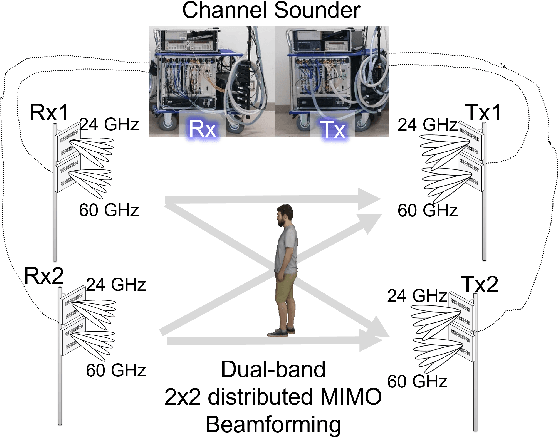
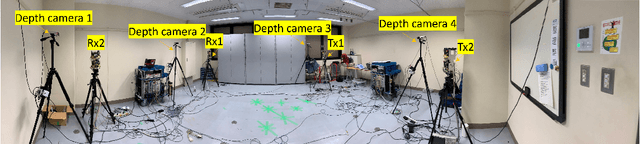
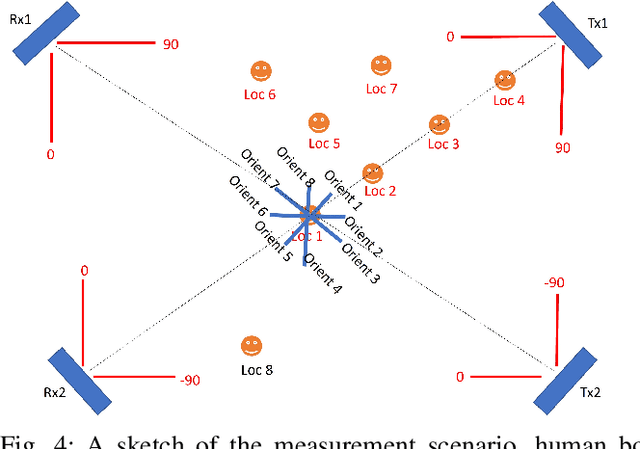
In this paper, we introduce our millimeter-wave (mmWave) radio channel measurement for integrated sensing and communication (ISAC) scenarios with distributed links at dual bands in an indoor cavity; we also characterize the channel in delay and azimuth-angular domains for the scenarios with the presence of 1 person with varying locations and facing orientations. In our setting of distributed links with two transmitters and two receivers where each transceiver operates at two bands, we can measure two links whose each transmitter faces to one receiver and thus capable of line-of-sight (LOS) communication; these two links have crossing Fresnel zones. We have another two links capable of capturing the reflectivity from the target presenting in the test area (as well as the background). The numerical results in this paper focus on analyzing the channel with the presence of one person. It is evident that not only the human location, but also the human facing orientation, shall be taken into account when modeling the ISAC channel.