 Add to Chrome
 Add to Firefox
 Add to Edge
Latent Variable-Mediated Cross-Learning for Few-Shot Acoustic Impedance Imaging
Jul 23, 2026
Acoustic impedance imaging is a fundamental yet severely ill-posed problem in subsurface analysis: the seismic wavelet is unknown, observations are band-limited, and labeled well-log samples are extremely scarce (typically <1% of all traces). Existing semi-supervised deep learning methods mitigate few-shot problem by incorporating forward modeling, yet they either rely on inaccurate prior wavelet assumptions or introduce auxiliary networks, leading to unstable optimization and degraded performance. We propose RD-SCL, a novel framework that integrates regularized deconvolution with semi-supervised cross-learning. At its core lies a differentiable, closed-form first-order Tikhonov deconvolution operator that dynamically estimates the latent wavelet in the frequency domain during training, providing stable physics-guided feedback without explicit auxiliary networks and fixed wavelet priors. Building on this operator, we design a symmetric cross-learning that enforces consistency between predictions on labeled and unlabeled data, thereby effectively exploiting abundant unlabeled traces. Extensive experiments on the SEAM and Marmousi 2 benchmarks demonstrate that RD-SCL consistently outperforms state-of-the-art supervised and semi-supervised methods, achieving substantial gains with lower computational cost. With only 56.5k learnable parameters and competitive runtime, RD-SCL offers a practical, physically consistent, and efficient solution for acoustic impedance imaging.

Zero-Shot Self-Consistency Learning for Seismic Irregular Spatial Sampling Reconstruction
Nov 01, 2024
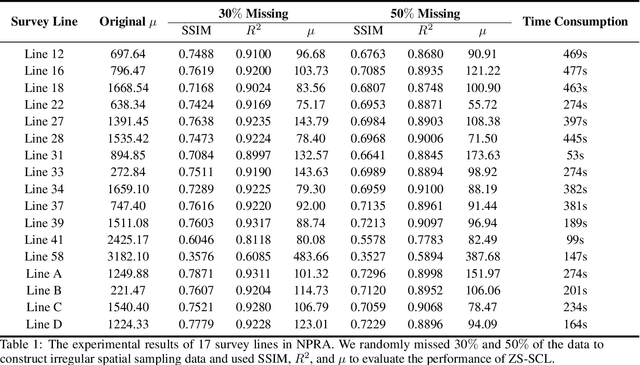
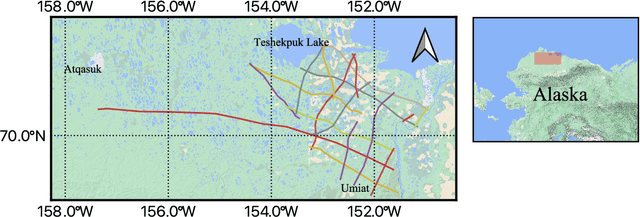
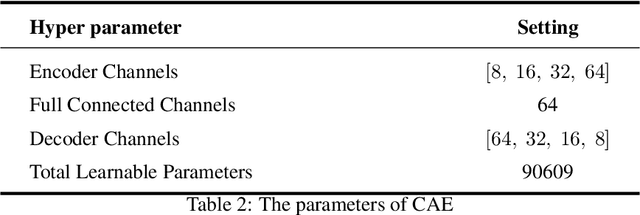
Seismic exploration is currently the most important method for understanding subsurface structures. However, due to surface conditions, seismic receivers may not be uniformly distributed along the measurement line, making the entire exploration work difficult to carry out. Previous deep learning methods for reconstructing seismic data often relied on additional datasets for training. While some existing methods do not require extra data, they lack constraints on the reconstruction data, leading to unstable reconstruction performance. In this paper, we proposed a zero-shot self-consistency learning strategy and employed an extremely lightweight network for seismic data reconstruction. Our method does not require additional datasets and utilizes the correlations among different parts of the data to design a self-consistency learning loss function, driving a network with only 90,609 learnable parameters. We applied this method to experiments on the USGS National Petroleum Reserve-Alaska public dataset and the results indicate that our proposed approach achieved good reconstruction results. Additionally, our method also demonstrates a certain degree of noise suppression, which is highly beneficial for large and complex seismic exploration tasks.